AMD Launches MI350P PCIe AI Cards for Existing Server Infrastructure
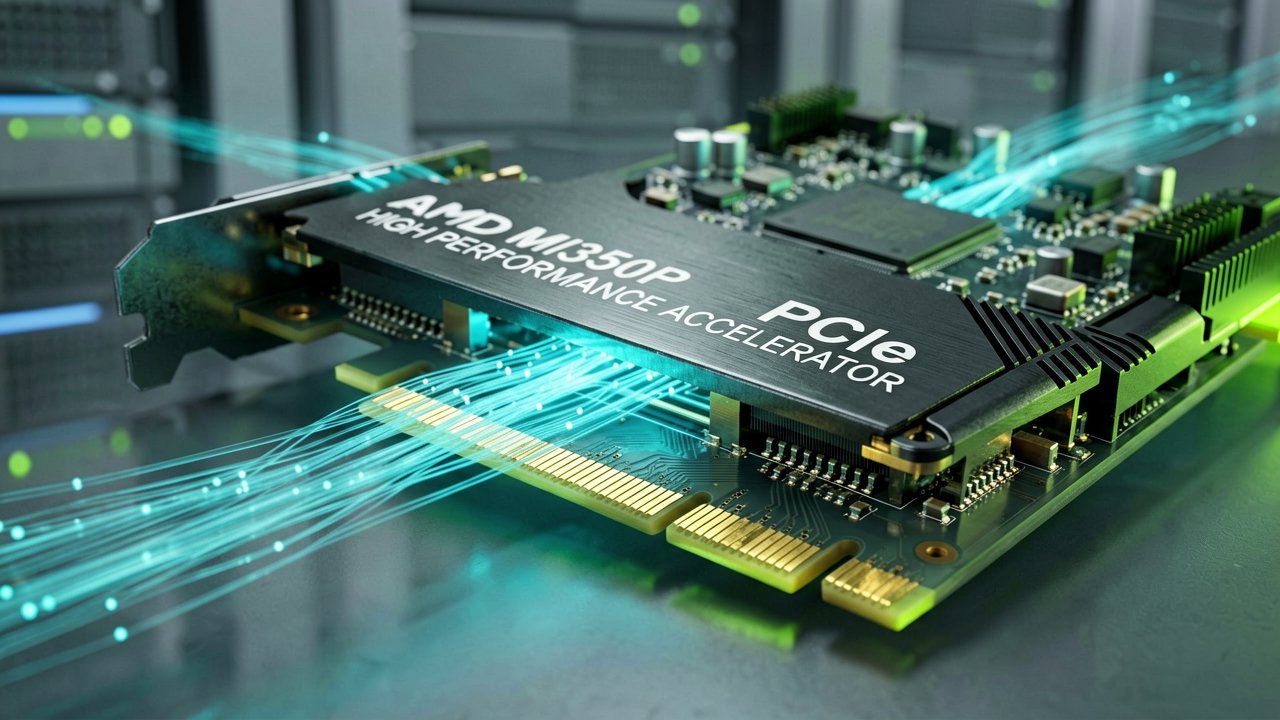
The enterprise AI accelerator market just got a new player that doesn't require a complete data center overhaul. AMD has launched the Instinct MI350P, a PCIe-based GPU designed to slot directly into existing air-cooled server infrastructure. This marks the company's first PCIe-form Instinct accelerator in four years, a significant departure from their traditional OAM module bundles that typically ship eight GPUs at once.
According to the official AMD blog post, the MI350P is engineered as a dual-slot drop-in card for standard 2U or larger server designs. The physical reality here matters: IT teams can install these cards without rewiring power distribution or upgrading cooling systems. That's the kind of practical detail that separates marketing fluff from actual deployment feasibility.
Performance specifications are aggressive. The card delivers an estimated 2,299 teraflops (TFLOPS) of compute, scaling to 4,600 peak TFLOPS at MXFP4 precision. AMD claims this represents the highest performance currently available in an enterprise PCIe card. The chip packs 144GB of HBM3E memory running at 4TB/s bandwidth, paired with CDNA 4 architecture built on TSMC's 3nm and 6nm FinFET processes.
Network World's coverage corroborates the technical details and adds context about the market positioning. The publication notes the MI350P is ideal for companies looking to gradually invest in AI rather than making a large hardware commitment. This is a crucial distinction—many enterprises have been stuck in evaluation purgatory, unable to justify the capital expenditure of full GPU accelerator platforms.
The card supports up to eight accelerators per node, enabling scaling from single-card experiments to multi-GPU deployments. AMD says each MI350P can handle around 200 to 250 billion parameter large language models. For inference and RAG pipelines, that's substantial capacity without requiring liquid cooling or specialized rack infrastructure.
Sparsity support is another technical feature worth noting. The technology ignores zero values in data sets and matrices, reducing processing time. This means higher precision formats like INT8 and BF16 deliver efficient performance alongside the lower-precision MXFP6 and MXFP4 options. It's a nuanced approach that balances throughput with accuracy requirements.
Power consumption sits at a 600W envelope, though the card can be configured to run at 450W for thermally constrained chassis. The fanless cooling solution relies on chassis fans in rack-mounted servers. This is where the physical interaction becomes apparent—system administrators will need to verify their existing airflow patterns can handle the thermal load before installation.
Software compatibility runs through the ROCm open source stack, which AMD offers across Instinct and Radeon products. The company provides the enterprise AI reference stack at no licensing cost, including Kubernetes GPU Operator and native support for frameworks like PyTorch. Migration from bare-metal infrastructure to production-ready AI systems should require minimal code changes.
Tom's Hardware analysis adds competitive context, noting the MI350P edges out Nvidia's H200 NVL in theoretical compute performance. The specs show roughly 40% faster FP16 and FP8 performance compared to Nvidia's PCIe competitor. However, the article also highlights the elephant in the room: Nvidia's CUDA ecosystem dominance remains a significant barrier to adoption.
AMD did not provide a launch date or pricing for the MI350P. This omission is telling. Enterprise hardware pricing typically depends on volume commitments, system integrator partnerships, and regional availability. The lack of concrete numbers suggests the company is still working through supply chain and partner distribution channels.
The timing aligns with broader industry shifts toward agentic AI workloads. Organizations are discovering that cloud-based AI introduces privacy concerns and unpredictable costs. On-premises deployment offers control, but supporting large GPU-accelerator platforms traditionally required expensive data center redesigns. The MI350P attempts to bridge that gap.
Whether enterprises actually adopt this solution depends on factors beyond raw specifications. Software ecosystem maturity, developer familiarity with ROCm versus CUDA, and total cost of ownership calculations will determine real-world deployment rates. The hardware is available now, but the software ecosystem catch-up remains an open question.
For IT teams evaluating AI infrastructure upgrades, the MI350P represents a pragmatic middle ground. It offers enterprise-grade performance without the infrastructure overhaul. Whether that's enough to shift market share from Nvidia remains to be seen. The card exists, but adoption is a different story entirely.
Artūras Malašauskas is an AI Systems Integrator with 20+ years of production-grade web engineering experience. He has designed, shipped, and scaled enterprise Python/PHP systems for logistics, SaaS, and public-sector clients. For the past year, he has focused exclusively on AI integrations: deploying open-source LLMs, building generative media pipelines (image, audio, video), and engineering multi-agent workflows for real production environments. His standard: reproducibility, security, cost-efficient inference—no vaporware. He documents and evaluates emerging AI tooling, separating verified capabilities from marketing noise. Technical editor at: muza-ai.eu, ai-verslas.lt, ai-naujinos.lt Connect on LinkedIn
Comments