Genesis AI Unveils GENE-26.5 Model and Human-Like Robotic Hand
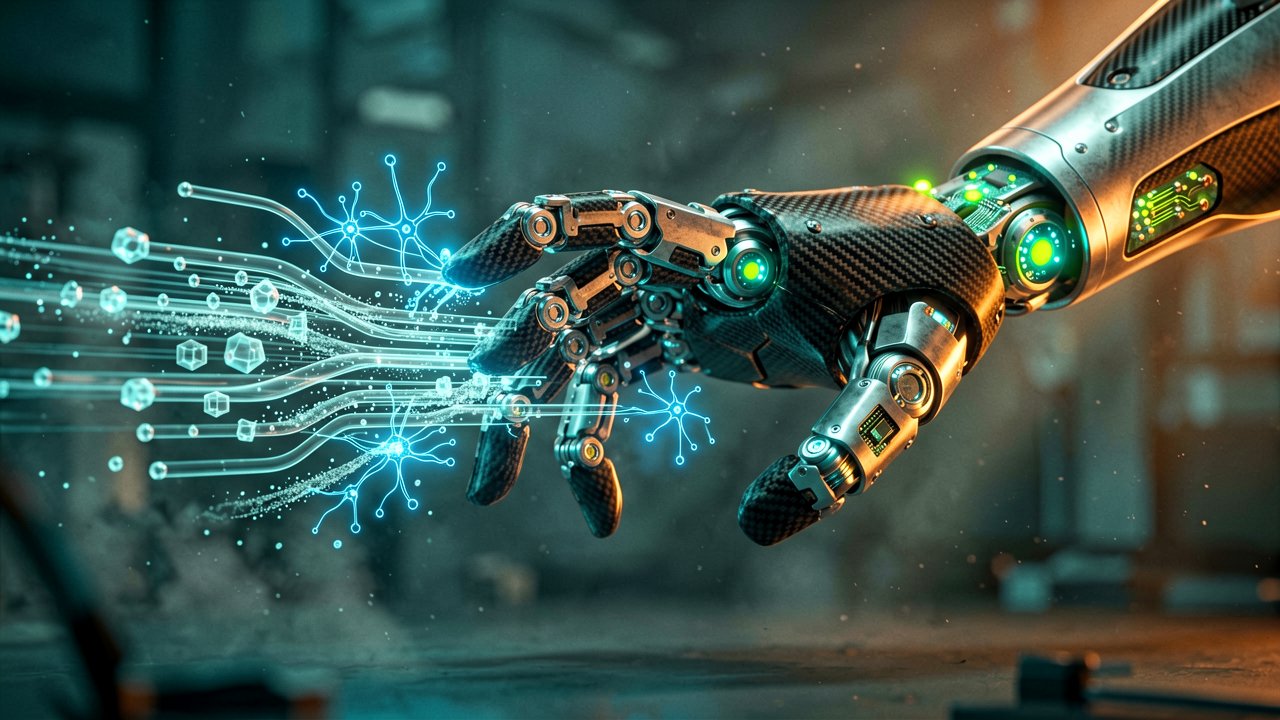
French robotics startup Genesis AI has unveiled a new AI model called GENE-26.5 alongside a human-like robotic hand capable of performing tasks such as chopping tomatoes, cracking eggs, solving a Rubik's Cube, and playing the piano.
The company, founded in early 2025, is co-founded by Theophile Gervet, a former researcher at Mistral AI. It has raised $105 million in its initial funding round, matching the record seed round of Mistral AI. Backers include former Google CEO Eric Schmidt, French telecoms tycoon Xavier Niel, and state investment bank Bpifrance.
According to Indiatimes reporting, the GENE-26.5 model can run a range of robots, including those made by other companies. Genesis AI is in advanced talks with potential customers in France, Germany, and Italy.
CEO Zhou Xian told Business Insider that the demonstrations were executed autonomously at 1x speed, though they were not zero-shot executions. The robots still required training for specific tasks. His team of around 60 people taught the robot to play a new song on the piano in one hour.
For the cooking demonstration, Xian said it required a "few hundred trajectories" or recorded examples of relevant tasks. A 30-second "complex skill" requires a few hours of human data, combined with less than half an hour of data from the robot performing the task. The robot still failed on some subtasks: while most steps reached roughly 90% to 95% success, one-handed egg cracking and transferring chopped tomato with a knife were closer to 50% to 60% during filming.
Genesis AI's robotic hand has 20 degrees of freedom and 20 motors directly inside it. That differs from tendon-driven hands, where motors are placed in the forearm and cables move the fingers. The design more closely mirrors human anatomy, enabling more direct transfer of human motion to machines.
One video showed robotic hands keeping up with a piano composition that moves at around a brisk 130 beats per minute. The startup also demonstrated robots cracking an egg with one hand and harnessing wires. Xian said the robot is exhibiting about 60% to 70% of human speed.
The company is targeting sectors such as automotive, electronics, pharmaceuticals, and logistics, where conventional robots struggle with delicate or variable tasks such as wire harnessing, which involves bundling and taping cables. Vivian Sun, vice president of commercial and strategy, said engagements will typically run three to five years, depending on client needs.

Genesis AI is also working with partners to build robotics datasets, including collecting real-world data from tens of thousands of industrial workers using sensor-equipped gloves. Rather than relying solely on video data and teleoperation, the startup is using a mix of internet data and raw human data collected through proprietary training gloves that capture hand motion and tactile, force-like signals.
The launch puts Genesis in competition with China's Linkerbot, which Reuters reported is targeting a $6 billion valuation as demand grows for highly dexterous robotic hands. Both companies are developing hardware to enable more human-like manipulation in industrial settings.
Europe is pushing to reindustrialise and cut reliance on Asian manufacturing. Germany's Schaeffler said this week it expects its robotics order book to reach hundreds of millions of euros by 2030. Gervet told Reuters the company was prioritising Europe for two reasons: the talent base and the industrial base as a market.
Unlike model-focused firms such as Physical Intelligence, Genesis AI is developing the entire stack: the AI model, robot hand, training gloves, simulator, and eventually the robot itself. The startup uses an in-house simulator to test models trained on real-world data across many virtual environments, which lets the company evaluate systems faster than running each test on a physical robot.
Xian said he's not making the bold claim that manipulation has been solved, but that Genesis' approach is a "critical step" toward pushing robot manipulation to the next level. He said in 10 years, he does not see why a factory robot should be fundamentally different from a home robot.
Genesis AI said it expects to raise more capital but that a public listing remains premature. The company is signing customers but declined to name them. Whether industrial clients actually deploy these systems at scale, or whether the 50% to 60% success rate on certain tasks becomes acceptable for production environments, remains to be seen.
Artūras Malašauskas is an AI Systems Integrator with 20+ years of production-grade web engineering experience. He has designed, shipped, and scaled enterprise Python/PHP systems for logistics, SaaS, and public-sector clients. For the past year, he has focused exclusively on AI integrations: deploying open-source LLMs, building generative media pipelines (image, audio, video), and engineering multi-agent workflows for real production environments. His standard: reproducibility, security, cost-efficient inference—no vaporware. He documents and evaluates emerging AI tooling, separating verified capabilities from marketing noise. Technical editor at: muza-ai.eu, ai-verslas.lt, ai-naujinos.lt Connect on LinkedIn
Comments