Cognex In-Sight 3900 Brings Qualcomm-Powered AI Vision to Factory Floors
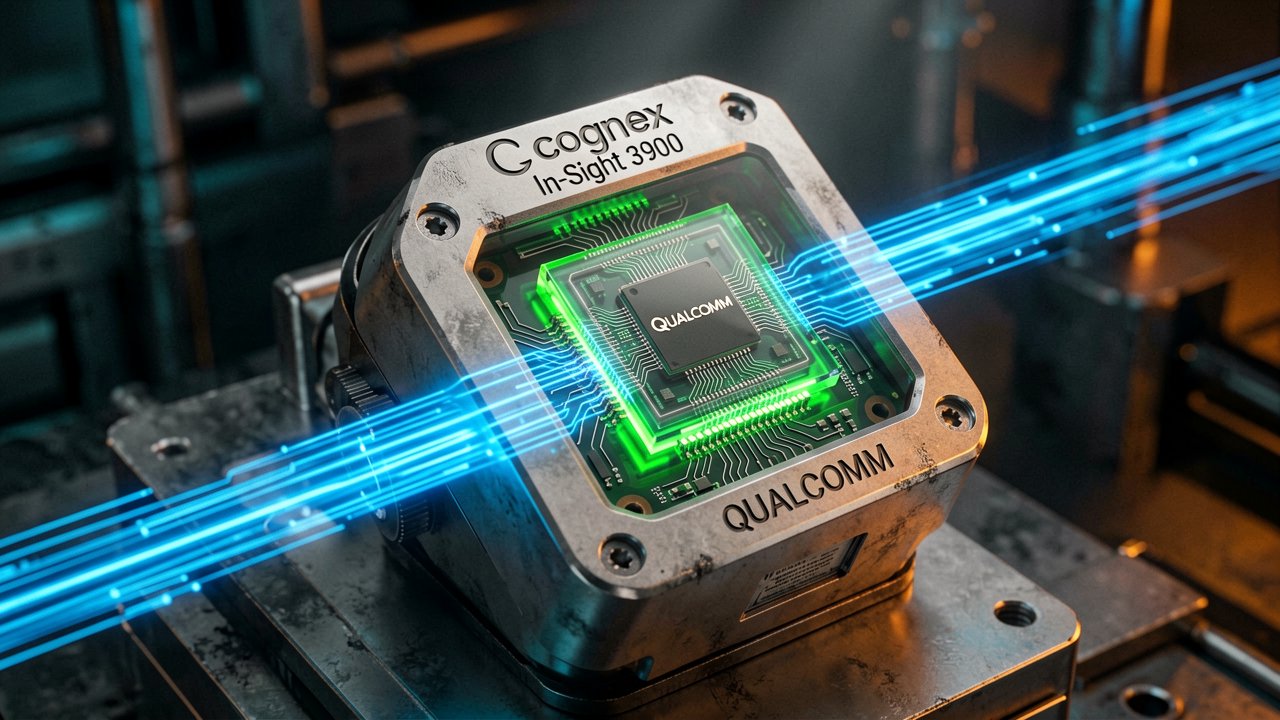
Industrial machine vision has long operated under a frustrating constraint: manufacturers could either inspect products thoroughly or keep production lines moving at full speed, but rarely both. Cognex Corporation announced on May 5, 2026, that its new In-Sight 3900 Vision System aims to break that limitation. The system runs on Qualcomm Dragonwing™ platforms and delivers embedded AI processing directly at the edge without requiring an external PC.
The press release details specifications that matter to factory engineers who've spent years wrestling with legacy vision bottlenecks. Cognex's official announcement states the In-Sight 3900 processes inspections up to four times faster than previous-generation systems. It supports image resolutions up to 25 megapixels. That's not just a number on a spec sheet—higher resolution means wider fields of view and finer defect detection in a single camera acquisition. No more stitching multiple images together and hoping the alignment holds.
Matt Moschner, President and CEO of Cognex, framed the launch as a fundamental shift in what embedded AI can deliver on the factory floor. "Manufacturers no longer have to choose between inspection depth and line speed," he said. "We have built a system that delivers both, with the reliability and simplicity Cognex is known for." The language is confident, but the real test comes when production lines actually run at full speed during peak shifts.
The technical architecture combines three distinct toolsets: Edge AI for fast deployment and inspection stability, Advanced AI for complex high-variability applications, and traditional rule-based vision tools. This hybrid approach matters because not every inspection problem needs deep learning. Some defects are deterministic—scratches, missing components, misaligned parts. Those can be caught with rule-based logic. Others require pattern recognition across variable conditions. The In-Sight 3900 handles both without forcing engineers to choose one paradigm over the other.
Embedded compute is the differentiator here. Legacy systems often required external PCs to run AI workloads, adding latency, cabling complexity, and points of failure. The In-Sight 3900 incorporates a dedicated high-performance AI processor for deterministic decision-making directly at the edge. Deterministic means predictable timing—critical when synchronizing with high-speed production lines where milliseconds matter. (Nobody wants a vision system that occasionally takes three seconds to decide whether a part is defective while the conveyor belt keeps moving.)
Connectivity is industrial-grade. Dual Ethernet architecture ensures reliable communication with PLCs, robots, and enterprise systems. This isn't consumer Wi-Fi. Factory floors are electrically noisy environments with metal machinery everywhere. Ethernet provides the reliability needed for continuous operation. The dual architecture also adds redundancy—if one port fails, the system maintains communication.
Andrea Sabbadini, Engineering Manager at Fuji Seal, provided a customer perspective that validates the performance claims. "Our packaging lines run at extremely high speeds, which previously limited us to using traditional OCR tools," Sabbadini said. "The In-Sight 3900 now allows us to deploy Cognex's Edge AI Read tools at full production speed without compromising throughput." Packaging lines are notoriously fast-moving environments. The ability to run AI-powered reading at full speed without sacrificing throughput is a meaningful operational improvement.
The system integrates with Cognex OneVision software for a cloud-to-edge AI vision ecosystem. OneVision streamlines model development, cross-site collaboration, and deployment across devices. Manufacturers can train AI models centrally while executing inspections locally at production speed. This separation of training and inference is standard in AI deployment, but the industrial implementation matters. Training happens in controlled environments with curated datasets. Inference happens on the factory floor with real-world variability.

Shyam Krishnamurthy, Senior Vice President at Qualcomm, noted the collaboration's focus on supporting manufacturers with demanding inspection requirements. "Cognex has pushed the boundaries of what embedded AI vision can deliver at the edge," he said. Qualcomm's involvement brings semiconductor-level optimization to the vision pipeline. The Dragonwing platform isn't just a processor—it's a system-on-chip designed for AI workloads with dedicated neural processing units.
Secondary coverage from StreetInsider corroborates the core specifications and quotes. The independent reporting confirms the 4X speed improvement, 25 MP resolution support, and PC-free operation. Multiple sources aligning on these metrics increases confidence in the claims.
Physical deployment considerations remain important. The In-Sight 3900 is a fully integrated vision system, but integration still requires mounting, cabling, lighting setup, and calibration. Engineers need to position cameras at optimal angles, configure illumination for the specific material being inspected, and tune parameters for acceptable defect thresholds. The system simplifies validation and lifecycle management, but it doesn't eliminate the need for skilled technicians.
Target industries include packaging, automotive, electronics, and consumer goods. These sectors share common characteristics: high-volume production, strict quality requirements, and pressure to maintain throughput. The In-Sight 3900 addresses all three simultaneously. Automotive applications might focus on weld inspection or component verification. Electronics manufacturing could use it for PCB inspection or connector alignment. Packaging lines need label verification and defect detection at speeds that would overwhelm traditional systems.
Cognex has been in the machine vision business for over 40 years. The company serves more than 30,000 customers worldwide across 30+ countries. This isn't a startup's first product launch. The In-Sight 3900 builds on decades of industrial vision experience. That institutional knowledge matters when deploying systems in regulated industries where validation and traceability are mandatory.
The pricing structure wasn't disclosed in the announcement. Industrial vision systems typically range from thousands to tens of thousands of dollars depending on configuration. The In-Sight 3900's positioning as a high-performance system suggests premium pricing. Whether the ROI justifies the investment depends on specific use cases. A packaging line running 24/7 might recoup costs quickly through reduced scrap and higher throughput. A smaller operation might find the economics less compelling.
Availability details weren't specified beyond the May 5, 2026 announcement date. Industrial hardware launches often include lead times for production ramp-up. Customers with immediate needs might face waiting periods. The cloud-to-edge ecosystem integration with OneVision adds another layer of deployment complexity—software updates, model versioning, and cross-site synchronization all require planning.
Whether the In-Sight 3900 actually delivers the promised performance across diverse manufacturing environments remains to be seen. Press releases are optimistic. Factory floors are messy. The real validation comes from installations that run continuously for months without requiring constant tuning. Cognex has the track record. The technology checks the boxes. Now the work begins.
Artūras Malašauskas is an AI Systems Integrator with 20+ years of production-grade web engineering experience. He has designed, shipped, and scaled enterprise Python/PHP systems for logistics, SaaS, and public-sector clients. For the past year, he has focused exclusively on AI integrations: deploying open-source LLMs, building generative media pipelines (image, audio, video), and engineering multi-agent workflows for real production environments. His standard: reproducibility, security, cost-efficient inference—no vaporware. He documents and evaluates emerging AI tooling, separating verified capabilities from marketing noise. Technical editor at: muza-ai.eu, ai-verslas.lt, ai-naujinos.lt Connect on LinkedIn
Comments