WaiV Robotics Unveils Autonomous Drone Landing System for Moving Vessels
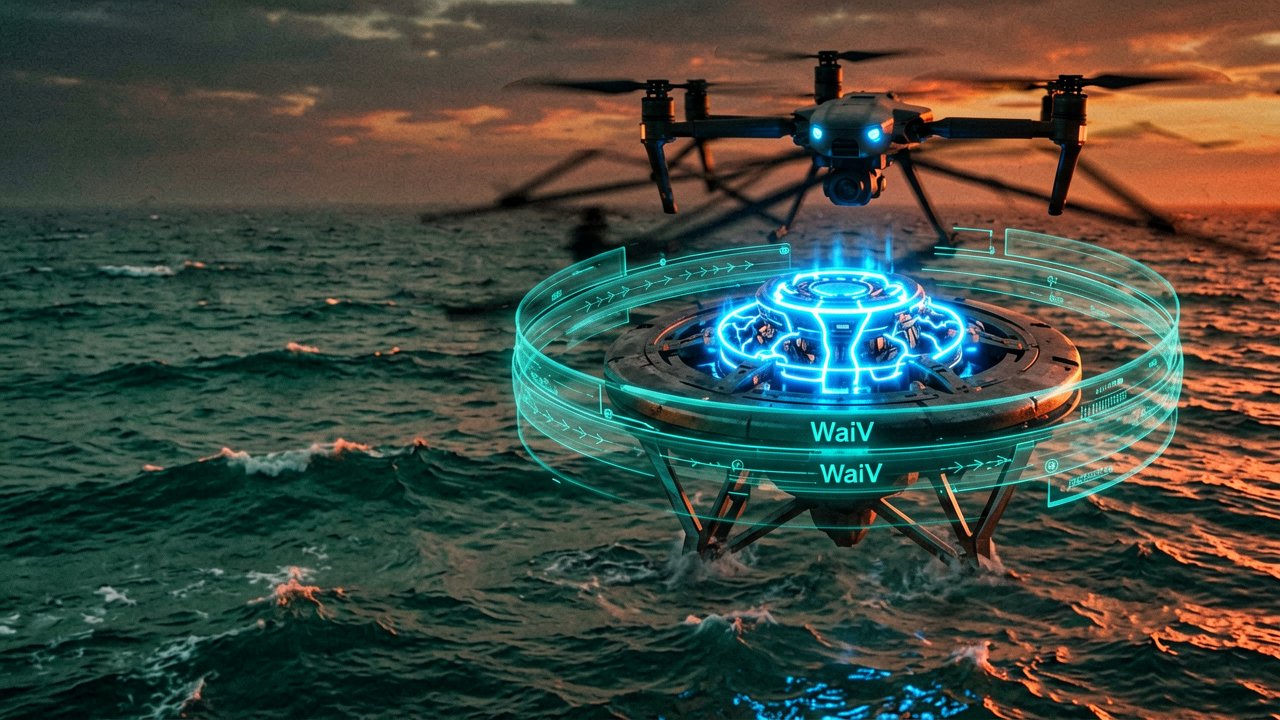
Offshore drone operations have long been bottlenecked by one stubborn reality: the landing surface refuses to stay still. WaiV Robotics, a London-based maritime startup, announced on May 5, 2026, a system designed to solve autonomous vertical takeoff and landing (VTOL) drone recovery from moving vessels at sea. The company emerged from stealth alongside the disclosure of a $7.5 million seed funding round.
The core problem is physical, not theoretical. A vessel deck moves through six degrees of freedom under stochastic wave patterns, and salt spray makes the surface slippery on contact. Existing solutions have been limited to calm waters or laboratory conditions, leaving offshore operators hesitant to deploy UAVs from smaller vessels. Ocean News & Technology reported that until now, no viable solution existed for reliable drone landings on moving boats in real maritime conditions.
WaiV's approach centers on infrastructure rather than aircraft modification. The system works without any hardware or software changes to the UAV itself. Instead, it uses a gyro-stabilized landing platform paired with AI-driven predictive algorithms that guide the drone during its final approach. The platform effectively "takes over the sticks," controlling the drone via its remote control and eliminating the need for an expert pilot during landing (a problem that has plagued users for years, frankly).
The patent-pending catch-lock-release landing mechanism handles the physical reality of contact. The landing pad absorbs impact on touchdown, while a locking mechanism secures the UAV's skids to prevent bounce, slide, or roll-off in high-sea conditions. This is critical because the difference between a successful recovery and a lost drone often comes down to milliseconds of contact time on a pitching deck.
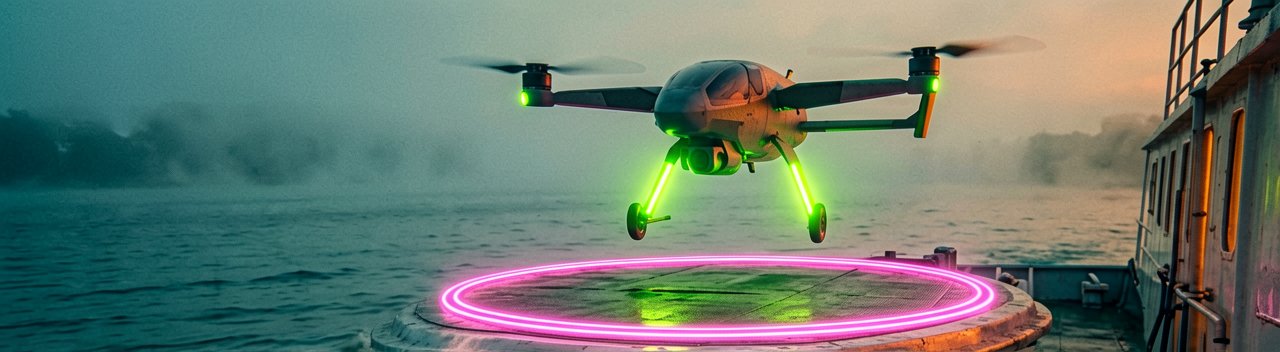
Dronelife confirmed the technical specifications: the system enables UAVs to operate from vessels as small as 10 meters and supports any type of VTOL UAV, including multicopter, fixed-wing, and helicopter platforms regardless of manufacturer. The current platform handles drones up to 15 kilograms, with plans to scale down to aircraft as small as 3 kilograms and up to carriers in the 100 to 300 kilogram class.
Johnny Carni, Founder and CEO of WaiV Robotics, explained the technology was developed under an R&D entity called Dronelander, conducting extensive in-house testing and validation to refine the system under real-world maritime conditions. Carni's background spans engineering, electro-optical, and aerospace fields, including roles in business development across Asia-Pacific markets working with companies involved in airborne sensing and drone systems.
The idea emerged while Carni was working with a coast guard on maritime observation systems. "They asked for my help to procure a UAV drone capable of landing on their vessels," Carni explained. "After extensive research, I realized no viable solution exists. Thanks to my background in aviation and maritime landings, I immediately understood exactly why the industry hadn't succeeded yet."
He described two defining moments: first recognizing the scale of that gap, and later confirming through academic input that the underlying problem could be solved. "The moment I knew the 'impossible' part was actually solvable, we set out to build Waiv," Carni added.

For drones to become a reliable part of offshore operations, the missing piece isn't the aircraft, it's the infrastructure around it. Carni's pitch is that vessels could operate as mobile launch and recovery hubs without relying on specialist pilots. The platform is production-ready and available for deployment, with WaiV actively engaging with partners across defense, offshore, and commercial maritime sectors.
Even the Royal Navy has been testing how drones can be deployed at sea, recently carrying out its first ship-to-ship delivery of supplies using a drone. But such deployments still rely on controlled conditions and specialist handling, underscoring the challenge of making drone operations routine on moving vessels.
The $7.5 million seed funding from an undisclosed roster of private investors was completed prior to the public launch. This capital positions WaiV to scale the technology across offshore fleets that have traditionally faced deployment constraints. The company is not disclosing specific names of early partners or customers at this stage.
Whether the maritime industry actually adopts this technology at scale remains the real question. The infrastructure is ready, but offshore operators have historically been conservative about deploying unproven systems in harsh environments. Time will tell if WaiV's solution can move beyond demonstration to daily operational use.
Artūras Malašauskas is an AI Systems Integrator with 20+ years of production-grade web engineering experience. He has designed, shipped, and scaled enterprise Python/PHP systems for logistics, SaaS, and public-sector clients. For the past year, he has focused exclusively on AI integrations: deploying open-source LLMs, building generative media pipelines (image, audio, video), and engineering multi-agent workflows for real production environments. His standard: reproducibility, security, cost-efficient inference—no vaporware. He documents and evaluates emerging AI tooling, separating verified capabilities from marketing noise. Technical editor at: muza-ai.eu, ai-verslas.lt, ai-naujinos.lt Connect on LinkedIn
Comments