SAP Acquires Prior Labs and Dremio for €1B+ AI Data Push

SAP has announced two major acquisitions that signal a strategic pivot toward structured data AI: Prior Labs, the pioneer of Tabular Foundation Models, and Dremio, an open data lakehouse platform. The German enterprise software giant is committing more than €1 billion over four years to scale Prior Labs into a globally leading frontier AI lab, while Dremio will transform SAP Business Data Cloud into an Apache Iceberg-native enterprise lakehouse. Both transactions remain subject to regulatory approval.
The Prior Labs deal is expected to close in the second or third quarter of 2026, with Dremio following in the third quarter. Terms of the individual acquisitions were not disclosed, but SAP confirmed Prior Labs will continue operating as an independent unit to maintain research velocity. This structure mirrors how companies like Google or Microsoft handle acquired research teams—keeping them insulated from corporate bureaucracy while providing enterprise-scale resources.
Tabular Foundation Models represent a fundamental departure from large language models. LLMs struggle with structured business data because they have only rudimentary understanding of tables, numbers, and statistics. TFMs, by contrast, are purpose-built for this domain. They can predict payment delinquencies, supplier risks, customer churn, and upsell opportunities directly from tabular data without the hallucination problems that plague generative AI on spreadsheets.
Prior Labs' flagship TabPFN-2.6 ranks first on TabArena, the leading benchmark for TFMs. The model matches the accuracy of a four-hour automated machine learning pipeline—instantly, in a single model, at a fraction of the complexity. The open-source model has accumulated over three million downloads, with support expanding from 10,000 to 10 million rows of data in less than a year. That growth trajectory is remarkable (and frankly, the kind of momentum that makes enterprise buyers nervous about vendor lock-in).
Once the transaction closes, SAP will deploy TFMs through SAP AI Core and the SAP Business Data Cloud. The agentic AI layer Joule coordinates the experience. Users can ask questions in natural language, select datasets, and run what-if scenarios without requiring data science expertise. The model adapts immediately to new use cases without separate training cycles. This matters because most enterprise AI projects fail not because models are inadequate, but because the underlying data is fragmented, locked in proprietary formats, and stripped of business context.
SAP's official announcement details the Prior Labs acquisition, emphasizing the company's conviction that the greatest untapped opportunity in enterprise AI wasn't large language models—it was AI built for structured data. SAP CTO Philipp Herzig stated this explicitly: "Early on, SAP recognized that the greatest untapped opportunity in enterprise AI wasn't large language models; it was AI built for the structured data that runs the world's businesses."
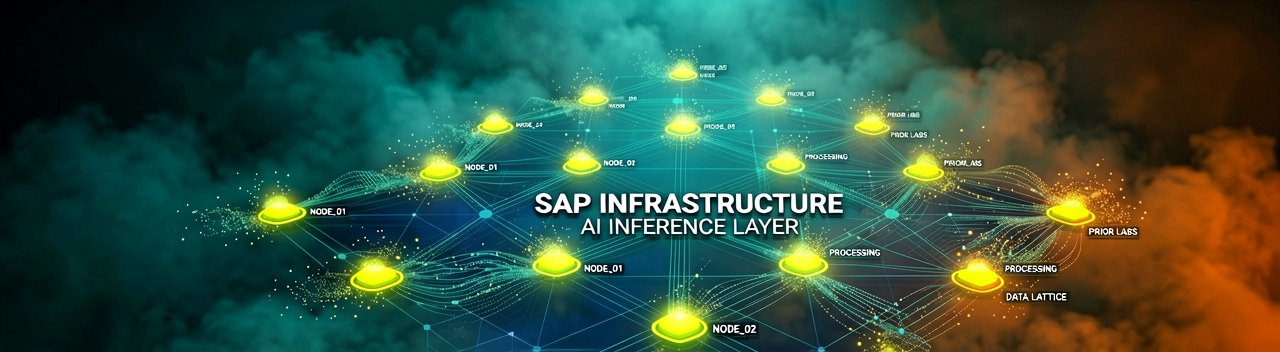
The Dremio acquisition addresses the data infrastructure bottleneck. Dremio is an open, serverless data lakehouse platform designed to accelerate analytics and AI workloads. With this deal, SAP Business Data Cloud becomes Apache Iceberg-native. SAP and non-SAP data can coexist on the same open foundation without data migration or format conversion. The platform automatically scales up during demand peaks and back down when load decreases—no fixed capacity to provision, no performance ceiling when it matters most.
SAP's Dremio announcement confirms the company will deliver a universal, open catalog based on Apache Polaris and the Apache Iceberg REST Catalog API. This catalog serves as the discovery and semantic layer of SAP Business Data Cloud, giving every connected engine a single point of access to unified business context: meaning, relationships, access rights, and data lineage. The catalog will form the foundation of the SAP Knowledge Graph, embedding business relationships, organizational hierarchies, regulatory classifications, and cross-system lineage as native properties.
From a physical interaction perspective, this changes how analysts work. Instead of wrestling with ETL pipelines, waiting for data engineers to provision capacity, or navigating multiple proprietary interfaces, users query federated data sources through a conversational interface. The latency difference is tangible—what used to take days of data preparation now happens in minutes. The serverless architecture means no more midnight alerts when someone runs an unoptimized query that tanks the warehouse.
Prior Labs' cofounders—Frank Hutter, Noah Hollmann, and Sauraj Gambhir—lead a team recruited from Google, Apple, Amazon, Microsoft, Goldman Sachs, and CERN. The company works with leading scientists including Yann LeCun, ACM A.M. Turing Award winner and executive chairman at Advanced Machine Intelligence, and Bernhard Schoelkopf, director of Max Planck Institute for Intelligent Systems and ELLIS president. Both will serve on Prior Labs' scientific advisory board as it scales.
CIO Dive reports that data infrastructure issues lead to $108 billion in wasted AI spend annually, according to a Hitachi Vantara analysis. IT leaders expect AI spending to rise by as much as 76% in the next two years despite these challenges. SAP's acquisitions mark the company's latest steps toward building a data foundation to support enterprise AI deployments. In March, SAP announced intentions to acquire Reltio, a master data management software provider, to propel SAP Business Data Cloud into an enterprise data platform supporting agentic AI at scale.
The timing is deliberate. At SAP Sapphire 2026, CEO Christian Klein plans to announce fundamental changes to the company's portfolio, including how SAP will govern the agentic AI layer for customers and infuse domain knowledge into SAP AI agents. Klein noted during the Q1 2026 earnings call that agents often lack full understanding of business data and processes to deliver highly accurate outcomes. This is needed to deploy agentic AI use cases at scale with high accuracy in mission-critical parts of customers' businesses.
SAP confirms that Prior Labs' open-source strategy around TabPFN and Dremio's contributions to Apache Iceberg, Polaris, and Arrow will continue. This commitment matters for developers who have built workflows around these tools. The open-source ecosystem provides a safety valve against vendor lock-in, even as the commercial platform integrates deeply with SAP's enterprise stack.
Whether this strategy succeeds depends on execution. The enterprise AI market is crowded with vendors promising similar capabilities. SAP's advantage lies in its existing customer base and deep integration with business processes. But integrating acquired technologies without cannibalizing existing products is a challenge that has tripped up many enterprise software companies. The €1 billion investment signals confidence, but market adoption will determine whether this becomes a category-defining move or another expensive experiment.
Artūras Malašauskas is an AI Systems Integrator with 20+ years of production-grade web engineering experience. He has designed, shipped, and scaled enterprise Python/PHP systems for logistics, SaaS, and public-sector clients. For the past year, he has focused exclusively on AI integrations: deploying open-source LLMs, building generative media pipelines (image, audio, video), and engineering multi-agent workflows for real production environments. His standard: reproducibility, security, cost-efficient inference—no vaporware. He documents and evaluates emerging AI tooling, separating verified capabilities from marketing noise. Technical editor at: muza-ai.eu, ai-verslas.lt, ai-naujinos.lt Connect on LinkedIn
Comments