Micropolis Unveils M1.5 Robot for Border Patrol and Oil Sites
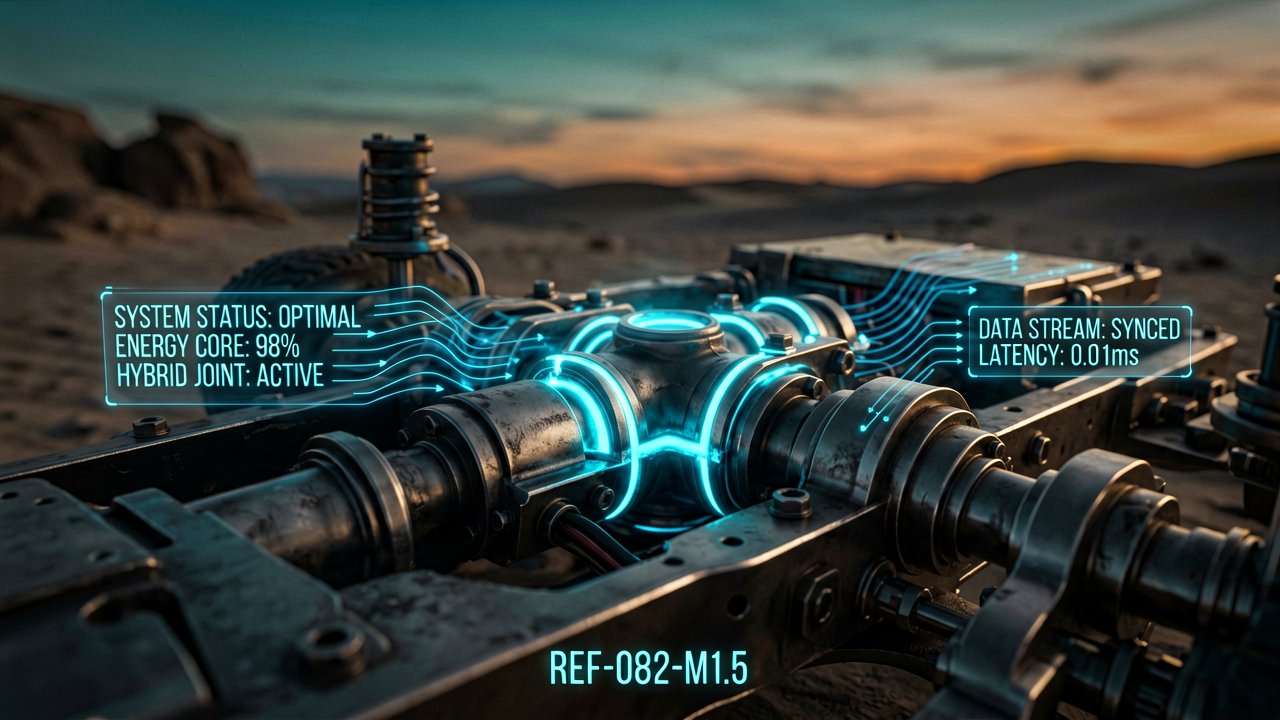
The desert heat doesn't care about your battery percentage. Neither do the sandstorms that regularly sweep across the UAE-Saudi border. Micropolis AI Robotics appears to understand this reality, unveiling its M1.5 hybrid autonomous robot at Make it in the Emirates 2026 in Abu Dhabi on May 4, 2026. The platform represents an evolution of the company's existing robotics systems, engineered specifically for extended-range, off-road, mission-critical deployments where reliability matters more than novelty.
According to the official press release distributed via Globe Newswire, the M1.5 is designed to operate across longer distances, extended durations, and more complex terrains. The robot has been developed in direct response to operational requirements from entities such as the UAE National Guard, Saudi Arabia's Ministry of Interior, and critical infrastructure operators. These aren't hypothetical use cases. They're actual customers who've already tested earlier versions of the technology.
What makes the M1.5 different from its predecessors? The company describes it as having improved off-road mobility, increased endurance, and greater operational resilience. In practical terms, this means the robot can traverse rougher terrain without getting stuck, run longer between charges, and keep functioning when conditions deteriorate. For border patrol operations spanning hundreds of kilometers of unforgiving landscape, those aren't marginal improvements—they're the difference between a successful deployment and a stranded piece of equipment.
The M1.5 builds on Micropolis's existing portfolio, which includes the Patrol M1 and Patrol M2 systems. These platforms are already deployed across security, surveillance, and smart infrastructure applications. They handle continuous monitoring, autonomous navigation, and real-time data capture in controlled and semi-structured environments. The new hybrid robot extends that capability into more demanding operational theaters.

Fareed Aljawhari, Founder and Chief Executive Officer of Micropolis, framed the launch as a natural progression of the company's work. "We take pride in building advanced robotics and AI systems in the UAE that are designed to operate in real-world, high-demand environments," he said in the announcement. "The introduction of the M1.5 reflects our continued focus on extending performance and capability where it matters most: endurance, adaptability, and reliability." The quote is standard corporate speak, but the underlying message is clear: this isn't a lab prototype. It's built for actual field conditions.
Also featured alongside the M1.5 is Microspot, Micropolis's proprietary AI and software platform. This serves as the intelligence layer across the company's ecosystem, enabling real-time monitoring, fleet coordination, data analytics, and integration with broader command-and-control systems. Think of it as the brain that coordinates multiple robots working in concert rather than as isolated units. The software layer is often where the real value emerges in autonomous systems, though it's rarely the headline grabber.
Micropolis's participation in Make it in the Emirates highlights the strength of Emirati engineering and manufacturing capabilities. The company's systems are designed, developed, and produced in the UAE. It's working with leading national institutions including Dubai Police, the UAE National Guard, DP World, and Aramco. These partnerships support mission-critical applications across security, logistics, and infrastructure environments. The company is also the first UAE robotics company to achieve a public listing in the United States, trading on the NYSE American under ticker MCRP.
Recent operational history shows Micropolis has been active in securing partnerships and pilots. In February 2026, the company completed a one-month pilot with the Saudi Ministry of Interior at an ARAMCO oil refinery and the Riyadh national power station. This validated off-road performance, autonomous systems, L-band communications, and AI functionality for industrial and critical infrastructure sites. QSS Robotics issued an additional letter of intent for 270 robots, adding to a prior 500-unit LOI and bringing the total indicated volume to 770 robots. In March, Micropolis signed a commercial development and multi-year distribution agreement with AfricAI valued at approximately $9.3 million over an expected 18-month development period.

The market's reaction to these announcements has been mixed. Stock Titan's analysis notes that recent operational and partnership announcements often saw muted or negative next-day moves, with only the large Saudi LOI in February showing a clearly positive price reaction. MCRP was up 2.64% pre-news while key peers showed mixed moves. Three of the last five news events were followed by modest share price declines, while two saw gains. This pattern suggests investors are cautious about converting LOIs into binding orders and watching for actual deployment traction rather than partnership announcements alone.
From a technical standpoint, the M1.5's specifications remain somewhat vague in public materials. The company emphasizes operational resilience and endurance without providing concrete metrics on range, payload capacity, or battery life. This is common in defense and security robotics, where detailed specifications can reveal operational capabilities to potential adversaries. For potential customers, this means procurement decisions will likely involve direct demonstrations and site-specific testing rather than spec sheet comparisons.
The physical reality of deploying these robots matters. Operators need to know how long they can run before recharging, what terrain they can actually traverse without getting stuck, and how they perform in extreme heat or sand conditions. The M1.5's hybrid designation suggests it may combine electric and combustion power sources, though the company hasn't confirmed this publicly. Such a configuration would extend operational range significantly compared to purely electric systems, but adds mechanical complexity and maintenance requirements.
Integration with existing infrastructure is another practical consideration. The Microspot platform needs to work with current command-and-control systems used by border patrol agencies and industrial operators. This isn't just about the robot functioning autonomously—it's about the robot feeding data into existing workflows, alerting operators when anomalies are detected, and coordinating with other security assets. The friction points in these integrations often determine whether a technology succeeds or sits in a warehouse gathering dust.
Whether the M1.5 achieves widespread adoption depends on several factors. The conversion of LOIs into binding orders will be critical. Actual deployment data from field operations will matter more than exhibition demonstrations. And the company's ability to scale manufacturing while maintaining quality will determine if it can meet demand from multiple regional customers simultaneously. The robotics market is crowded with competitors, and government procurement cycles are notoriously slow.
Micropolis has positioned itself at the intersection of national security, industrial automation, and sovereign technology development. The M1.5 launch reinforces that positioning, but the real test comes when these robots operate in the field under actual mission conditions. Whether operators find them reliable enough to trust with critical infrastructure remains the real question.
Artūras Malašauskas is an AI Systems Integrator with 20+ years of production-grade web engineering experience. He has designed, shipped, and scaled enterprise Python/PHP systems for logistics, SaaS, and public-sector clients. For the past year, he has focused exclusively on AI integrations: deploying open-source LLMs, building generative media pipelines (image, audio, video), and engineering multi-agent workflows for real production environments. His standard: reproducibility, security, cost-efficient inference—no vaporware. He documents and evaluates emerging AI tooling, separating verified capabilities from marketing noise. Technical editor at: muza-ai.eu, ai-verslas.lt, ai-naujinos.lt Connect on LinkedIn
Comments