NVIDIA Launches Ising Quantum AI Models, Huang Calls AI the 'Control Plane'
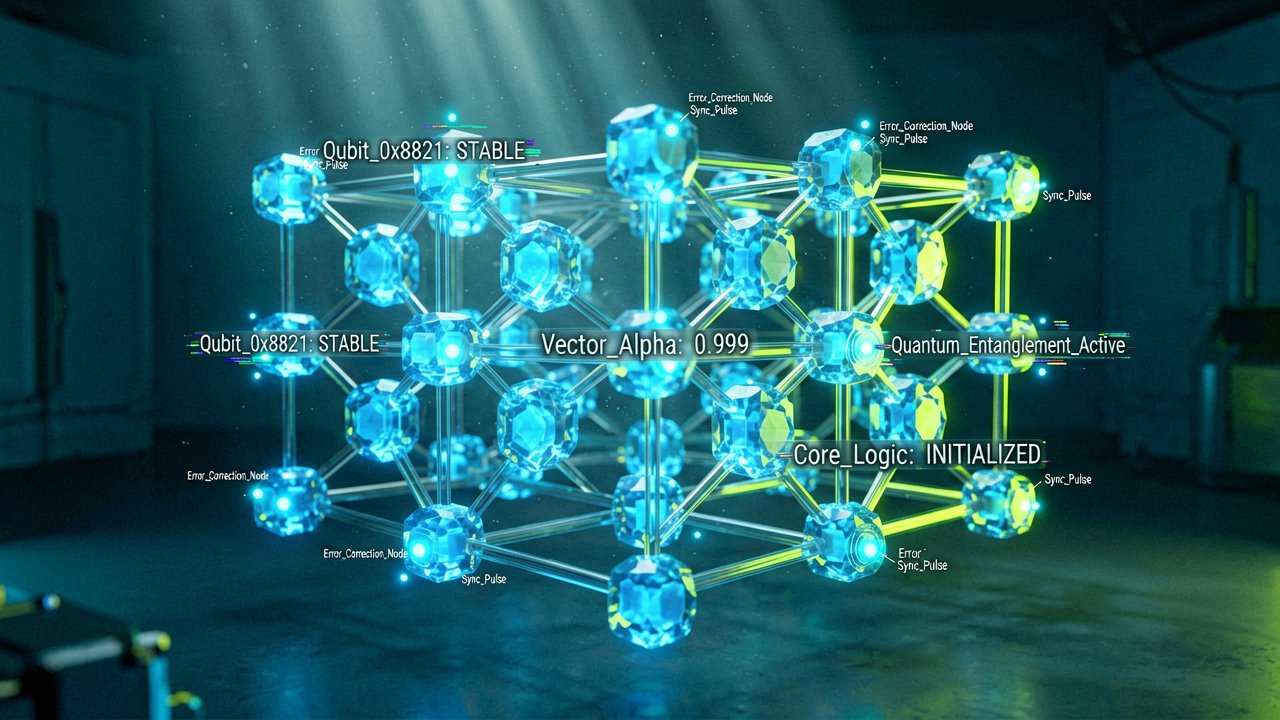
NVIDIA has officially launched Ising, the first family of open-source AI models designed specifically for quantum computing infrastructure. The announcement positions artificial intelligence not as a competitor to quantum systems, but as the essential control layer that makes them practical. CEO Jensen Huang called it the "control plane" — effectively the operating system for quantum machines.
The press release from NVIDIA details two core components: Ising Calibration and Ising Decoding. NVIDIA's official documentation states Ising Calibration uses a vision language model to automate continuous quantum processor calibration, reducing setup time from days to hours. Ising Decoding employs 3D convolutional neural networks for quantum error correction, delivering performance up to 2.5x faster and 3x more accurate than pyMatching, the current open-source industry standard.
Quantum error correction remains the single biggest bottleneck in the field. Current qubits are fragile, prone to decoherence, and require constant monitoring. Without effective error correction, quantum computers cannot run useful applications at scale. NVIDIA's approach treats this as a machine learning problem rather than a pure physics problem. The models interpret measurements from quantum processors in real-time and react to correct errors before they cascade.
Huang's framing is deliberate. By calling AI the "control plane," he's drawing a parallel to how classical computing evolved. Early computers required manual rewiring for each task. Operating systems abstracted that complexity. NVIDIA is attempting the same abstraction for quantum hardware. The physical reality of using quantum computers today involves cryogenic chambers, microwave pulses, and specialized technicians. Ising aims to reduce that friction.
The ecosystem adoption list reads like a who's who of quantum research. Atom Computing, IonQ, IQM Quantum Computers, Fermi National Accelerator Laboratory, Harvard, and the U.K. National Physical Laboratory are already using Ising Calibration. Cornell University, Sandia National Laboratories, and UC Santa Barbara are deploying Ising Decoding. These aren't theoretical partnerships. The models are available on GitHub, Hugging Face, and build.nvidia.com, with training data and workflow cookbooks included.
Stock markets reacted immediately. D-Wave Quantum (QBTS) surged 22%, IonQ (IONQ) gained 21%, Quantum Computing Inc (QUBT) rose 16%, and Rigetti Computing (RGTI) climbed 13%. HeyGotrade reporting noted this marked a fourth consecutive session of gains across the sector. The rally signals renewed investor confidence that practical quantum applications may be closer than previously estimated.
Analyst firm Resonance projects the quantum computing market will surpass $11 billion in 2030. This growth trajectory depends entirely on solving engineering challenges like error correction and scalability. NVIDIA's tools could compress that timeline. The company isn't building quantum hardware itself. Instead, it's positioning as an enabler in the supply chain, similar to how it became indispensable in the AI chip market.
There's a physical reality check here. Quantum computers still require temperatures near absolute zero. They occupy entire rooms. They need specialized cooling infrastructure. Ising doesn't eliminate those requirements. It makes the software layer more manageable. The difference between a quantum computer that takes days to calibrate and one that takes hours matters for research throughput, but it doesn't make quantum computing consumer-ready.
NVIDIA Ising complements the CUDA-Q software platform for hybrid quantum-classical computing. It integrates with NVQLink, the QPU-GPU hardware interconnect for real-time control. This creates a full stack: quantum processors connect to NVIDIA GPUs via NVQLink, AI models handle error correction and calibration, and developers access everything through CUDA-Q. The architecture assumes quantum computers will work alongside classical systems, not replace them.
The open-source nature of Ising is strategic. Any quantum computing company can integrate the models into their systems without licensing fees. This mirrors NVIDIA's successful strategy in AI, where it became indispensable by providing tools everyone else builds upon. If the models deliver on Huang's claims, NVIDIA accelerates the entire sector's timeline to profitability while potentially creating a new revenue stream beyond its dominant GPU business.
Significant challenges remain for individual quantum stocks. Quantum Computing Inc burns approximately $37 million in cash annually. Analysts estimate the company may not achieve profitability before 2029. Rigetti Computing remains down roughly 66% below its all-time high despite this week's rally. The stock trades near the bottom of its 52-week range. The four-day rally has drawn comparisons to previous quantum computing hype cycles that ended in sharp reversals.
What distinguishes this rally is NVIDIA's involvement. The endorsement from the world's most valuable chipmaker adds credibility that previous quantum computing catalysts lacked. But NVIDIA's announcement validates the quantum computing concept without guaranteeing commercial success for any individual company. The path from error correction improvements to profitable quantum applications still requires years of development and significant capital investment.
Whether users actually pay for quantum computing services remains the real question. Error correction is necessary but not sufficient. Companies still need to demonstrate applications that justify the cost. The models are available now. The hardware challenges persist. Time will tell if this accelerates the timeline or just adds another layer of complexity to an already difficult problem.
Artūras Malašauskas is an AI Systems Integrator with 20+ years of production-grade web engineering experience. He has designed, shipped, and scaled enterprise Python/PHP systems for logistics, SaaS, and public-sector clients. For the past year, he has focused exclusively on AI integrations: deploying open-source LLMs, building generative media pipelines (image, audio, video), and engineering multi-agent workflows for real production environments. His standard: reproducibility, security, cost-efficient inference—no vaporware. He documents and evaluates emerging AI tooling, separating verified capabilities from marketing noise. Technical editor at: muza-ai.eu, ai-verslas.lt, ai-naujinos.lt Connect on LinkedIn
Comments