UAE Launches National Supply Chain Resilience Programme
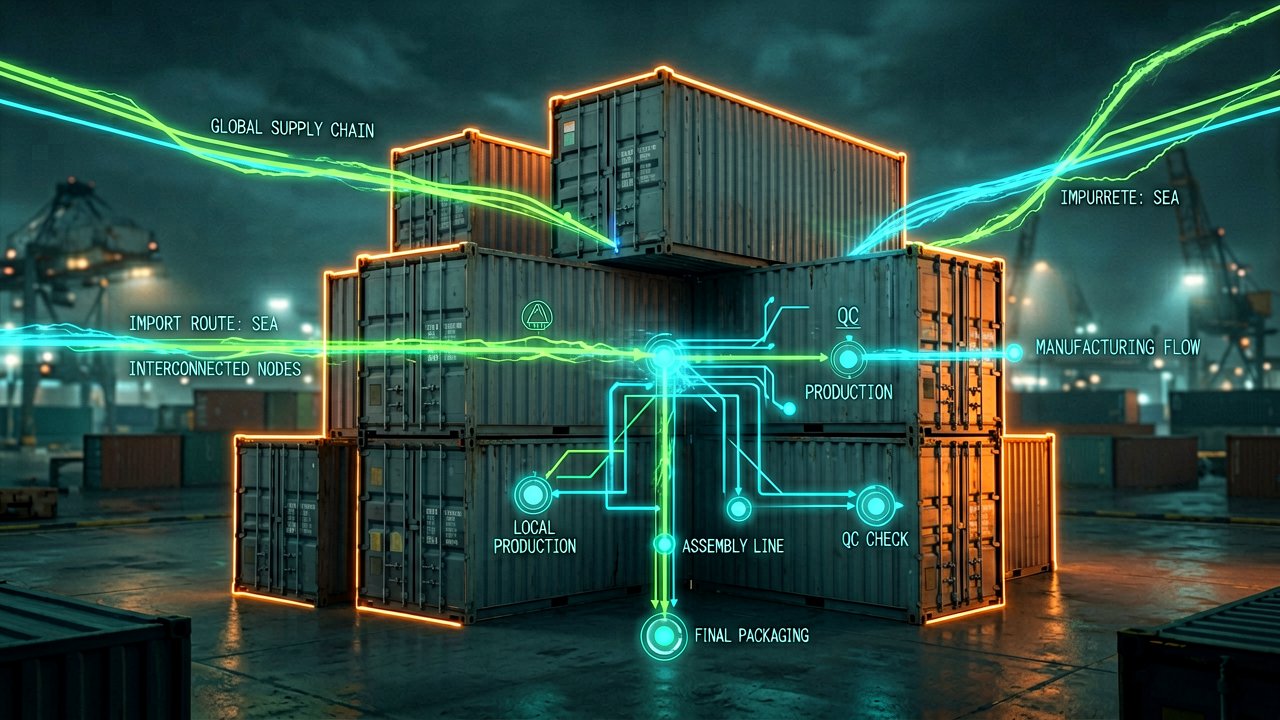
His Highness Sheikh Mohammed bin Rashid Al Maktoum, Vice President and Prime Minister of the UAE and Ruler of Dubai, has approved the launch of a National Programme to Strengthen Supply Chain Resilience. The initiative represents a coordinated government effort to safeguard access to essential commodities amid persistent global disruptions.
Announced on April 29, 2026, the programme targets three critical sectors: food, medical supplies, and industrial products. These categories represent the backbone of daily economic and social function in the UAE, where import dependency remains high across all three areas.
According to Gulf News, the initiative adopts an integrated approach that includes diversifying import sources, boosting local manufacturing and agriculture through private sector partnerships, and expanding international collaborations.
The programme will identify priority goods crucial to the UAE, assess their exposure to import-related risks, and determine strategic markets and supply sources. This is not a vague policy statement—it involves concrete risk assessment of specific commodities and their supply routes.

Consider the physical reality: a hospital in Abu Dhabi needs surgical gloves. A supermarket in Sharjah needs wheat. A construction firm in Ras Al Khaimah needs steel. The programme aims to ensure these items remain available even when global logistics fracture (which happens more often than supply chain managers admit).
Independent reporting from Reuters via WAM confirms the programme's scope and timeline. The Emirates News Agency (WAM) serves as the official source for the announcement, providing direct attribution to government channels.
Key operational components include evaluating various supply scenarios, examining the feasibility of producing essential goods within the UAE, and broadening investment opportunities with partner countries involved in production. This moves beyond rhetoric into actual feasibility studies and investment frameworks.
The initiative will also establish partnerships aimed at ensuring continuity and stability in supply. This means contracts, agreements, and potentially long-term commitments with international entities capable of large-scale production and efficient delivery.

Domestic expansion receives specific attention. The programme explores opportunities to expand agricultural output and industrial production while assessing investment prospects in sectors that support long-term supply chain resilience. Local production reduces exposure to shipping delays, port congestion, and geopolitical friction points.
From a business perspective, this creates both obligations and opportunities for UAE-based companies. Private sector partners will need to align with government priorities, potentially receiving support for local manufacturing initiatives. The question becomes whether these partnerships deliver measurable results or remain ceremonial.
Global supply chains have proven fragile over the past decade. Pandemic disruptions, regional conflicts, and climate-related shipping delays have exposed vulnerabilities in just-in-time delivery models. The UAE's approach acknowledges that resilience requires redundancy, not efficiency alone.
The programme underlines the UAE's proactive efforts to mitigate risks facing global supply chains by building a comprehensive national system. This system aims to guarantee sustainable access to vital commodities while strengthening preparedness for regional and global developments.
Implementation details remain to be published. No specific budget figures, timelines for local production targets, or performance metrics appeared in the initial announcement. Stakeholders will need to wait for subsequent documentation to understand the programme's operational parameters.
Whether the initiative achieves its stated goals depends on execution, not approval. Government programmes of this scale often face challenges in coordination between ministries, private sector engagement, and measurable outcomes. The real test begins when the first local facility comes online or the first diversified import route proves reliable.
For now, the framework exists. The question is whether it translates into tangible supply chain improvements that UAE businesses and consumers can actually feel when they walk into a store or hospital.
Artūras Malašauskas is an AI Systems Integrator with 20+ years of production-grade web engineering experience. He has designed, shipped, and scaled enterprise Python/PHP systems for logistics, SaaS, and public-sector clients. For the past year, he has focused exclusively on AI integrations: deploying open-source LLMs, building generative media pipelines (image, audio, video), and engineering multi-agent workflows for real production environments. His standard: reproducibility, security, cost-efficient inference—no vaporware. He documents and evaluates emerging AI tooling, separating verified capabilities from marketing noise. Technical editor at: muza-ai.eu, ai-verslas.lt, ai-naujinos.lt Connect on LinkedIn
Comments