GalaxEye Launches Drishti, Claims World's First OptoSAR Satellite

Bengaluru-based space startup GalaxEye deployed its first commercial satellite, Drishti, aboard a SpaceX Falcon-9 rocket from Vandenberg, California, on Sunday, May 3, 2026. The firm is calling it the world's first OptoSAR satellite, a designation that hinges on integrating Electro-Optical (EO) and Synthetic Aperture Radar (SAR) sensors into a single operational platform.
The spacecraft weighs 190 kilograms, making it India's largest privately developed Earth observation satellite. That's roughly the size of a compact refrigerator, though it carries a deployable antenna spanning about three-and-a-half metres once in orbit. The physical constraints of fitting both sensor types onto one bus create engineering challenges that most competitors sidestep by building separate satellites for optical and radar imaging.
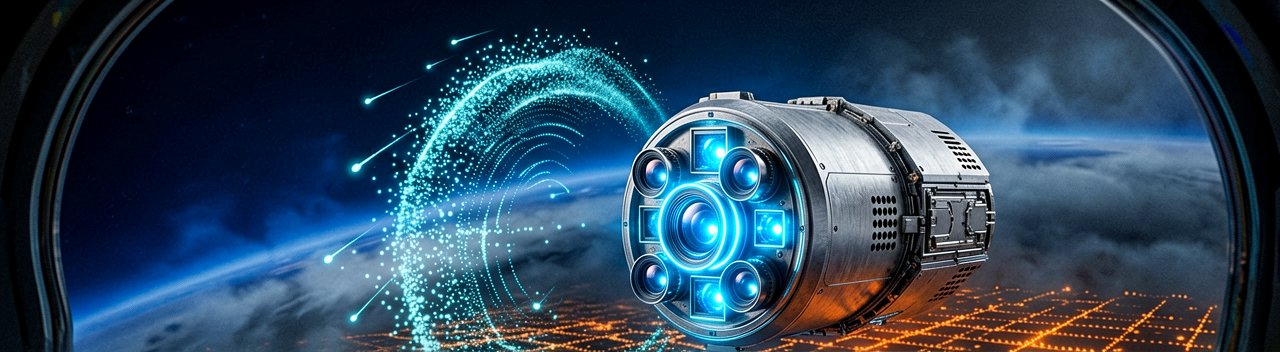
According to GalaxEye's official mission page, the satellite combines MSI (Multispectral Imaging) and SAR on a single platform. The company's documentation describes this as "data that is inherently aligned," meaning the optical and radar imagery are synchronised rather than requiring post-processing correlation.
Here's why that matters: optical satellites provide high-resolution images but fail in cloud cover or darkness. Radar satellites operate day and night, penetrating clouds, smoke, and rain, though their imagery is harder to interpret. By synchronising both data streams, GalaxEye claims the satellite can generate more consistent and usable imagery for users on the ground. During floods, cyclones, or landslides, radar imaging can continue functioning even when cloud cover prevents optical satellites from capturing images.
The satellite can deliver imagery at a resolution of 1.5 metres and revisit locations globally every seven to ten days. That revisit window is competitive but not groundbreaking—constellations of smaller satellites can achieve better temporal resolution, though typically with lower individual image quality. The trade-off is familiar to anyone who's tried to track a moving target from orbit.
Another key feature onboard is artificial intelligence processing powered by Nvidia's Jetson Orin computing platform. Instead of transmitting vast quantities of raw imagery back to Earth for analysis, parts of the processing will happen directly in orbit. The idea is to reduce the time taken to convert satellite imagery into actionable information (a problem that has plagued users for years, frankly).
GalaxEye co-founder and CEO Suyash Singh told The Times of India that the launch marks the culmination of over five years of sustained R&D. The company had earlier tested its imaging systems through nearly 500 aerial sorties involving drones, Cessna aircraft, and high-altitude platforms, besides flying an earlier payload aboard an ISRO PSLV mission under the POEM platform.
Interest in the project has emerged from both defence and civilian agencies. The company said discussions have taken place with multiple Indian government departments, including defence and agriculture ministries, while agencies such as the Defence Space Agency, Indian Air Force, Army, and Navy have been tracking the programme. Following Drishti's launch, the startup plans to build a larger constellation of 8 to 12 satellites over the next four years, with future versions targeting even sharper imagery.
Dr. Pawan Goenka, Chairman of the Indian National Space Promotion and Authorization Center (IN-SPACe), commented on the successful launch. He noted that sustained effort over the last five to six years on confidence-building and commercialisation of India's private space technology ecosystem is now showing tangible results. Mission Drishti complements India's broader initiatives, including the active 29 Earth Observation satellites outlined in ISRO's recent annual report.
GalaxEye has also signed distribution partnerships across more than 20 countries. Following Drishti's launch, initial imagery is expected to be delivered to customers in the coming weeks after commissioning. The satellite is a dual-use Earth observation platform, supporting use cases across defence, agriculture, disaster management, maritime monitoring, and infrastructure planning.
The claim of being "world's first" OptoSAR satellite warrants scrutiny. While GalaxEye's integration of EO and SAR on a single platform is novel, other companies have experimented with multi-sensor satellites. The distinction here is the synchronised, analysis-ready output rather than simply carrying both sensor types. Whether users actually pay for the premium remains the real question.
Initial imagery delivery timelines are typical for new satellites—commissioning takes weeks, sometimes months, before data quality stabilises. The physical reality of orbital mechanics means ground stations must be scheduled, antennas deployed, and thermal systems calibrated. None of that happens instantly.
Whether this technology becomes a standard or remains a niche offering depends on customer adoption. The 1.5-metre resolution is adequate for many applications but not for high-value intelligence work. The all-weather capability is the real selling point, though it comes at the cost of complexity and mass.
Artūras Malašauskas is an AI Systems Integrator with 20+ years of production-grade web engineering experience. He has designed, shipped, and scaled enterprise Python/PHP systems for logistics, SaaS, and public-sector clients. For the past year, he has focused exclusively on AI integrations: deploying open-source LLMs, building generative media pipelines (image, audio, video), and engineering multi-agent workflows for real production environments. His standard: reproducibility, security, cost-efficient inference—no vaporware. He documents and evaluates emerging AI tooling, separating verified capabilities from marketing noise. Technical editor at: muza-ai.eu, ai-verslas.lt, ai-naujinos.lt Connect on LinkedIn
Comments