ABB Robotics Unveils OmniVance Surface Finishing Cell for SMEs
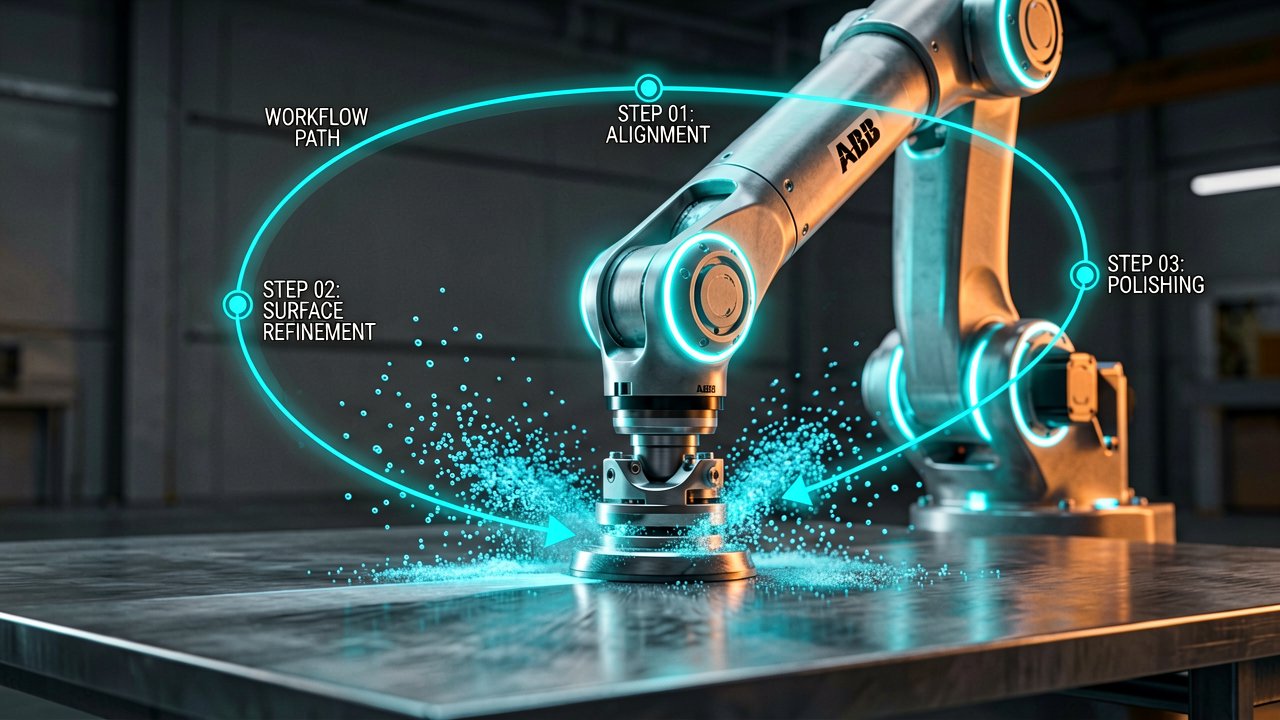
The industrial automation landscape just got a bit more accessible. ABB Robotics has launched its first fully automated sanding and polishing cell — the OmniVance Collaborative Surface Finishing Cell — designed specifically for manufacturers who need industrial-grade quality without the engineering overhead. This isn't another vague promise of future automation. It's a self-contained, CE-certified unit that ships ready to plug in and run.
According to the company's official announcement, the cell uses a GoFa collaborative robot to execute precision surface finishing tasks. The entire system arrives as a complete package, including safety components and the cobot itself. No additional engineering required to switch on and begin production (which is a relief, given how many "turnkey" solutions still need three weeks of integration). The European standard CE certification means it complies with the EU Machinery Directive and ships with the required Declaration of Conformity for EU markets.
ABB's press release details the core value proposition: bridging the gap between expensive, customized automation and entry-level tool kits that lack scalability. Craig McDonnell, Managing Director Business Line Industries at ABB Robotics, explained the market gap directly. Many smaller businesses lack in-house robotics expertise, yet they need to deliver perfect quality every time. Until now, many have not had a solution that fits their needs.
Surface finishing is a critical step in manufacturing across virtually every industry. The physical reality of this work involves dust, repetitive motion, and the kind of strain that accumulates over years. Businesses face dual pressures of more complex production demands and a shortage of skilled labor. Projections from Deloitte and The Manufacturing Institute indicate 1.9 million manufacturing jobs will be unfilled by 2033. That's not a theoretical problem. It's a current operational bottleneck.
The OmniVance cell addresses this by automating repetitive sanding and polishing tasks. The result is increased throughput and reduced scrap and rework. Integrated dust extraction readiness helps maintain a clean, healthy work environment while further enhancing finished product quality. Automation also reduces physical strain and frees skilled workers to concentrate on more valuable tasks. The tactile difference is immediate — no more hours of hand-sanding that leave workers' arms aching by mid-afternoon.
Matching the cell's industrial-grade quality is its operational simplicity. ABB Robotics developed intuitive software to govern the entire finishing process. The tablet-style interface is user-friendly for those without robotics expertise and needs no custom programming. Features such as lead-through 3D path recording, 2D preset path creation, and intuitive path editing are integrated into Wizard Easy Programming blocks. These can reduce programming time by up to 90%.
That 90% figure is significant. Traditional industrial robot programming often requires specialized training and weeks of development. The OmniVance cell's approach means a floor manager with basic technical skills can set up a new finishing operation in hours rather than weeks. The lead-through recording feature lets users physically guide the robot through the desired path, which the system then memorizes and repeats with consistent precision. It's less of a programming exercise and more of a demonstration.
Independent coverage from Robotics & Automation News corroborates the specifications and market positioning. The outlet notes that the cell is entirely self-contained and delivered as a complete plug-and-play solution. The easy addition of new tools and accessories makes it highly adaptable in high-mix environments. This flexibility matters for smaller operations that can't afford dedicated cells for each product variant.
The business case hinges on ROI speed. By automating repetitive tasks, the cell increases throughput and reduces traditional scrap and rework, saving time, effort, and costs. For a small manufacturer running three shifts, the math becomes compelling quickly. One less worker needed for sanding, plus reduced material waste from inconsistent finishing, plus the ability to run the cell during off-hours. The numbers stack up, assuming the initial investment doesn't break the budget.
ABB says the OmniVance Collaborative Surface Finishing Cell demonstrates how collaborative robots can deliver application-specific solutions that boost competitiveness, even for businesses and operators who are new to robotics. The company positions itself as one of the world's leading robotics companies, the only one with a comprehensive and integrated AI-powered portfolio covering robots, cobots, and Autonomous Mobile Robots (AMRs). The business employs approximately 7,000 people.
There's a practical reality check here. Not every surface finishing task is suitable for automation. Complex geometries, variable material hardness, or highly customized aesthetic requirements may still demand human judgment. The OmniVance cell targets the repetitive, high-volume work that dominates many production floors. It's not replacing all finishing labor. It's replacing the parts of the job that humans hate doing anyway.
The labor shortage context cannot be overstated. With 1.9 million manufacturing jobs projected unfilled by 2033, companies that can automate without requiring robotics PhDs gain a competitive edge. The OmniVance cell's plug-and-play nature means deployment timelines shrink from months to days. That speed matters when production schedules are already tight and customer expectations are rising.
Whether users actually pay for it remains the real question. The technology works. The market need is documented. But adoption depends on pricing, availability, and whether small manufacturers can justify the capital expenditure in the current economic climate. ABB has positioned this as affordable and scalable, but the final numbers will determine if this becomes a standard or a niche solution.
Time will tell if the OmniVance cell becomes the new baseline for surface finishing automation. For now, it represents a concrete step toward making industrial robotics accessible to businesses that previously couldn't justify the investment. The dust extraction is ready. The programming is simplified. The robot is waiting. Whether companies pull the trigger is up to them.
Artūras Malašauskas is an AI Systems Integrator with 20+ years of production-grade web engineering experience. He has designed, shipped, and scaled enterprise Python/PHP systems for logistics, SaaS, and public-sector clients. For the past year, he has focused exclusively on AI integrations: deploying open-source LLMs, building generative media pipelines (image, audio, video), and engineering multi-agent workflows for real production environments. His standard: reproducibility, security, cost-efficient inference—no vaporware. He documents and evaluates emerging AI tooling, separating verified capabilities from marketing noise. Technical editor at: muza-ai.eu, ai-verslas.lt, ai-naujinos.lt Connect on LinkedIn
Comments