EXEED × AiMOGA Secures 1,000 Police Robot Units at China Conference
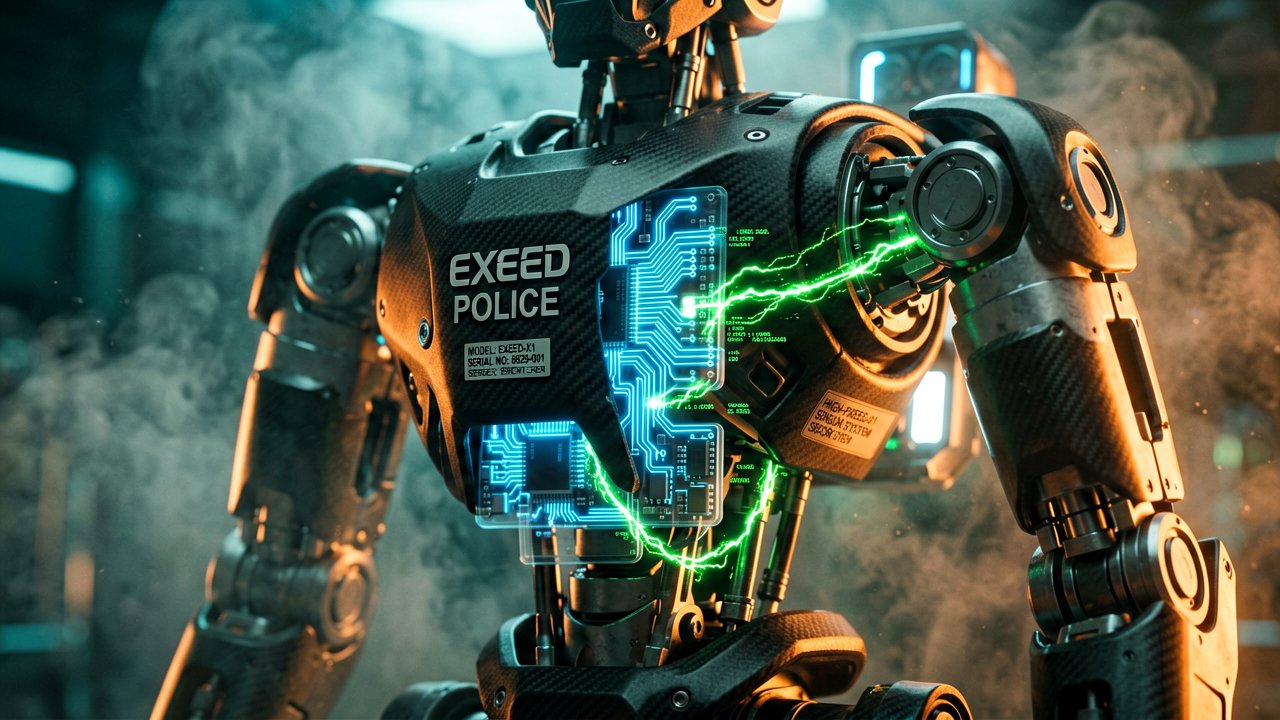
The automotive and robotics sectors collided in Wuhu, Anhui, on April 27, 2026, when EXEED and AiMOGA Robotics announced a significant commercial milestone at their Global Release Conference. The companies signed agreements for 1,000 intelligent police robots and completed delivery of 110 units during the event. This marks what the firms describe as a transition from pilot demonstrations to scaled commercial deployment.
The conference, themed "Driven by Scenarios, United for Growth," showcased AiMOGA's full product portfolio including the humanoid robot Mornine, medical assistance robots, and quadruped robots. Thailand Business News reported the signing and delivery ceremony as one of the event's key highlights, with a partner representative from Vietnam detailing plans to establish a robotics experience center and intelligent industrial park.
Yin Tongyue, Chairman of Chery Group, delivered a keynote address outlining the strategic thinking behind Chery's entry into robotics. He emphasized that intelligent vehicles are essentially mobile robots, sharing foundational technology in perception, planning, and control. This technological commonality forms EXEED's core advantage in developing robotics products.
The 110 delivered units are already operating in multiple cities across China. Their deployment covers school-zone traffic support, marathons, and urban football leagues. The robots handle peak-hour traffic guidance, illegal parking detection, and non-motorized vehicle violation management. These deployments supplement frontline policing resources while enhancing urban traffic governance efficiency.

From a physical standpoint, these aren't sleek consumer gadgets. They're industrial-grade machines designed for outdoor operation in variable weather conditions. The robots must navigate crowded streets, detect violations, and coordinate with traffic signals while maintaining centimeter-level positioning. That's the kind of reliability that separates prototype demonstrations from actual commercial products (a distinction that matters when you're deploying hundreds of units across multiple cities).
AiMOGA unveiled a three-phase industrialization strategy at the conference. Phase one focuses on affordable robots for children's companionship scenarios. Phase two targets scenario-based robots for public and enterprise services. Phase three aims to bring robots into homes as intelligent assistants in everyday life. Zhang Guibing, President of AiMOGA Robotics, presented this vision during the event.
The company also announced partnerships with 100 universities for talent development, robotics R&D, and industry-academia integration. AiMOGA has established 31 innovation application laboratories across six key fields and is building the AiMOGA Academy. Through testing lines, laboratories, and internship bases, the company aims to cultivate specialized robotics professionals.
Perhaps more interesting than the hardware itself is the business model innovation. AiMOGA launched the "AiMOGA Robot Rental Platform" at the conference. Through leasing, financial services, and operational support, the platform aims to lower adoption barriers and accelerate deployment across industries. This addresses a fundamental challenge in robotics commercialization: the high upfront cost that prevents widespread adoption.
The robotics industry cannot rely on single products alone. True commercialization requires a complete ecosystem including application scenarios, multidisciplinary teams, robust technology, competitive industrial chains, stable sales channels, financial leasing platforms, after-sales service systems, and data collection centers. Only by connecting the full value chain from R&D through data feedback can robots continuously evolve in real-world environments.
EXEED's automotive heritage provides advantages in supply chain management and global networks. The mature R&D system and validation processes enable rapid iteration from concept to prototype. Global sales and service networks offer unique channels for market expansion, enabling "global R&D, global manufacturing, and global delivery" through overseas brand recognition and channel resources.
On April 23, 2026, EXEED AiMOGA Robotics entered a global strategic partnership with NVIDIA. The two parties will jointly develop and deploy physical AI across assisted driving, cockpit AI, and robotics. This includes humanoid robots and diversified intelligent robot platforms based on NVIDIA Jetson, plus the introduction of NVIDIA Isaac Sim simulation framework and NVIDIA Isaac GR00T development platform.
The 1,000-unit order represents more than a sales figure. It signals that AiMOGA's intelligent police robots have moved beyond single-point pilots into systematic operations. The transition from isolated application trials to thousand-unit agreements demonstrates market validation of the technology and business model.
Whether this scales beyond China remains uncertain. The Vietnam partnership suggests international expansion, but regulatory frameworks for autonomous police robots vary significantly across jurisdictions. The leasing platform helps address cost barriers, but operational integration with existing public safety infrastructure presents its own challenges.
Whether governments actually pay for this technology at scale remains the real question.
Artūras Malašauskas is an AI Systems Integrator with 20+ years of production-grade web engineering experience. He has designed, shipped, and scaled enterprise Python/PHP systems for logistics, SaaS, and public-sector clients. For the past year, he has focused exclusively on AI integrations: deploying open-source LLMs, building generative media pipelines (image, audio, video), and engineering multi-agent workflows for real production environments. His standard: reproducibility, security, cost-efficient inference—no vaporware. He documents and evaluates emerging AI tooling, separating verified capabilities from marketing noise. Technical editor at: muza-ai.eu, ai-verslas.lt, ai-naujinos.lt Connect on LinkedIn
Comments