Multiverse Computing Releases LittleLamb 0.3B Models for Edge AI

The AI compression specialist Multiverse Computing has released the LittleLamb model family, three open-source models designed for edge and mobile environments. The announcement came via official press release on April 28, 2026, with all three variants now available on Hugging Face.
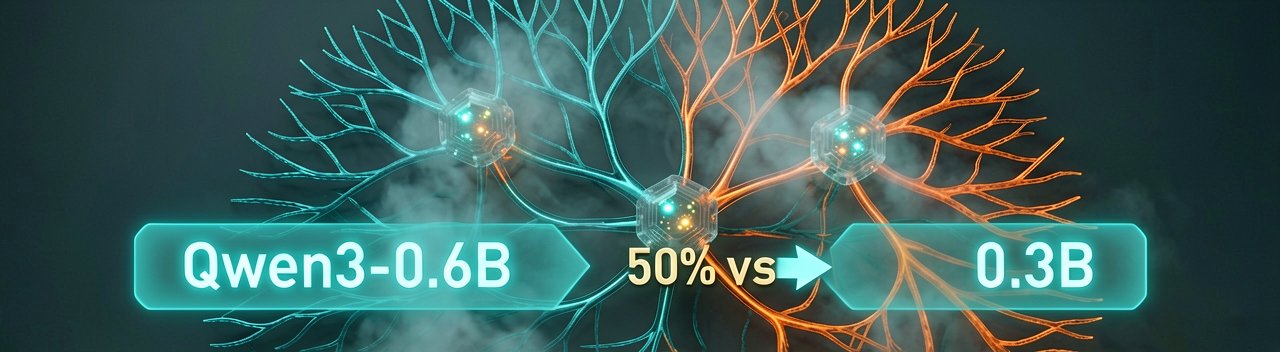
Each model in the family shares a ~0.3B parameter footprint, built by compressing Qwen3-0.6B using the company's proprietary CompactifAI technology. The compression cuts the base architecture size by approximately 50%, according to the official GlobeNewswire press release. This reduction enables deployment across edge, mobile, and offline environments where traditional models would be impractical.
The three variants serve distinct use cases. LittleLamb 0.3B is a general-purpose bilingual model for conversational AI and reasoning. LittleLamb 0.3B Tool-Calling adds fine-tuning for native tool use, function calling, and structured JSON outputs—essential for agentic workflows. LittleLamb 0.3B Mobile is specifically packaged for on-device inference where latency, memory, and battery budgets are tight.
Both the general and tool-calling versions outperform the original Qwen3-0.6B model on HLE benchmarks, as well as models in the Gemma 270M class. The mobile variant improves accuracy on Mobile Action tasks compared to the Gemma 270M class. This performance retention is notable given the aggressive compression ratio.

CompactifAI applies quantum-inspired tensor network mathematics to reduce model size by up to 95% with only a 2–3% precision loss. This contrasts sharply with conventional compression approaches that often forfeit 20–30% accuracy at similar ratios. The technology positions Multiverse to serve enterprises needing on-device intelligence where privacy, latency, or limited connectivity rule out large cloud-based models.
CEO Enrique Lizaso Olmos framed LittleLamb as proof that compact models can deliver more than simple chat. The models enable advanced reasoning in constrained settings without major performance sacrifices. This matters because the challenge is no longer access to AI models in theory, but access to models that are practical to run (developers have been waiting for this for years, honestly).
All three models support English and Spanish, with dual inference modes giving developers flexibility. Thinking mode enables chain-of-thought-style reasoning for complex tasks such as math, science, and multi-step problem solving. Non-thinking mode prioritizes speed for efficient, general-purpose dialogue. The choice depends on whether you need deeper reasoning or lower latency for your specific deployment.
Technical documentation, benchmarks, and integration guides accompany each release on the company's Hugging Face page. This lowers integration friction for developers and system integrators. The models are available at https://huggingface.co/MultiverseComputingCAI/littlelamb, https://huggingface.co/MultiverseComputingCAI/littlelamb-toolcalling, and https://huggingface.co/MultiverseComputingCAI/littlelamb-mobile.
Independent reporting from TipRanks corroborates the technical specifications and market positioning. The outlet notes the launch deepens Multiverse's push into edge-native AI and strengthens its open-source footprint, which can accelerate developer adoption.
With more than 100 global customers already—including Iberdrola, Bosch, and the Bank of Canada—the LittleLamb release is likely to be used both as a showcase for CompactifAI's capabilities and as a lead generator for broader AI compression and deployment projects. The company is headquartered in Donostia, Spain, with offices in the United States, Canada, and across Europe.
For device manufacturers, the models enable on-device inference with compressed models that fit limited compute and memory. For corporations, they can extend infrastructure by running advanced AI on existing hardware with compressed models that cut CAPEX and energy use. For data centers, smaller, faster models increase throughput and profitability without adding racks.
The physical reality of using these models matters. Developers will experience faster time to first token, increased token throughput, and models that are cheaper to run. Some customers report 50–80% cost and energy savings. Telefónica noted compressed models can be deployed directly on their network, including local facilities, reducing energy consumption by up to 75% compared to uncompressed models.
Whether this translates to widespread adoption depends on whether developers actually find the 2–3% precision loss acceptable for their use cases. The models are free on Hugging Face, but enterprise support and customized compression will likely require commercial engagement. Time will tell if the compression tradeoffs work for production workloads.
Artūras Malašauskas is an AI Systems Integrator with 20+ years of production-grade web engineering experience. He has designed, shipped, and scaled enterprise Python/PHP systems for logistics, SaaS, and public-sector clients. For the past year, he has focused exclusively on AI integrations: deploying open-source LLMs, building generative media pipelines (image, audio, video), and engineering multi-agent workflows for real production environments. His standard: reproducibility, security, cost-efficient inference—no vaporware. He documents and evaluates emerging AI tooling, separating verified capabilities from marketing noise. Technical editor at: muza-ai.eu, ai-verslas.lt, ai-naujinos.lt Connect on LinkedIn
Comments