Japan Airlines Tests Humanoid Robots for Ground Handling at Haneda
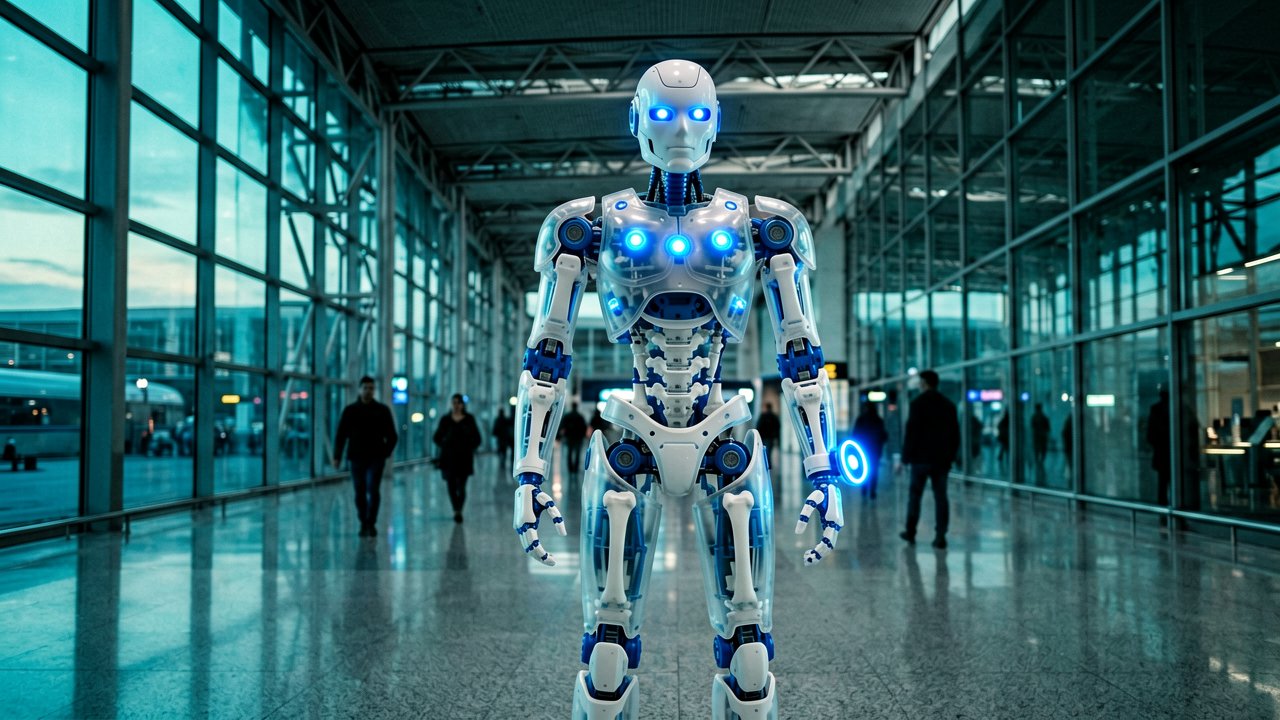
Airport tarmacs are about to get stranger. Japan Airlines has announced a partnership with GMO AI & Robotics to test humanoid robots for ground handling operations at Tokyo-Haneda Airport. The trial begins in May 2026 and runs through 2028, marking one of the first real-world deployments of bipedal robots in commercial aviation logistics.
The robots themselves are manufactured by Unitree, a Hangzhou-based Chinese robotics firm. During a media demonstration, a 130cm-tall unit was observed tentatively pushing cargo onto a conveyor belt next to a JAL passenger plane. The robot also waved to an unseen colleague, a gesture that felt more like a tech demo than actual operational readiness.
According to The Guardian, the humanoid units will handle luggage and cargo transport on the tarmac at Haneda, which processes more than 60 million passengers annually. The robots can operate continuously for two to three hours before requiring recharging breaks.
Yoshiteru Suzuki, president of JAL Ground Service, stated that using robots for physically demanding work would "inevitably reduce the burden on workers and provide significant benefits to employees," per the Kyodo news agency. He added that safety management tasks would remain with human staff.
The initiative addresses a genuine structural problem. Japan's aging population has created severe labor shortages across industries, including aviation. Nippon.com reports that JAL employs approximately 4,000 workers for ground handling, often in tight spaces. The airline decided to test humanoid robots to save labor while leveraging existing facilities.
Tomohiro Uchida, president of GMO AI and Robotics, noted that while airports appear highly automated and standardized, their back-end operations still rely heavily on human labor and face serious labor shortages. The roughly three-year test aims to reduce manpower needs and cut employee workloads amid the industry's severe labor shortage.
In the initial phase, two robots will carry out tasks such as transporting containers and opening and closing levers that secure them. Future plans include enabling the robots to operate autonomously, thereby expanding the range of tasks they can perform. The firms are also planning to use them for other tasks, such as cleaning aircraft cabins.
The timing is no accident. More than 7 million people visited Japan in the first two months of 2026, according to the Japan National Tourism Organisation, after a record 42.7 million last year. This surge in inbound tourism coincides with forecasts of more severe labor shortages. According to one estimate, Japan will need more than 6.5 million foreign workers in 2040 to reach its growth targets as the indigenous workforce continues to shrink.
There's a practical reality check here. These robots are Chinese-made, which introduces supply chain and geopolitical considerations. They're also limited to two to three hours of operation before recharging (a constraint that will matter during peak travel periods). And while they can push cargo, the demonstration showed them moving tentatively, not with the fluid efficiency of experienced baggage handlers.
The experiment is particularly significant as it marks one of the first real-world applications of humanoid robots specifically designed for ground handling in airports. It is expected to offer a glimpse into the future of automated travel, where robots and AI systems perform key roles in airports, airlines, and passenger services.
Whether this pilot project succeeds depends on several factors: reliability under real airport conditions, cost-effectiveness compared to human labor, and regulatory approval for autonomous operation near aircraft. The success of this robot experiment at Haneda Airport could set a precedent for other airports around the world to incorporate robotics and AI into their operations.
For now, passengers flying through Haneda may find themselves interacting with the first generation of robots designed to assist with airport ground operations. Whether users actually pay for it remains the real question.
Artūras Malašauskas is an AI Systems Integrator with 20+ years of production-grade web engineering experience. He has designed, shipped, and scaled enterprise Python/PHP systems for logistics, SaaS, and public-sector clients. For the past year, he has focused exclusively on AI integrations: deploying open-source LLMs, building generative media pipelines (image, audio, video), and engineering multi-agent workflows for real production environments. His standard: reproducibility, security, cost-efficient inference—no vaporware. He documents and evaluates emerging AI tooling, separating verified capabilities from marketing noise. Technical editor at: muza-ai.eu, ai-verslas.lt, ai-naujinos.lt Connect on LinkedIn
Comments