Tesla's Robotaxi Rollout Faces Reality Check in Austin
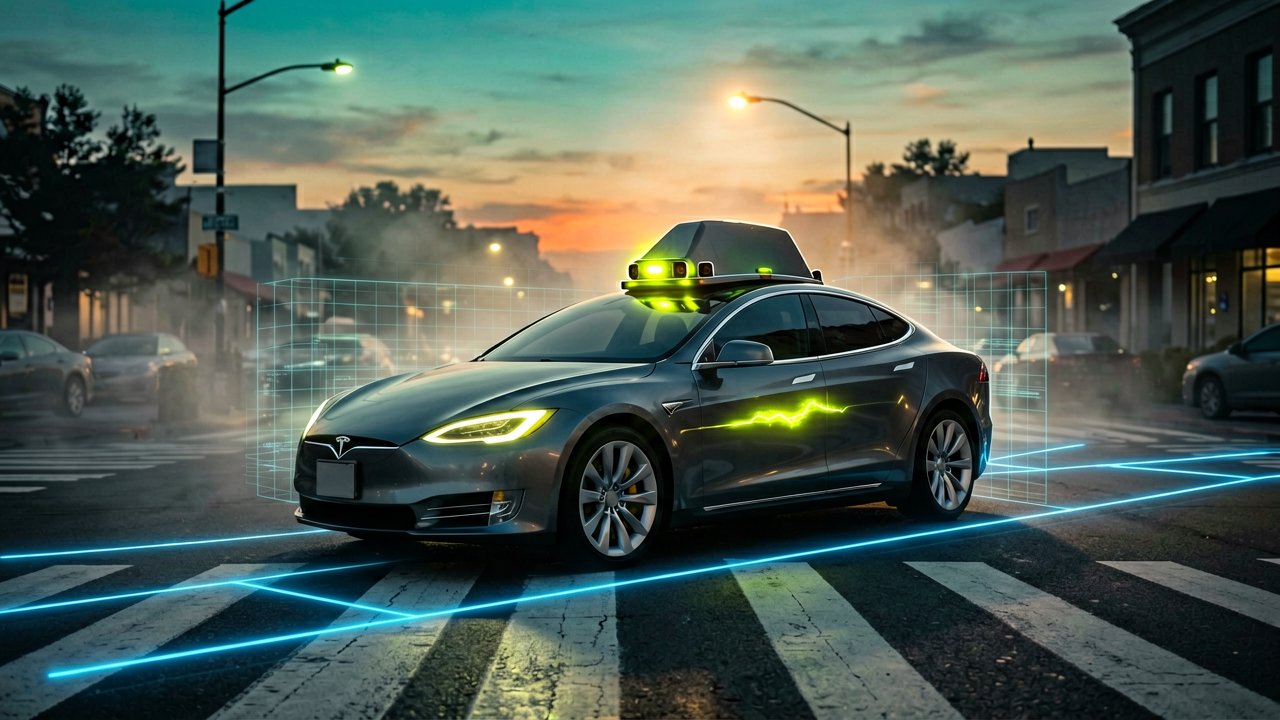
The electric carmaker Tesla launched a limited version of its driverless taxi service in Austin, Texas, this week, marking a milestone for the company's self-driving aspirations while simultaneously highlighting significant technological constraints.
Chief executive Elon Musk has touted the "robotaxis" as a potential revenue stream for the company and its customers, eventually offering car owners a way to monetize their vehicles when not in personal use. For now, the self-driving cabs come equipped with a safety monitor in the passenger seat ready to intervene, as well as internal systems that prevent the cars from traveling outside a narrow portion of the city.
The rollout marks a milestone for the company's self-driving taxi aspirations, but limitations placed on the vehicles and a series of apparent miscues suggest the technology remains far from wide adoption, some analysts told ABC News.
"It's a step in the right direction," Seth Goldstein, an analyst at research firm Morningstar who studies the electric-vehicle sector, told ABC News. "At the same time, it also highlights that Tesla is still in the early stages."
The self-driving taxi service, unveiled on Monday, involves 10 to 20 vehicles operating in a geofenced area of Austin. In addition to a real-life safety monitor, the cars feature other precautions: remote "teleoperators," plans to avoid bad weather conditions and time limits that keep them off the road from midnight to 6 a.m.
Customers hail the service using an app, much like rideshare competitors. Rides are priced at a flat rate of $4.20. Tesla-friendly influencers were invited to be among the first passengers.
Musk celebrated the launch on Sunday in a post on X, applauding the software and chip design teams for the "culmination of a decade of hard work."
Sawyer Merritt, a Tesla investor, said that he had taken 20 robotaxi rides, traveling 92 miles over a 36-hour period. "All my rides were smooth and comfortable," Merritt posted on X on Tuesday. "No interventions, no critical safety issues."
Some passengers appear to have encountered mishaps, however, according to videos posted online by riders. In one case, a robotaxi appeared to drive on the wrong side of the road for a few seconds before correcting course and navigating into the appropriate lane. In another, a robotaxi appeared to unexpectedly press the brakes as it approached the shadow of a nearby tree.
Some analysts downplayed the incidents as routine hiccups typical of a company testing a new product, while others viewed the miscues as a troubling sign for the capability of the technology, especially in light of favorable conditions sought out by Tesla.
"The limited video evidence that we've seen shows why a safety driver is still necessary," Bryant Walker Smith, a law professor at the University of South Carolina who studies transportation technology, told ABC News.
"That doesn't mean that every single trip will have an intervention. But the fact that any interventions of any kind have been necessary in mere days amply demonstrates why there needs to be and in fact is somebody in the car paying attention at all times ready to act if and when the car does the wrong thing," Walker Smith added.
Kara Kockelman, a professor of transportation engineering at the University of Texas at Austin, said the mishaps suggest an accelerated launch. "Elon Musk rolls things out quickly -- too quickly for most businesses' tastes for sure," Kockelman said, while noting the mistakes would help Tesla identify areas of improvement.
Previously, Tesla has faced scrutiny from federal and state officials over how it has advertised its self-driving technology, as well as concern over safety risks involved with the self-driving capability. The National Highway Traffic Safety Administration, a federal agency charged with investigating safety defects in vehicles, contacted Tesla on Monday after a video was posted online showing an incident involving a robotaxi.
Musk has promised to produce millions of robotaxis as soon as next year, but some experts questioned whether the company could attain its goal. Goldstein, of Morningstar, said the company would not scale up robotaxis any earlier than 2028.
Walker Smith voiced greater skepticism, saying Tesla had repeatedly failed to fulfill promises about the pace and extent of robotaxi development. Tesla may never offer self-driving cabs, he said. "The question is: Why should we believe you this time?" Walker Smith said.
Kockelman acknowledged previous delays while saying Musk could still achieve next year's goal. "If they do get lucky, he could be right," Kockelman said.
Broader context from Tesla's quarterly earnings call reveals additional complexity. The company recently started "unsupervised" robotaxi operations in Dallas and Houston, though independent observers have noticed only 2 different vehicles in each city, based on licence plate tracking, and they are only in operation some of the day.
According to Forbes, Tesla once again promises that regular customers will get some form of unsupervised FSD by the end of this year in "a dozen or so states." This will be based on their current 14.3 release which is "essentially" the same software running in the robotaxis.
However, for the first time, they have revealed that this customer product will have limitations on its service area, including not being able to go through regions that are deemed too complex or dangerous. This means not everybody will get the product, and it will avoid "unsafe intersections or bad road markings or a lot of weather challenges," according to Musk. That probably means no winter driving.
Musk also said that unsupervised FSD and Robotaxi revenue will "not be super material this year," quite at odds with past predictions that it was the future of the company and would reach half the population this year. "We would release unsupervised gradually to the customer fleet as we feel like a particular geography is confirmed to be safe."
This is quite a reversal from Tesla's previous representations that their approach did not require geofences or maps, though it is as expected by most in the industry.
The capital intensity challenge remains formidable. Manufacturing remains capital-intensive, as does fleet ownership. Unlike traditional ride-hailing's asset-light model where drivers own vehicles, robotaxis require fleet ownership more akin to car rental operations.
Technology crossroads also define the industry. Two competing visions have defined the industry for years. The choice between camera-based systems versus LiDAR technology represents more than technical preference - it's a fundamental business model decision.
Most incumbents favor modular systems combining multiple LiDARs, radars, cameras, and HD mapping. Companies like Waymo have demonstrated that this approach delivers safer, more interpretable results, but at significant cost that challenges economic viability.
Tesla's contrarian bet on camera-only systems with end-to-end deep learning promises lower costs and better scalability, but creates a "black box" problem that concerns insurers and regulators who cannot easily analyze decision-making processes.
The insurance puzzle represents perhaps the biggest regulatory challenge. Traditional motor insurance assumes driver responsibility. Remove the human driver, and liability shifts to manufacturers and operators - a fundamental restructuring of risk assessment and coverage models.
Whether users actually pay for it remains the real question. The technology may work in controlled conditions, but scaling to millions of vehicles across unpredictable real-world scenarios is an entirely different challenge. Time will tell if the promise matches the reality.
Artūras Malašauskas is an AI Systems Integrator with 20+ years of production-grade web engineering experience. He has designed, shipped, and scaled enterprise Python/PHP systems for logistics, SaaS, and public-sector clients. For the past year, he has focused exclusively on AI integrations: deploying open-source LLMs, building generative media pipelines (image, audio, video), and engineering multi-agent workflows for real production environments. His standard: reproducibility, security, cost-efficient inference—no vaporware. He documents and evaluates emerging AI tooling, separating verified capabilities from marketing noise. Technical editor at: muza-ai.eu, ai-verslas.lt, ai-naujinos.lt Connect on LinkedIn
Comments