DeepSeek Unveils V4 AI Models with 1.6T Parameters and Aggressive Pricing
Chinese AI developer DeepSeek launched preview versions of its DeepSeek V4 models on April 24, 2026, introducing two distinct variants designed to challenge established U.S. frontier systems. The release includes DeepSeek V4-Pro-Max with 1.6 trillion total parameters and DeepSeek V4 Flash with 284 billion parameters, both featuring 1 million token context windows as standard.
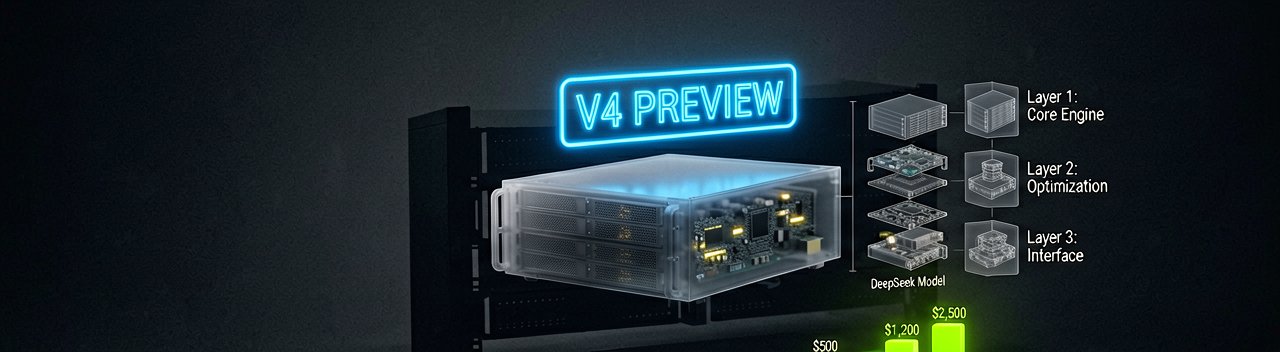
According to the official announcement from DeepSeek, the V4-Pro-Max activates 49 billion parameters per inference while V4 Flash activates 13 billion, using a mixture-of-experts architecture that selectively routes computation. This design choice directly addresses inference cost concerns (a problem that has plagued users for years, frankly).
The company's documentation states V4-Pro achieves performance "rivaling the world's top closed-source models" on reasoning and coding benchmarks. Independent analysis from Fortune confirms the models claim to outperform open-source peers while competing with OpenAI's GPT-5.4, Anthropic's Claude Opus 4.7, and Google's Gemini 3.1 Pro on specific tasks.
API pricing represents the most aggressive positioning in the current market. V4 Flash costs $0.14 per million input tokens and $0.28 per million output tokens. V4-Pro charges $1.74 per million input tokens and $3.48 per million output tokens. By comparison, GPT-5.5 charges $30 per million output tokens, while Claude Opus 4.7 charges $25 for the same volume.
Developers accessing the models through DeepSeek's official API documentation can use standard OpenAI ChatCompletions or Anthropic API formats. Both models support thinking and non-thinking modes, with the 1 million token context available across all official services. The open-source weights are hosted on Hugging Face under an MIT license, allowing local deployment and modification.
The physical reality of working with these models involves navigating chat.deepseek.com's Expert Mode or Instant Mode interfaces. Users report the 1 million token context enables loading entire codebases or lengthy documents into single prompts without the manual chunking that plagued earlier systems. The token-wise compression and DeepSeek Sparse Attention mechanisms reduce memory overhead during long-context processing.
Market reaction has been immediate. Fortune reports semiconductor manufacturer SMIC saw shares jump 10% in Hong Kong trading following the announcement, since DeepSeek trained V4 using Huawei's Ascend AI processors. Competitors MiniMax and Knowledge Atlas experienced share declines exceeding 9%.
Technical specifications reveal architectural innovations beyond parameter counts. The models incorporate novel attention mechanisms including token-wise compression and DeepSeek Sparse Attention (DSA) for efficient long-context handling. DeepSeek's tech report indicates V4 "falls marginally short of GPT-5.4 and Gemini 3.1 Pro, suggesting a developmental trajectory that trails state-of-the-art frontier models by approximately three to six months."
Open-sourcing the weights amplifies the competitive pressure on proprietary systems. Developers can download, fine-tune, and deploy the models on local hardware without API dependencies. This approach mirrors the strategy DeepSeek used with V3 and R1 in late 2024, which triggered a $1 trillion selloff in U.S. tech stocks as investors repriced AI training costs.
Existing DeepSeek API endpoints face retirement. The company announced that deepseek-chat and deepseek-reasoner will be fully retired after July 24, 2026, with current traffic routing to V4 Flash variants. Users must update their model parameters to deepseek-v4-pro or deepseek-v4-flash to maintain service continuity.
DeepSeek is reportedly pursuing a funding round valued at $20 billion, with Tencent and Alibaba as potential investors. The Financial Times suggests the capital raise aims to retain AI researchers amid poaching from other labs. This positions V4 within an increasingly crowded Chinese AI landscape, where Moonshot AI recently released Kimi K2.6 and Alibaba continues Qwen development.
Whether the pricing strategy sustains long-term profitability remains uncertain. DeepSeek expects to lower V4-Pro prices further as Huawei scales Ascend 950 processor production. The margin compression could force U.S. competitors to adjust their own pricing structures or risk losing cost-sensitive enterprise customers.
Whether users actually pay for it remains the real question.
Artūras Malašauskas is an AI Systems Integrator with 20+ years of production-grade web engineering experience. He has designed, shipped, and scaled enterprise Python/PHP systems for logistics, SaaS, and public-sector clients. For the past year, he has focused exclusively on AI integrations: deploying open-source LLMs, building generative media pipelines (image, audio, video), and engineering multi-agent workflows for real production environments. His standard: reproducibility, security, cost-efficient inference—no vaporware. He documents and evaluates emerging AI tooling, separating verified capabilities from marketing noise. Technical editor at: muza-ai.eu, ai-verslas.lt, ai-naujinos.lt Connect on LinkedIn
Comments