BDC Launches $500M LIFT Program for Small Business AI Adoption

The Business Development Bank of Canada has launched a $500-million loan program designed to accelerate artificial intelligence adoption among small and medium-sized enterprises. The federal Crown corporation unveiled the initiative, called LIFT (Lead with Innovation and Focus on Technology), on April 24, 2026, targeting more than 1,000 businesses across the country.
According to the official BDC press release, the program pairs eligible business owners with expert AI advisors and provides flexible financing to support implementation. Companies must generate at least $1 million in annual sales to qualify, regardless of sector.
Loan recipients can borrow up to $2 million for standard AI adoption projects and up to $5 million for initiatives involving physical AI, such as robotics. Borrowers will pay 2.25 per cent interest—the same as the Bank of Canada's current overnight rate—and can receive up to two years to repay the principal under certain conditions. Projects must include at least one Canadian component, whether domestically developed software, hardware, or integration services.
The timing reflects growing concern about Canada's productivity gap. BDC's own analysis pegged AI adoption at around 30 per cent among small and medium-sized businesses in 2025. Businesses that used the technology were 24 per cent more productive than those that did not. Statistics Canada reported only 12 per cent of all Canadian businesses used AI in the second quarter of 2025, with adoption heavily concentrated in larger firms and knowledge-intensive industries.

Finance and insurance businesses logged nearly 31 per cent adoption. Use among agriculture, transportation, and food services businesses remained below two per cent. The gap is widening (a problem that has plagued Canadian SMEs for years, frankly).
BDC chief operating officer Véronique Dorval explained the program's design in interviews with multiple outlets. "The main roadblock that we see for entrepreneurs is not that they don't think AI has potential," Dorval told The Gazette. "It's that sometimes they don't know where to start and how to make AI really create real benefits for their business."
Adopting AI requires more than purchasing software. Companies typically need to train staff and update internal workflows, which takes resources many entrepreneurs don't have. A 2025 OECD report cited skills shortages and financial constraints as the main barriers holding small businesses back from using AI. The LIFT program attempts to address both simultaneously through advisor pairing and subsidized financing.
The initiative arrives alongside other federal lending programs, including a $200-million Regional Artificial Intelligence Initiative and a $100-million AI Assist program. Uptake on those programs remains low, according to reporting from The Logic. BDC's research suggests if every SME matched the technological maturity of Canada's most advanced companies, GDP could grow by up to 14 per cent.
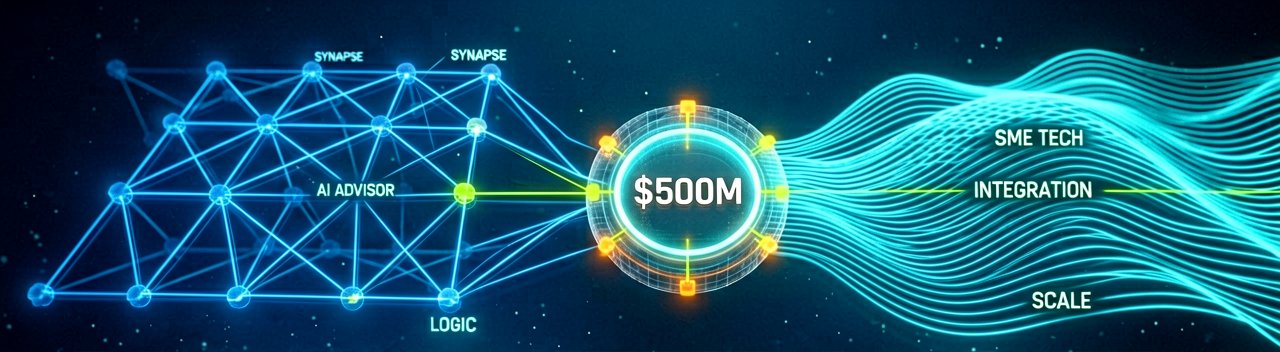
Overall SME productivity could rise by as much as 38 per cent if businesses across the country reached a very high level of digital maturity. That would reverse a decades-long struggle to keep pace with G7 peers. The physical reality of this gap shows up in daily operations—load times, manual data entry, inventory tracking done by hand instead of automated systems.
Regional adoption varies significantly. In Quebec, adoption sits at about 37 per cent. According to data from the Quebec Innovation Council in April, just two out of five Quebec companies intend to innovate in the next three years. Ontario is at a similar level, at 41 per cent, while British Columbia is slightly higher, at 46 per cent.
The program also aims to strengthen Canada's domestic tech ecosystem through preferential financing for businesses adopting Canadian-developed components. This comes amid renewed tensions with the United States ahead of a July review of the Canada-U.S.-Mexico Agreement. Prime Minister Mark Carney has described recent U.S. actions under President Donald Trump as a "rupture in the world order."
Whether users actually pay for it remains the real question. The 2.25 per cent interest rate is competitive, but the two-year principal repayment deferral only helps if businesses can absorb the operational costs of implementation. Many entrepreneurs will still face the friction of changing workflows, training staff, and integrating new systems into existing infrastructure.
BDC President and CEO Isabelle Hudon stated the goal is to "supercharge Canadian AI adoption and give SMEs a fighting chance to outpace the competition." The Honourable Evan Solomon, Minister of Artificial Intelligence and Digital Innovation, called LIFT a way to ensure "Canadian entrepreneurs lead the way—not just keep up."
Whether that optimism translates into actual adoption depends on execution. The program targets 1,000 businesses with $500 million—that's an average of $500,000 per company. Some will take the maximum $5 million for robotics projects. Others may only need $25,000 for basic software integration. The distribution will determine real impact.
For now, the infrastructure is in place. Entrepreneurs can apply through BDC's channels. The advisors are ready. The money is allocated. Whether small businesses actually move from considering AI to implementing it is the next chapter.
Artūras Malašauskas is an AI Systems Integrator with 20+ years of production-grade web engineering experience. He has designed, shipped, and scaled enterprise Python/PHP systems for logistics, SaaS, and public-sector clients. For the past year, he has focused exclusively on AI integrations: deploying open-source LLMs, building generative media pipelines (image, audio, video), and engineering multi-agent workflows for real production environments. His standard: reproducibility, security, cost-efficient inference—no vaporware. He documents and evaluates emerging AI tooling, separating verified capabilities from marketing noise. Technical editor at: muza-ai.eu, ai-verslas.lt, ai-naujinos.lt Connect on LinkedIn
Comments