Amazon Deploys 1 Millionth Robot, Launches DeepFleet AI Model
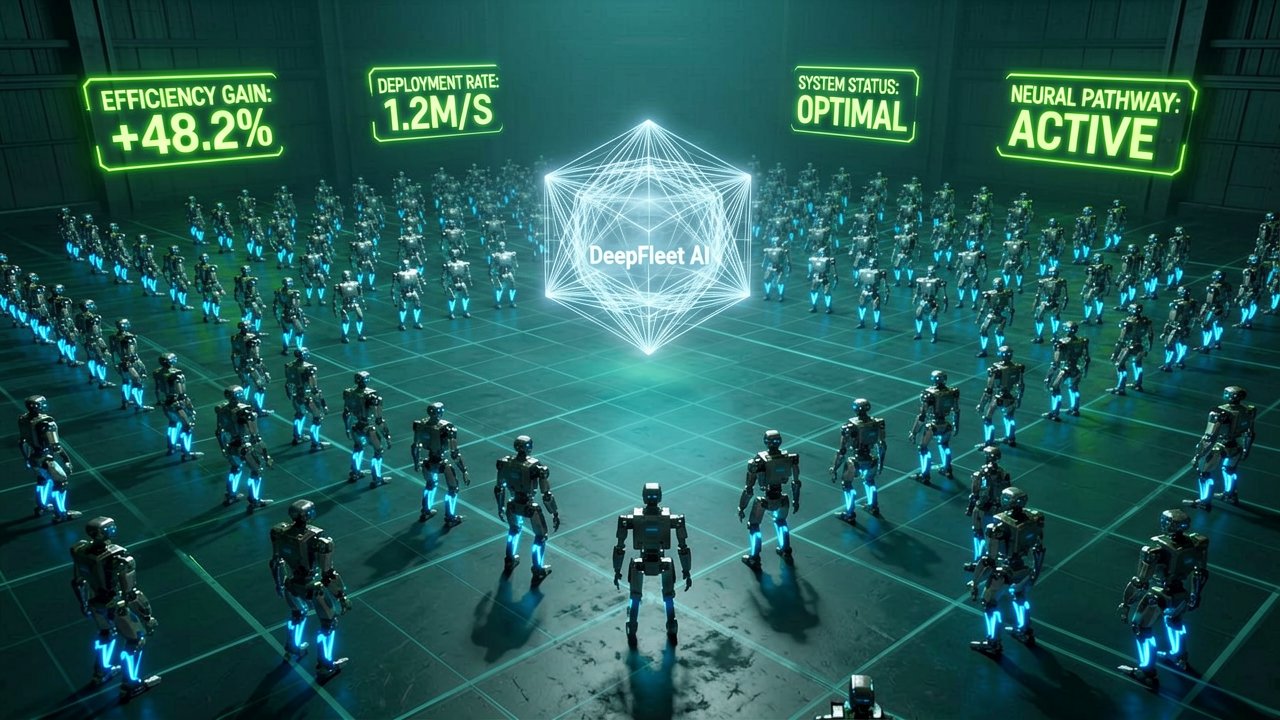
Amazon has officially deployed its one millionth robot across its global fulfillment network, marking a significant milestone in the company's robotics journey, according to an official announcement.
The milestone robot, a Hercules mobile drive unit capable of lifting 1,250 pounds, was delivered to a fulfillment center in Japan, joining a network spanning over 300 facilities worldwide. This deployment coincides with the introduction of DeepFleet, a new generative AI foundation model designed to coordinate robot movements across fulfillment centers, promising a 10% improvement in fleet travel efficiency.
DeepFleet functions as an intelligent traffic management system for warehouse robotics, optimizing paths to reduce congestion and accelerate order processing. Built using Amazon's extensive inventory movement datasets and AWS tools including Amazon SageMaker, the model leverages billions of hours of navigation data to predict and coordinate robot interactions. As Amazon Science explains, "DeepFleet can already help assign tasks to our robots and route them around potential congestion, increasing the efficiency of our robot deployments by 10%."
Amazon Robotics Chief Technologist Scott Dresser emphasized the practical approach to AI innovation, stating the technology solves real operational challenges rather than pursuing "technology for its own sake." The company's robotics journey began in 2012 with the acquisition of Kiva Systems, evolving from simple inventory-moving robots to a diverse fleet including the touch-sensitive Vulcan robots with dual arms and the fully autonomous Proteus robots that navigate open warehouse spaces.
The deployment of the millionth robot aligns with Amazon's broader strategy to integrate robotics with workforce development. The company reports having upskilled over 700,000 employees through training programs focused on robotics and AI, with its Shreveport, Louisiana fulfillment center requiring 30% more employees in reliability, maintenance, and engineering roles compared to traditional facilities.
While Amazon touts the benefits of robotics for employee safety and operational efficiency, the announcement comes amid broader industry concerns about automation's impact on employment. Per CNBC reporting, 48% of U.S. employers plan to reduce workforces due to AI adoption, and Amazon itself has cut over 27,000 jobs in recent years. However, Amazon maintains that robotics "work alongside employees, handling heavy lifting and repetitive tasks while creating new opportunities for our front-line operators to develop technical skills."
The DeepFleet model represents Amazon's adaptation of foundation model architecture to robotics coordination, drawing parallels to how large language models process sequential data. As Amazon Science notes, "Just as pretraining on next-word prediction enabled chatbots to answer a diverse range of questions, pretraining on location prediction can enable an AI to generate general solutions for mobile-robot fleets."
With its robotics network now approaching parity with human workforce numbers in fulfillment centers, Amazon's approach demonstrates how large-scale automation can coexist with workforce development. The company's emphasis on using internal data and AWS infrastructure for model training—rather than relying on third-party AI—highlights its unique position as both a robotics manufacturer and AI developer.
As Amazon continues to scale its robotic fleet, the DeepFleet model's ability to improve efficiency through continuous learning represents a practical application of generative AI in physical operations. The technology's 10% travel time reduction translates directly to faster delivery times and lower operational costs, creating tangible benefits for both customers and the company's bottom line.
Artūras Malašauskas is an AI Systems Integrator with 20+ years of production-grade web engineering experience. He has designed, shipped, and scaled enterprise Python/PHP systems for logistics, SaaS, and public-sector clients. For the past year, he has focused exclusively on AI integrations: deploying open-source LLMs, building generative media pipelines (image, audio, video), and engineering multi-agent workflows for real production environments. His standard: reproducibility, security, cost-efficient inference—no vaporware. He documents and evaluates emerging AI tooling, separating verified capabilities from marketing noise. Technical editor at: muza-ai.eu, ai-verslas.lt, ai-naujinos.lt Connect on LinkedIn
Comments