China's Honor Robot Beats Human Half-Marathon Record
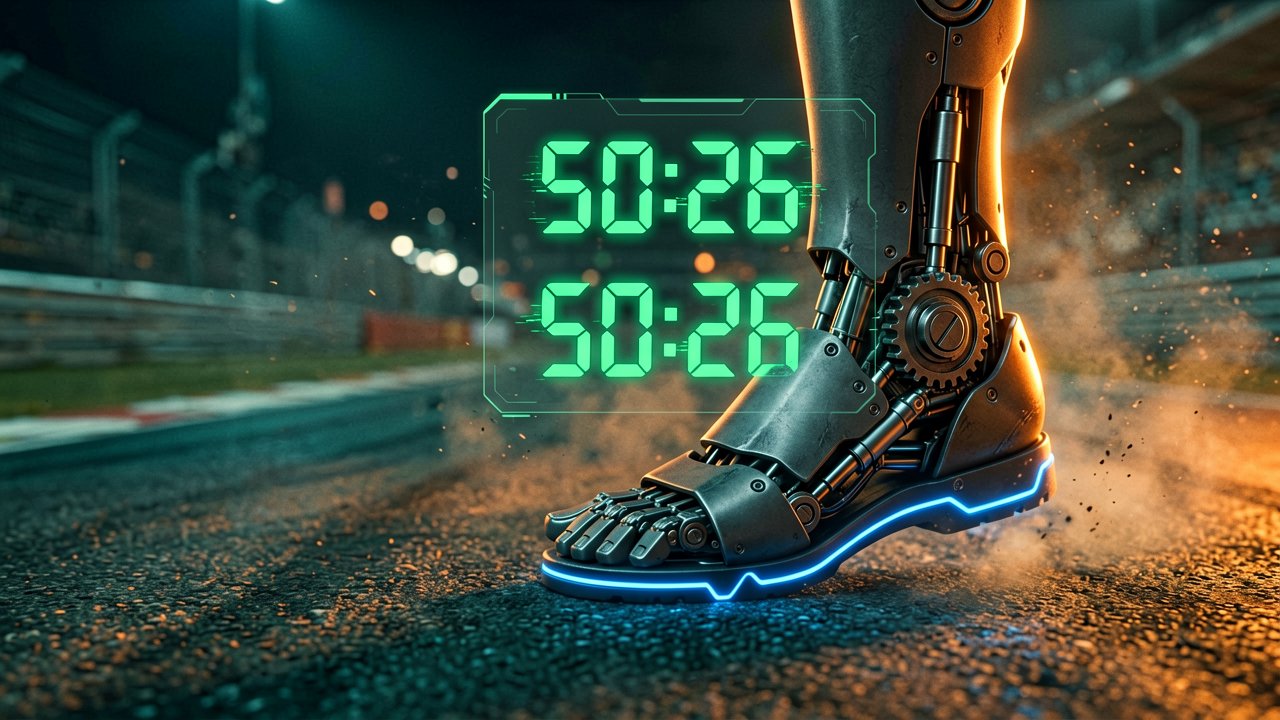
A Chinese-developed humanoid robot has achieved a significant milestone by completing a half-marathon in Beijing in 50 minutes and 26 seconds, surpassing the human world record by more than six minutes, according to a report from CNN.
The robot, named "Lightning" and developed by Chinese smartphone manufacturer Honor, finished the 21-kilometer race in Beijing on April 19, 2026, beating the human world record of 57 minutes and 20 seconds held by Ugandan runner Jacob Kiplimo, as documented by World Athletics. The robot, standing 169cm tall with bright-red coloring, demonstrated autonomous navigation and burst power that enabled it to maintain speed throughout the race without slowing down.
This achievement represents a significant leap in humanoid robotics, particularly for China, which has been actively investing in robotics as part of its broader technological strategy. China's government identified humanoid robotics as a "new frontier in technological competition" in a 2023 policy document, setting a 2025 target for mass production and secure supply chains for core components. This focus has led to a boom in robot sporting events across China, including the recent Beijing Humanoid Robot Half Marathon, which saw over 100 teams participate—nearly five times as many as the previous year's debut event.
The race featured two categories: fully autonomous robots and remote-controlled robots. Lightning, the fully autonomous robot developed by Honor's Monkey King team, won the autonomous category with a net time of 50 minutes and 26 seconds. A remotely controlled version from the same team completed the race in 48 minutes and 19 seconds, though it was subject to a 1.2x time penalty for remote control, making its adjusted time 57 minutes and 51 seconds.
China's robotics industry has accelerated significantly since 2015, when the government listed robotics as one of 10 key sectors in a blueprint for upgrading Chinese industries. This strategic focus has transformed China's reputation from being primarily known as the world's "cheap-labor factory" to becoming a significant player in advanced robotics. The recent half-marathon victory is part of a broader trend of Chinese robotics companies showcasing their capabilities through competitive events, including the world's first Humanoid Robot Games held in Beijing last year, which featured robots competing in soccer, boxing, and martial arts.
The achievement has sparked both excitement and concern among observers. While the robot's performance demonstrates remarkable progress in mobility and autonomy, it has also raised questions about the future of human-robot interaction, particularly in applications like security and public safety. Online reactions to the robot's victory included concerns about potential "robot police" and fears about human obsolescence in certain roles, as reflected in social media discussions following the event.
From a technical perspective, the robot's performance highlights key advancements in autonomous navigation, balance, and energy efficiency. The ability to complete a 21-kilometer race without significant slowdowns requires sophisticated algorithms for motion planning, energy management, and real-time environmental adaptation. The fact that the robot could maintain speed without the need for battery swaps during the race (unlike some other robots that required pit stops) suggests significant progress in power efficiency and endurance.
Industry analysts note that while this achievement is impressive, it represents a specific application rather than a general "fastest" robot. The robot's performance is optimized for a controlled race environment, not for navigating unpredictable real-world conditions. As one Reddit user noted, "The requirement that the humanoid robots that enter this race must have 2 hands, and 2 legs, and can't use wheels, etc, is a hindrance to their speed," suggesting that future improvements might be limited by these design constraints.
China's strategic investment in robotics is part of a broader effort to position itself as a leader in advanced manufacturing and automation. The country's focus on humanoid robotics aligns with its broader goals of technological self-sufficiency and reducing reliance on foreign technology. This is particularly significant in the context of the ongoing technological competition with the United States, where the U.S. has traditionally held an edge in more sophisticated humanoid models.
Looking ahead, the success of robots like Lightning in competitive events could accelerate the development of practical applications in industries such as logistics, manufacturing, and public safety. However, as with any technological advancement, the ethical and societal implications of increasingly capable humanoid robots will require careful consideration and regulation.
The half-marathon victory by Honor's Lightning robot is not just a technical achievement—it's a milestone in the evolution of human-robot collaboration. While it may not mean that robots will replace humans in all physical tasks, it does signal that we are approaching a new phase in robotics where machines can outperform humans in specific, well-defined physical challenges. This progress will likely continue to accelerate as China and other countries invest more resources into this field, with the potential to reshape industries and redefine our relationship with automation in the coming decade.
Artūras Malašauskas is an AI Systems Integrator with 20+ years of production-grade web engineering experience. He has designed, shipped, and scaled enterprise Python/PHP systems for logistics, SaaS, and public-sector clients. For the past year, he has focused exclusively on AI integrations: deploying open-source LLMs, building generative media pipelines (image, audio, video), and engineering multi-agent workflows for real production environments. His standard: reproducibility, security, cost-efficient inference—no vaporware. He documents and evaluates emerging AI tooling, separating verified capabilities from marketing noise. Technical editor at: muza-ai.eu, ai-verslas.lt, ai-naujinos.lt Connect on LinkedIn
Comments