Volkswagen Strategic Pivot: Level 3 Autonomy Deployed in Asian Markets to Bypass Western Regulatory Inertia
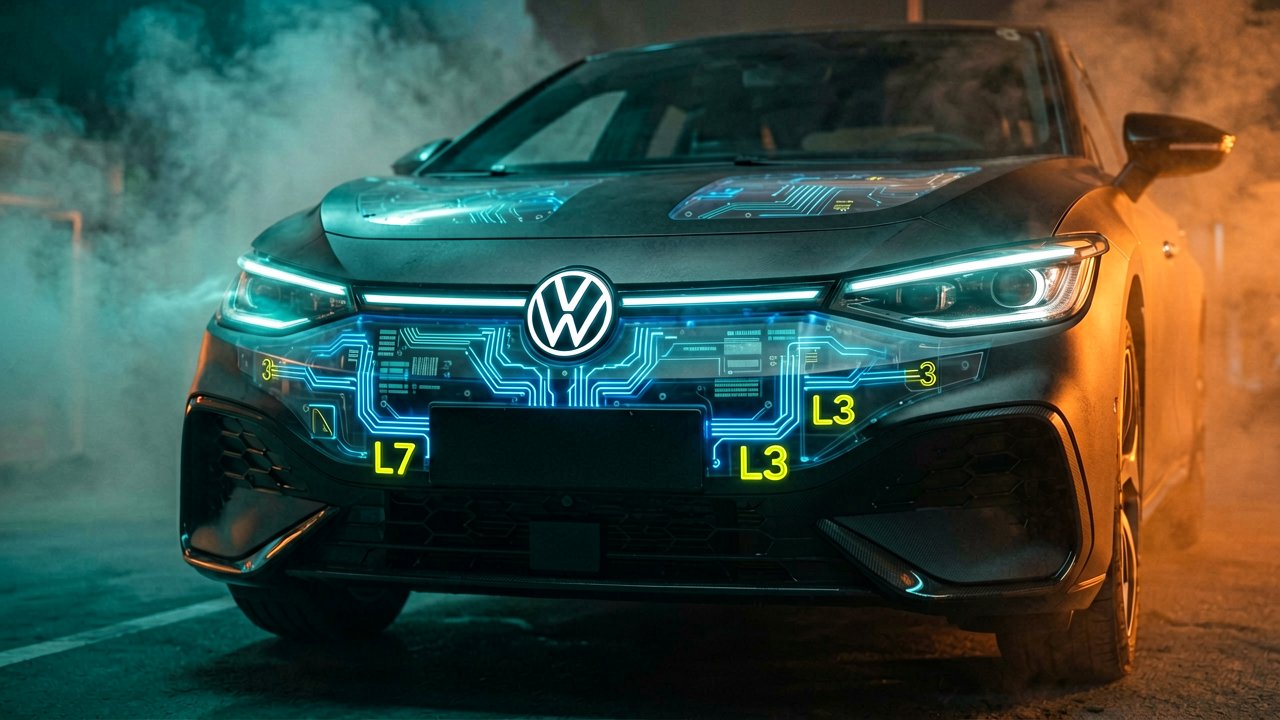
In a decisive move to counter aggressive local competition and overcome stagnant regulatory landscapes in the West, Volkswagen has officially initiated its timeline to deploy SAE Level 3 autonomous driving technology exclusively within Asian markets. This tactical shift focuses on integrating automated systems into specific non-Western vehicle models, specifically targeting commercial rollout beginning in the second half of 2027. Rather than trying to navigate the fractured and slow-moving regulatory frameworks of Europe and North America, the German automotive giant is utilizing a localized technology stack to capture rapidly expanding intelligent driving segments abroad.
The strategic deployment serves as a centerpiece for the company's regional recovery plan. Facing shrinking market shares against aggressive domestic electric vehicle manufacturers, Volkswagen is pivoting from standard European software development to a specialized "In China, for China" ecosystem. By embedding high-level autonomy directly into vehicles built outside Western jurisdiction, the brand aims to establish a benchmark for high-level intelligent driving that challenges the perception that foreign legacy automakers lag behind in software intelligence.
Localized Architectures Drive Non-Western Rollout
The implementation of Level 3 capabilities relies heavily on Volkswagen's proprietary China Electronic Architecture (CEA), developed in close collaboration with local EV manufacturer Xpeng. According to reports by Carscoops , the upcoming Level 3 automated driving technology will initially lead a rollout focused on specific models designed for regional consumers, including the ID. Unyx 06 and ID. Unyx 07. These vehicles utilize a locally developed electronic platform rather than the standard software packages built for European markets, allowing real-time scenario simulation and faster software adaptation loops.
This initiative leverages a massive joint venture investment named Carizon, which combines the resources of Volkswagen's software division, Cariad, and Chinese artificial intelligence pioneer Horizon Robotics. Detailed by the Wall Street Journal, this partnership grants Volkswagen direct access to advanced AI foundation models. This tech stack utilizes a custom-designed "C7H" system-on-chip and the "GAIA World Model" data platform to achieve the required data processing speeds for hands-off, eyes-off conditional automation.

Regulatory Divergence and Market Expansion
The decision to deploy high-level automation exclusively in Asian markets highlights a massive divergence between Western and non-Western regulatory environments. While Western consumer safety bodies maintain stringent, multi-tiered homologation frameworks that stall deployment, Asian jurisdictions have aggressively established pilot testing corridors and standardized data infrastructure. As noted by Electrive, while commercial deployment remains contingent upon local final safety validation, the tech framework is built specifically to meet flexible regulatory frameworks that allow gradual consumer activation on designated public motorways.
Furthermore, this localization strategy is not intended to remain confined to a single country. Executives note that the localized software and hardware architecture will serve as an export hub. By standardizing the automated driving stack outside of Western constraints, Volkswagen plans to seamlessly scale its Level 3 systems into secondary growth markets across Southeast Asia, Central Asia, and the Middle East, capturing the Global South before Western regulatory frameworks even mature.
The Paradox of Exporting Regional Intelligence
Reading Between the Lines: Volkswagen’s plan to use its non-Western autonomous vehicle architectures as an export hub reveals a glaring contradiction in its global identity. For decades, the brand traded on its reputation for centralized, uncompromising German engineering, setting global standards from a single core. Now, by depending entirely on joint-venture frameworks like Carizon to engineer its Level 3 capabilities, the automaker is effectively outsourcing its technological leadership to regional tech suppliers. This strategy creates a paradox where Europe's largest carmaker must rely on software stacks developed under highly specific external regulatory frameworks to remain competitive globally.
Furthermore, the assumption that this non-Western tech stack can seamlessly scale into secondary markets across the Middle East and Southeast Asia glosses over significant geopolitical and technical barriers. Autonomous driving systems are fundamentally shaped by the specific data architectures, road conditions, and local traffic behaviors of their primary testing grounds. A neural network trained on localized public highways cannot easily adapt to the infrastructure variations of other countries without extensive retraining. By fragmenting its software base into regional silos, Volkswagen risks creating an unmanageable matrix of localized codebases that could destroy the scale efficiencies legacy automakers rely on to remain profitable.

This regional segregation also creates a major challenge for the company's long-term product roadmap in Western markets. While Volkswagen uses these agile environments to accelerate its software maturity, the gap between its localized architectures and rigid Western safety frameworks continues to widen. By isolating its most advanced automated driving systems from Western validation pipelines, the automaker may find itself technologically trapped. It risks falling permanently behind domestic Western competitors who are systematically building architectures designed from the ground up to clear the strict regulatory and data-privacy hurdles of Europe and North America.
"Ultimately, the strategy of keeping your cars' best brains strictly overseas ensures that while the vehicles navigating Asian megacities are busy computing the future of mobility, the models sitting in European showrooms remain perfectly optimized to help drivers practice the ancient, analog art of paying attention."
Artūras Malašauskas is an AI Systems Integrator with 20+ years of production-grade web engineering experience. He has designed, shipped, and scaled enterprise Python/PHP systems for logistics, SaaS, and public-sector clients. For the past year, he has focused exclusively on AI integrations: deploying open-source LLMs, building generative media pipelines (image, audio, video), and engineering multi-agent workflows for real production environments. His standard: reproducibility, security, cost-efficient inference—no vaporware. He documents and evaluates emerging AI tooling, separating verified capabilities from marketing noise. Technical editor at: muza-ai.eu, ai-verslas.lt, ai-naujinos.lt Connect on LinkedIn
Comments