Hands in the High Frontier: The Military-Backed Space Mechanic is Finally Airborne
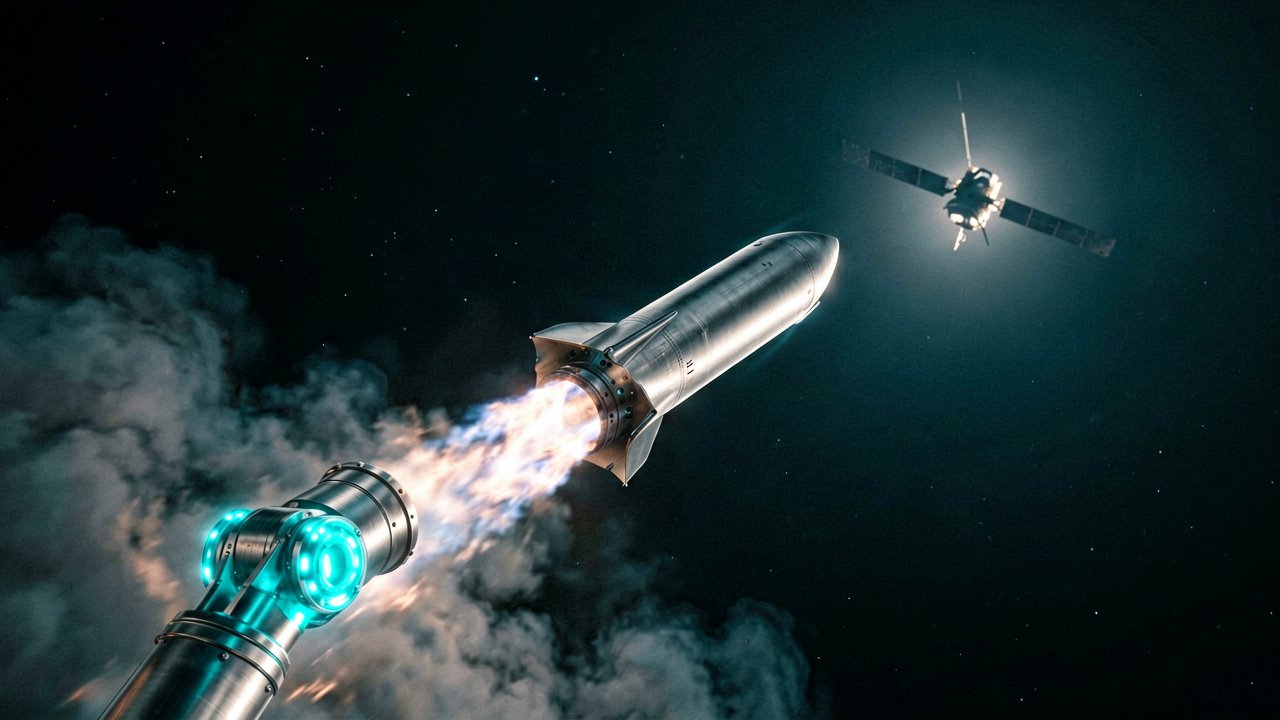
On July 21, 2026, a SpaceX Falcon 9 rocket roared off the pad at Cape Canaveral Space Force Station, carrying a payload that could fundamentally change how we maintain—and defend—our orbital hardware. Developed via a public-private tag team between DARPA and Northrop Grumman’s SpaceLogistics, the Mission Robotic Vehicle (MRV) is officially en route to geosynchronous Earth orbit. It's carrying a highly dexterous robotic servicing suite built by the U.S. Naval Research Laboratory, aiming to turn what used to be a graveyard for exhausted satellites into a dynamic, repairable high-frontier mechanics shop.
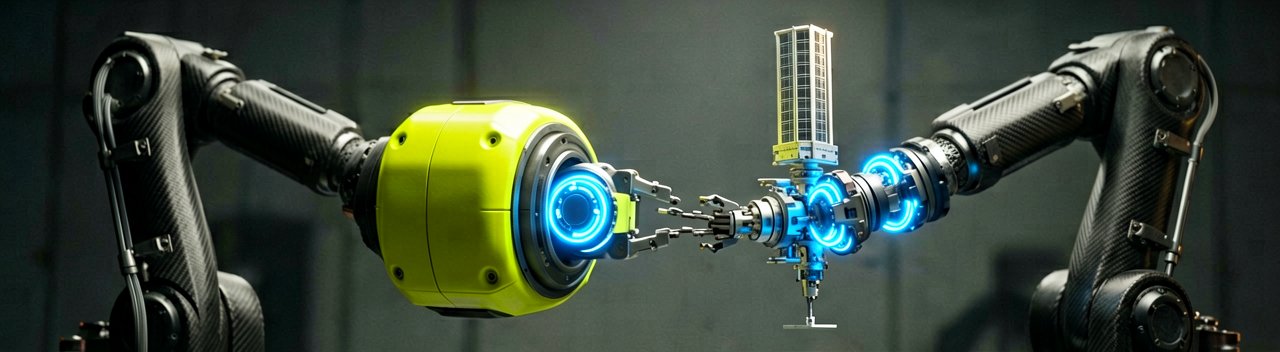
What makes this launch such a big deal isn't just the fact that it made it off the ground; it's the dual-use capability driving the technology. Ostensibly, the MRV’s primary day job is peaceful. It's designed to cozy up to aging, multimillion-dollar commercial and government communications satellites, latch on, and install "jetpack" modules known as Mission Extension Pods to prolong their operational life. But as detailed by defense analysts at The War Zone, those two fully articulated, tool-swapping mechanical arms could easily double as offensive hardware. The line between a mechanical helper that can repair an antenna and an orbital interceptor that can snap one off is razor-thin, and the U.S. Space Force has made no secret of its desire for space-based capabilities to protect assets from adversaries like Russia and China.
From Mechanics to Maneuvers
The spacecraft also debuts the first Passive Refueling Module, a newly standardized docking and refueling interface approved by the military. According to data from Northrop Grumman, this setup lets the MRV itself get refueled on orbit, meaning it won't just be a one-hit wonder; it will spend the next decade zooming between different targets. Throw in a suite of advanced onboard computer processors intended to handle future AI-driven autonomous piloting, and you've got a highly adaptable platform. While the Pentagon plans to access the vehicle primarily as a commercial resource when needed, the successful deployment signals a major pivot toward an era where military satellites are no longer static, disposable sitting ducks, but actively maintained assets in an increasingly crowded backyard.
Behind the Scenes: The realization of the Mission Robotic Vehicle is the culmination of a decade-long bureaucratic and engineering marathon that almost didn't cross the finish line. When DARPA first kicked off the Robotic Servicing of Geosynchronous Satellites program back in 2016, the agency envisioned a seamless public-private partnership. However, the initiative hit a major roadblock in 2019 when its original commercial partner, Space Systems Loral, abruptly pulled out of the project. The entire endeavor was left in limbo until Northrop Grumman’s SpaceLogistics stepped into the vacuum in 2020, restructuring the deal so that the government funded the cutting-edge robotics while private capital bankrolled the actual bus. It's a high-stakes compromise that highlights the military's growing reliance on commercial commercial-off-the-shelf space infrastructure.
By shifting to an asset-as-a-service model, the Pentagon is fundamentally rewiring how it approaches procurement in the space domain. According to program details tracked by SpaceNews , the U.S. Space Force has explicitly stated its intention to buy service time from the MRV as a commercial customer rather than owning the hardware outright. This strategy allows the military to leverage state-of-the-art robotic manipulation without assuming the full financial burden of operating the platform full-time. Meanwhile, commercial giants like Luxembourg’s SES and Australia’s Optus have already booked the vehicle's initial runs, effectively letting the commercial sector subsidize the maturation of a tool that the military can draft into strategic service at a moment's notice.
The Logistical Leap Forward
The technical sophistication required to pull off these orbital maneuvers is staggering, drawing heavily on civil spaceflight heritage. Under an interagency agreement formalized in 2024, NASA lent its extensive Hubble Space Telescope servicing expertise to the program, providing flight robot operators and advanced dynamic simulation tools to ensure the MRV’s arms don't accidentally crush the delicate targets they are meant to save. Operating a mechanical arm with micro-inch precision 36,000 kilometers above the Earth involves managing brutal signal latencies and zero-gravity dynamics. If successful, this blend of NASA expertise, DARPA funding, and commercial agility will transform geostationary orbit from a fragile, disposable frontier into a resilient, maintainable economic zone.
Reading Between the Lines: The celebratory rhetoric surrounding this launch conveniently glides over a glaring contradiction in international space policy. While the Pentagon frames the Mission Robotic Vehicle as a triumph of space sustainability and debris mitigation, the deployment of highly sophisticated, dual-use robotic arms in geostationary orbit injects a heavy dose of strategic paranoia into an already tense geopolitical climate. For years, Washington has loudly criticized Russian and Chinese "inspector" satellites for performing close-proximity maneuvers near American hardware, labeling such actions as provocative and destabilizing. By launching its own highly capable mechanic into the same orbital bands, the U.S. military is effectively normalizing the exact behavior it has spent the last decade trying to deter.
This creates a profound attribution problem for space situational awareness. If an American MRV approaches a failing commercial satellite to install a life-extension pod, it is a routine maintenance call. But if that same vehicle approaches a sensitive foreign military reconnaissance platform under the guise of an "inspection," it becomes a potential act of aggression. Because space technology is inherently dual-use, the difference between a wrench and a weapon is entirely a matter of intent. The lack of established international norms or rules of engagement for close-proximity operations means that this robotic leap forward could inadvertently accelerate the very space arms race the U.S. claims it wants to avoid.
The Reality of Orbit-Side Economics
There is also a fair share of fiscal skepticism to be applied to the commercial viability of this enterprise. Proponents argue that extending the life of a $300 million satellite is a no-brainer, but the math is changing rapidly. With the rise of mass-produced, low-cost mega-constellations in low Earth orbit, the traditional reliance on massive, prohibitively expensive geostationary behemoths is slowly giving way to more distributed, easily replaceable architectures. Spending millions to bolt a booster pod onto a decade-old satellite running on outdated processors might soon look like paying for a brand-new engine to be dropped into a 1998 sedan. The Pentagon’s bet on orbital servicing assumes a future where static geostationary assets remain the crown jewels of space architecture, a premise that modern responsive space launch capabilities are actively trying to disrupt.
It turns out that space exploration has finally entered the most human phase of its evolution, where the ultimate sign of technological maturity isn't hitting escape velocity, but realizing you still need a guy with a toolbox to go out there and whack the dashboard until the signal comes back.
Artūras Malašauskas is an AI Systems Integrator with 20+ years of production-grade web engineering experience. He has designed, shipped, and scaled enterprise Python/PHP systems for logistics, SaaS, and public-sector clients. For the past year, he has focused exclusively on AI integrations: deploying open-source LLMs, building generative media pipelines (image, audio, video), and engineering multi-agent workflows for real production environments. His standard: reproducibility, security, cost-efficient inference—no vaporware. He documents and evaluates emerging AI tooling, separating verified capabilities from marketing noise. Technical editor at: muza-ai.eu, ai-verslas.lt, ai-naujinos.lt Connect on LinkedIn
Comments