Robots on the Beat: Indian Railways deploys AI Rover to Patrol High-Footfall Transit Hubs
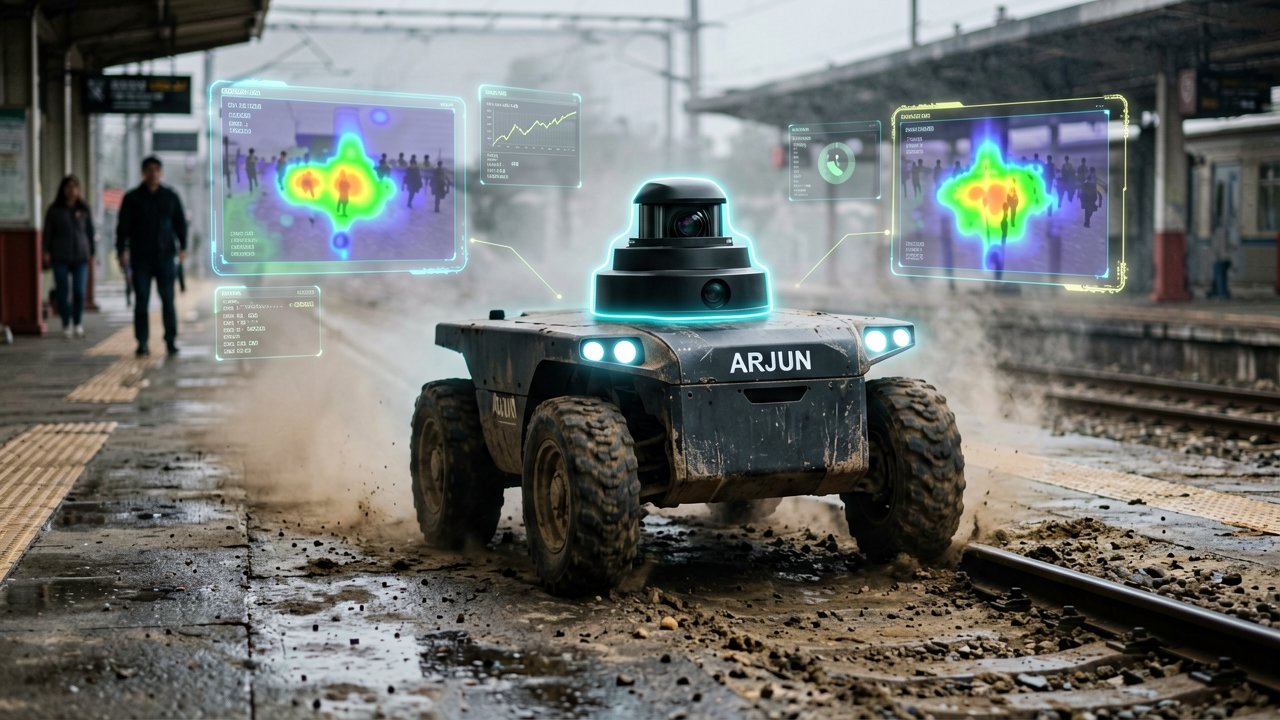
The intersection of public safety and autonomous robotics just took a massive leap forward in India. In a bid to reinforce terminal security and manage swelling holiday crowds, the East Coast Railway (ECoR) officially deployed DSC ARJUN, a highly sophisticated, AI-powered robotic security platform. Unveiled on July 22, 2026, by senior officials alongside the Railway Protection Force (RPF), this multi-terrain autonomous rover is engineered to act as an intelligent force multiplier in critical infrastructure environments. The initial rollout targets high-density traffic areas, making its immediate debut at Puri Railway Station to bolster security for the upcoming Bahuda Yatra festival before transitioning to a permanent post at Bhubaneswar Railway Station, according to updates tracked by The Economic Times.
While standard closed-circuit cameras offer a passive gaze, DSC ARJUN introduces a proactive layer of edge-computed threat detection. Officially standing for Dedicated Security Chassis Advanced Railway Junction Under Network Enabled Surveillance, the platform is crammed with deep-tech frameworks including advanced computer vision, machine learning, and Internet of Things (IoT) connectivity. Rather than waiting for a remote operator to notice an anomaly, the rover roams concourses, platforms, and parcel offices to analyze crowd density, log passenger counts, and trigger instant alerts if baggage is left unattended. It's a fascinating look at how automation can alleviate the cognitive load on human security forces when scanning thousands of faces in real time.
A Layered Ecosystem of AI and Machine Learning
From an engineering perspective, the hardware architecture is built to withstand the chaotic, high-temperature variables of a major railway transit station. Security officials confirmed that the unit features an integrated Face Recognition System (FRS) that matches imagery against known security databases, delivering immediate pings to RPF control rooms. Beyond its defensive metrics, the robot features autonomous navigation with active obstacle avoidance, alongside environment-sampling sensors capable of detecting fire or smoke long before traditional ceiling-mounted alarms might trip. To ensure it doesn't alienate the public, the platform delivers real-time public address announcements in regional languages including Odia, Hindi, and English, matching its security posture with clear public utility.
The Evolutionary Path of Robotic Policing
This deployment isn't a flash-in-the-pan experiment; it represents the next step in a multi-year technological roadmap for Indian public infrastructure. The lineage of this platform dates back to the pandemic-era "Captain ARJUN" rolled out by Central Railways in 2020, followed by the humanoid variant "ASC ARJUN" deployed at Visakhapatnam earlier this year, as reported by My City Links. However, where previous iterations leaned on stationary or highly restricted paths, the DSC ARJUN’s chassis design focuses heavily on mobility across varied terminal terrains like parking areas and ticket halls. As municipal frameworks globally grapple with the logistics of monitoring massive public spaces, ECoR's rolling AI guard provides a concrete blueprint for autonomous, algorithmic policing in the real world.

Behind the Scenes: The Engineering Bottlenecks and Jurisdictional Shifts of Algorithmic Rail Security
While the promotional rollouts present a seamless vision of autonomous policing, the actual integration of DSC ARJUN into the daily friction of India’s busiest railway hubs is a masterclass in edge-computing logistics. Veteran station managers point out that a railway platform is one of the most hostile environments for an autonomous robot. The air is thick with high-frequency electromagnetic interference from overhead traction wires, floors are routinely slick or littered with debris, and the sheer density of human traffic creates an unpredictable, non-Newtonian fluid dynamic of movement. For the engineers behind the Dedicated Security Chassis, the true victory isn't the AI model itself, but the chassis' ability to recalculate navigation paths fifty times a second without colliding with a rushing passenger or tumbling onto the tracks.
The transition from the 2020 pandemic-era "Captain ARJUN"—which was largely a glorified, stationary thermal screening kiosk—to this multi-terrain rover highlights a massive shift in strategic philosophy. Early iterations relied heavily on cloud connectivity, rendering them virtually useless when entering the subterranean corridors or dead zones typical of older colonial-era station architecture. DSC ARJUN circumvents this by shifting its primary computational load directly to the machine's localized hardware. By processing facial recognition models and anomaly detection algorithms at the edge, the rover maintains operational integrity even when completely severed from the station’s central Wi-Fi network, storing telemetry locally until a secure handshaking connection is re-established.
This autonomy has fundamentally altered the day-to-day workflow of the Railway Protection Force. Rather than replacing human personnel, the platform acts as a digital filter for the hundreds of thousands of data points generated every hour. RPF officers note that human operators monitoring a wall of a hundred CCTV screens experience cognitive fatigue within twenty minutes, often missing subtle anomalies like a backpack left under a bench or an individual loitering near restricted parcel zones. The rover standardizes this baseline surveillance, autonomously flagging only high-probability threats to human dispatchers, effectively transforming the RPF from passive observers into targeted, data-driven responders.
However, the deployment has triggered quiet but intense debates among civil liberties advocates and transit legal experts regarding privacy in public infrastructure. The integration of a mobile Face Recognition System that actively cross-references civilian crowds against criminal databases operates in a regulatory gray zone. Unlike fixed cameras that passengers can theoretically avoid, a mobile AI rover actively pursues spatial coverage, making consent impossible to navigate. While railway officials emphasize that the database is strictly limited to active, vetted security threats, tech policy analysts warn that without robust, transparent data-deletion protocols, these rovers risk turning public transit hubs into permanent, dragnet surveillance zones.

Looking at the broader horizon, East Coast Railway’s aggressive rollout is being closely watched by municipal transit authorities across Asia and Europe. The economic argument for the DSC ARJUN framework extends far beyond simple security. By combining environmental sensors that detect structural fires, chemical leaks, and rolling stock anomalies with standard security policing, the platform amortizes the immense cost of deep-tech development across multiple municipal departments. If the Puri and Bhubaneswar deployments prove that a single chassis can reliably lower response times while surviving the brutal operational wear-and-tear of the Indian summer, the age of the algorithmic station master will rapidly become the global standard.
Reading Between the Lines: The Friction Between Silicon Valley Optics and Platform Realities
The institutional enthusiasm surrounding the DSC ARJUN deployment masks a fundamental contradiction in how modern public infrastructure approaches security. Railway administrations love the optics of high-tech robotics because a rolling, sleek AI rover signals modernization to the public far more effectively than upgrading legacy signaling systems or fixing broken station plumbing. Yet, there is a gaping disconnect between the sterile, algorithmic environments where these machines are trained and the unpredictable chaos of a standard Indian transit terminal. While the rover's object-detection models can easily identify a classic leather briefcase left sitting neatly on a bench, they face a steep learning curve when tasked with identifying an anomalous threat among the sprawling, irregular bundles of textiles, oversized cardboard boxes, and improvised baggage that define domestic transit commerce.
This raises the uncomfortable question of false positives and the systemic friction they introduce to emergency response workflows. In a high-footfall environment like Bhubaneswar or Puri during a major festival, the line between an "unattended package" and a family momentarily stepping away to buy food is razor-thin. If the AI's sensitivity parameters are set too high, the RPF risks being buried under a mountain of false alarms, leading to alarm fatigue that could cause officers to ignore legitimate alerts. Conversely, dialing down the sensitivity to prevent operational gridlock renders the platform's core security value proposition moot, turning an expensive piece of autonomous engineering into little more than a mobile public relations stunt.
Furthermore, the long-term maintenance of deep-tech hardware in tropical, dust-heavy transit environments remains an unproven gamble. Autonomous vehicles rely heavily on complex arrays of LiDAR sensors, stereoscopic cameras, and exposed ventilation ports to keep their localized processors cool. The fine iron dust generated by train braking systems, combined with extreme ambient humidity and ambient temperatures that regularly cross forty degrees Celsius, creates a uniquely corrosive cocktail for delicate optoelectronics. History is littered with smart city initiatives that quietly decommissioned their robotic fleets within two years because the specialized maintenance costs outpaced the budgetary realities of public utility departments.
Ultimately, the true metric of success for DSC ARJUN will not be found in press releases or successful pilot runs during orchestrated festivals, but in its ability to navigate the mundane, daily grind without becoming a liability. If autonomous rovers are to become a permanent fixture of public safety, transit agencies must move past the novelty factor and treat them as standard utility hardware. Until then, these platforms remain a fascinating but fragile bridge between the idealized promises of the artificial intelligence boom and the unyielding, gritty reality of public infrastructure.
It seems the ultimate test for the future of robotic policing isn't outsmarting sophisticated security threats, but simply surviving a Friday evening rush hour without being accidentally toppled into the tracks by a commuter frantically chasing the 18:15 express.
Artūras Malašauskas is an AI Systems Integrator with 20+ years of production-grade web engineering experience. He has designed, shipped, and scaled enterprise Python/PHP systems for logistics, SaaS, and public-sector clients. For the past year, he has focused exclusively on AI integrations: deploying open-source LLMs, building generative media pipelines (image, audio, video), and engineering multi-agent workflows for real production environments. His standard: reproducibility, security, cost-efficient inference—no vaporware. He documents and evaluates emerging AI tooling, separating verified capabilities from marketing noise. Technical editor at: muza-ai.eu, ai-verslas.lt, ai-naujinos.lt Connect on LinkedIn
Comments