The Architecture of Accuracy: Why Enterprise AI is Pivoting to Specialized Vertical Models

The initial corporate rush to adopt general-purpose artificial intelligence has hit a definitive structural bottleneck. While horizontal large language models dazzled the public with broad conversational abilities, enterprise implementations have increasingly faltered when confronted with highly regulated environments and nuanced corporate workflows. Recent data published by Towards AI reveals that while horizontal AI adoption was initially swift, only 23% of organizations successfully managed to scale those generic agents due to operational performance gaps. In high-stakes environments like finance and legal compliance, generic algorithms frequently predict the most mathematically probable word rather than the factually correct one, presenting massive financial and operational risks.
This reality has triggered a profound shift toward vertical AI architectures, which are purpose-built for specific industries and isolated workflows. Rather than relying on a single omniscient foundation model, corporations are building and buying specialized systems trained on domain-specific data. Analysis by ACTG Systems highlights that market forecasts from analysts at Gartner and McKinsey point to more than 40% of enterprise AI deployments shifting to vertical-first systems. Driven by the necessity for predictable, audit-ready performance, this migration is rapidly transforming how the enterprise technology layer is built, budgeted, and commercialized.
The Factual Gap and the Failure of Horizontal Systems
The core limitation of horizontal models lies in how they process dense, specialized corporate data. Because general-purpose platforms are trained on massive, unstructured public datasets, they lack the contextual nuance required to manage overlapping compliance frameworks. Academic and corporate tracking compiled by Dydon AI indicates that standard general-purpose AI tools achieve roughly 52% factual correctness when auditing financial documents, whereas domain-optimized systems reach an accuracy rate of 94%. In industries governed by strict compliance mandates, a 48% error rate is not simply a minor operational hurdle; it is a disqualifying risk profile.
When generalist models encounter highly localized jargon or complex regulatory frameworks, they fill the structural information gaps with plausible-sounding but entirely fabricated information. Vertical models eliminate this fundamental vulnerability by restricting the conceptual scope. According to structural insights from DigiWagon , deploying a specialized architecture combined with domain-aware Retrieval-Augmented Generation (RAG) can shrink error rates from an average of 20% down to under 2% in critical corporate workflows. By embedding specific regulatory parameters directly into the model's training pipeline and validation architecture, companies ensure that outputs remain traceable to verified sources.

Regulatory Pressure and the Rise of Mandatory Compliance
The migration toward specialized AI is further accelerated by an evolving legal landscape that penalizes opaque system designs. Regulatory bodies worldwide are actively transitioning from broad policy frameworks to aggressive enforceability. As detailed by The CAIO Hub, enterprise risk compliance has transitioned into a strict commercial launch requirement, meaning organizations can no longer deploy production-level AI without providing auditable evaluation packs, model cards, and transparent risk testing data. Because generalist engines often rely on closed, untraceable data loops, they cannot provide the precise audit trails required by modern corporate legal teams.
Consequently, specialized compliance models are becoming core corporate infrastructure. Market data from Marketintelo shows that the global market for AI-governed enterprise communications compliance platforms is expanding rapidly, reflecting a massive shift in corporate spending toward automated, highly targeted monitoring systems that can operate across institutional workflows while adhering strictly to regional financial regulations. This shift ensures accountability at the system level rather than relying on standard vendor liability disclaimers.
The Strategic Pivot for Enterprise Software Vendors
This industrial evolution has completely upended the economics of artificial intelligence development, altering how tech firms protect their market valuation. Building a larger foundational model no longer yields an automatic competitive advantage, as raw intelligence is increasingly commoditized. Instead, enterprise differentiation has moved directly to the integration and intelligence layer. Vendors that once focused on creating flexible, all-purpose digital helpers are rapidly pivoting to design highly constrained, vertical software integrations that resolve industry-specific bottlenecks.
This operational pivot is heavily reflected in how enterprise software is purchased and valued. As reported by Presta, vertical AI platforms are succeeding by establishing unique data moats through deep, industry-specific knowledge graphs that horizontal systems cannot easily replicate. Furthermore, companies are moving away from unpredictable token-based compute pricing and toward value-based commercial agreements. By tying AI investments directly to specific compliance outcomes and operational efficiency metrics, the enterprise market is rewarding tech providers that build highly specialized, surgically precise vertical tools over broad generalist promises.
Inside the Architectural Pivot: What the Executive Briefings Miss
Beneath the Boardroom Rhetoric: The foundational miscalculation of the early enterprise generative AI boom was treating artificial intelligence as a general utility like electricity or cloud storage, rather than an expert professional. Initial procurement strategies assumed that a larger parameter count naturally translated to better institutional performance. However, corporate tech stacks are not built on generalized reasoning; they are built on hyper-specific protocols, proprietary terminology, and highly isolated databases. When early enterprise adopters deployed horizontal systems to parse multi-layered contracts or automate intricate supply chain logs, they discovered that these systems possessed vast, shallow knowledge but entirely lacked the deep structural context required to execute a single, highly regulated operational task safely.
This operational friction has triggered an internal battle within corporate technology teams. While chief executive officers frequently push for broad, transformative automation to appease market shareholders, chief information officers and general counsels are quietly holding the line against the risks of unverified data loops. A generic model operating on public-internet training data cannot distinguish between a minor contractual variation and a catastrophic regulatory violation without massive, expensive fine-tuning. This realization has shifted engineering priorities from prompt engineering to architectural isolation. Technologists are increasingly recognizing that it is far more cost-effective to deploy an agile, domain-specific model optimized via specialized Retrieval-Augmented Generation than it is to continuously patch a massive, unpredictable foundation model.
The commercial reality is that enterprise value has officially migrated from the foundational model layer to the proprietary data moat. Venture capital and corporate development budgets are no longer flowing to generic software providers promising all-in-one digital workforce transformations. Instead, investment is aggressively targeting software companies that possess deep, exclusive relationships with vertical industry platforms, such as specialized electronic health record systems or localized financial clearing houses. These niche integrations allow specialized models to process high-fidelity industry data that generalist tech firms cannot scrape from the open web, establishing a defensible competitive advantage rooted in sheer accuracy.
Looking ahead, this transition will fundamentally alter corporate talent acquisition and software procurement strategies over the next several years. Organizations are moving away from hiring general prompt engineering consultants and are instead embedding specialized domain experts directly into their software development lifecycle teams. Medical professionals, legal scholars, and industrial logistics managers are increasingly tasked with curating training datasets and establishing localized validation parameters. This collaborative evolution ensures that artificial intelligence transitions from a speculative, error-prone conversational novelty into a rigorously audited, production-grade enterprise utility capable of operating autonomously within strict regulatory parameters.
The Hidden Overhead of Hyper-Specialization
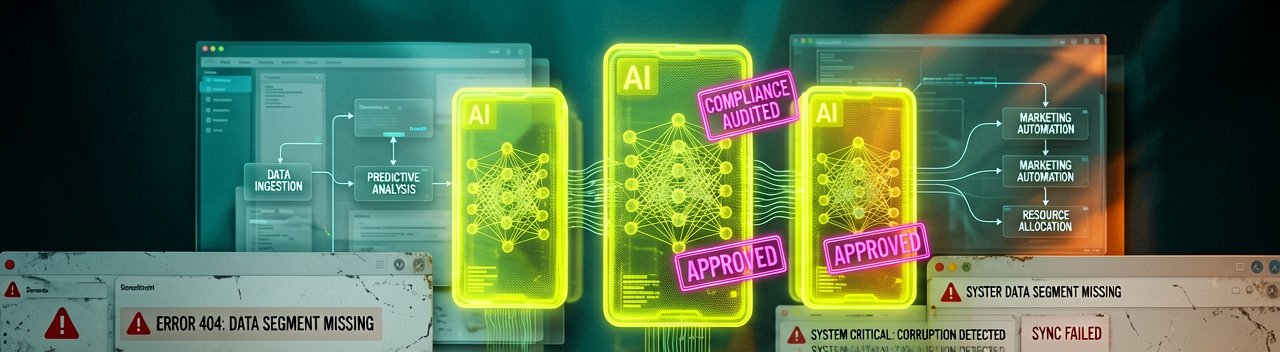
Reading Between the Lines: The collective enterprise rush toward vertical AI models is frequently framed as a frictionless path to operational absolute certainty, yet this narrative oversimplifies a highly complex engineering reality. The prevailing assumption that specialized models inherently solve the compliance and accuracy dilemma overlooks the structural fragmentation it introduces to the corporate tech stack. Swapping out a single, generalized foundation model for dozens of highly siloed, niche industry applications introduces a massive integration overhead. Enterprises risk recreating the exact legacy software traps they spent the last two decades dismantling: a disorganized network of isolated, single-use platforms that cannot communicate with one another, resulting in high maintenance costs and fractured data governance.
Furthermore, the tech industry's sudden embrace of "data moats" as the ultimate defense mechanism contains a glaring economic contradiction. While software vendors aggressively market their deep integration with proprietary industry datasets, the long-term utility of that data remains highly volatile. Regulatory frameworks are moving targets, and the specialized datasets used to train a niche model today can quickly become obsolete or legally compromised tomorrow. This creates an ongoing, capital-intensive cycle of retraining and re-validation. Enterprise buyers who pivoted to vertical AI to escape the unpredictable API token pricing of horizontal giants are now discovering that they have simply traded variable computing costs for spiraling engineering fees required to keep specialized models current.
This shift also exposes a critical vulnerability in the vendor ecosystem, particularly for smaller, industry-specific AI startups. Many of these specialized platforms are not actually building distinct, ground-up architectures; instead, they are merely operating as highly polished custom interfaces layered on top of the very horizontal foundation models they claim to replace. If a major foundational vendor updates its core algorithm or shifts its enterprise pricing model, the thin margins of these dependent vertical providers can vanish overnight. For corporate buyers, this reality necessitates a highly skeptical vetting process to determine whether a vendor owns a genuinely isolated, specialized asset or is simply re-selling a repackaged version of a mass-market commodity.
Ultimately, the fragmentation of the AI market means that the promised land of total automation will likely remain an elusive milestone for the foreseeable future. Instead of achieving seamless, autonomous execution, enterprises are transitioning into an era of digital oversight, where human workers spend less time generating content and far more time auditing the highly specialized outputs of competing internal systems. The true bottleneck to enterprise AI adoption was never a lack of generalized reasoning capability, but rather the hard reality that corporate workflows require an absolute standard of accuracy that automated systems can approximate, but never fully guarantee on their own.
"The corporate tech stack has achieved its ultimate evolution: we have successfully replaced the generalist intern who guessed the answers with a network of expensive, highly specialized digital consultants who argue with each other over the exact definition of the footnotes, leaving the human executive to fix the spreadsheet anyway."
Artūras Malašauskas is an AI Systems Integrator with 20+ years of production-grade web engineering experience. He has designed, shipped, and scaled enterprise Python/PHP systems for logistics, SaaS, and public-sector clients. For the past year, he has focused exclusively on AI integrations: deploying open-source LLMs, building generative media pipelines (image, audio, video), and engineering multi-agent workflows for real production environments. His standard: reproducibility, security, cost-efficient inference—no vaporware. He documents and evaluates emerging AI tooling, separating verified capabilities from marketing noise. Technical editor at: muza-ai.eu, ai-verslas.lt, ai-naujinos.lt Connect on LinkedIn
Comments