Beyond the Factory Floor: UBTech’s Lifelike Humanoids Shift AI Companionship into Reverse-Engineering Human Emotion
For years, the robotics industry promised us autonomous helpers that would scrub our floors and fold our laundry, yet the actual market evolution is taking a far more intimate turn. On June 30, 2026, Chinese robotics heavyweight UBTech flipped the script at its global launch event in Shenzhen by officially unveiling the UWORLD U1 series—the world's first full-size, ultra-bionic humanoid robots optimized strictly for mass production and domestic companionship. Rather than obsessing over factory payloads or heavy industrial lifting, this new lineup pivots entirely toward addressing social isolation through hyper-realistic physical designs and local emotional intelligence.
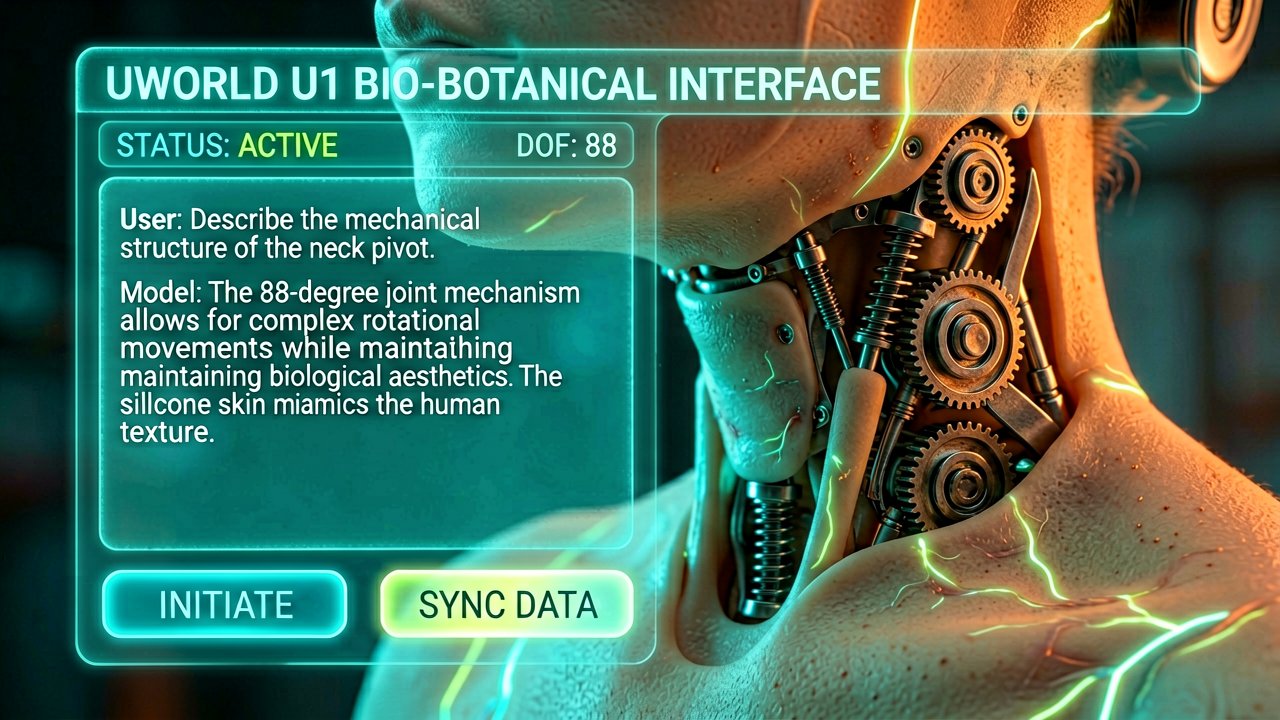
The U1 line signals a significant departure from standard mechanical aesthetics, arriving in life-sized male and female variants that stand up to 183 centimeters tall. Wrapped in a sophisticated biomimetic silicone skin featuring simulated blood vessels, pores, and fingerprints, the hardware relies on 88 degrees of freedom and a dual-pivot cervical spine to mirror roughly 90 percent of fundamental human movements. This mechanical fluidity is paired with an on-board "emotional large language model" engineered by UBTech to decode real-time vocal context and facial expressions without traditional wake words, achieving a claimed 90 percent accuracy rate across more than 20 fine-grained emotional states.
The Price of Empathy and Local Privacy
Stepping out of the laboratory and into consumer reality comes with a heavy dose of luxury market pricing. According to detailed reporting from the South China Morning Post, the U1 series spans from a basic torso "Lite" model starting at 119,800 yuan (approximately $17,650) to a highly dynamic full-body "Ultra" tier that maxes out at a staggering 990,000 yuan. To quell localized surveillance anxieties, the androids handle their processing locally using Rockchip’s RK3588 chipsets, storing user interaction history directly on the device rather than offloading psychological profiles to a vulnerable corporate cloud network.
While Western players like Tesla and Figure AI remain intensely focused on automating logistics warehouses and manufacturing assembly lines, Chinese firms are rapidly targeting the domestic sphere. The immediate market response highlights an intense cultural appetite for artificial companionship, with UBTech securing over 13,300 pre-orders right at launch, with initial consumer deliveries scheduled to begin this September. As demographic shifts continue to alter domestic life, the leap from industrial tool to emotional confidant may well redefine what it means to coexist with artificial intelligence.

What Most Reports Miss: The race to commodify loneliness isn't just a pivot in marketing strategy; it is an aggressive hardware hedge against a cooling industrial robotics market. For the past half-decade, companies like UBTech built their valuations on the promise of automating automotive assembly lines and warehouse logistics. However, as factory floors across Asia reach peak automation thresholds and hardware margins compress, the consumer domestic sector represents the last great untapped frontier for multi-billion-dollar robotics firms looking to justify their massive R&D overhead.
Industry insiders point out that building a robot for a living room presents an entirely different matrix of engineering headaches compared to a controlled factory setting. In a manufacturing plant, a humanoid operates within a highly predictable, geofenced zone where variables are strictly managed. In contrast, a middle-class home is a chaotic obstacle course filled with unpredictable pets, loose rugs, scattered toys, and erratic human movements. UBTech’s reliance on 88 degrees of freedom isn't just for aesthetic fluidness; it is a structural necessity to keep a 150-pound metal and silicone frame from accidentally tipping over onto a toddler or crashing into a glass coffee table.
The cultural backdrop of this rollout explains why China is serving as the primary incubator for this technology. Facing a rapidly aging demographic and a shrinking marriage rate, the country is grappling with an unprecedented social isolation epidemic. Skeptics argue that substituting genuine human relationships with 990,000-yuan bionic companions is an dystopian band-aid on a profound societal wound. Sociologists warn that normalizing artificial affection could create a feedback loop where individuals lose the patience required for navigating real, messy human relationships, opting instead for a perfectly compliant, programmed algorithmic partner.
The Ethical and Biological Frontier
Beyond the societal implications lies a deeply unsettling philosophical frontier regarding the illusion of consciousness. By utilizing an emotional large language model that reads micro-expressions, these units simulate empathy through advanced pattern recognition rather than genuine feeling. Ethicists are already raising alarms about the potential for psychological manipulation, as a local AI that knows exactly how to comfort an isolated senior citizen or an anxious professional holds immense sway over its user's daily habits, purchasing decisions, and emotional well-being.

The manufacturing complexity of the biomimetic silicone skin also introduces long-term maintenance challenges that early adopters are rarely prepared to face. Unlike a smartphone that sits safely in a pocket, a companion robot’s outer layers are subjected to constant friction, temperature fluctuations, and physical contact. Maintaining the illusion of life requires specialized care, and internal industry documents suggest that these ultra-lifelike skins may require complete replacement every twenty-four to thirty-six months due to material degradation, creating an ongoing, expensive subscription to physical realism.
Ultimately, UBTech's major market move forces a reassessment of what humanity actually wants from the robotics revolution. The technical achievement of keeping data processed locally on Rockchip chipsets proves that privacy can coexist with advanced AI, yet it does not solve the fundamental tension of mechanical intimacy. As the first wave of U1 series androids prepares to enter homes this autumn, the true test will not be whether they can balance on two legs or track a smile, but how comfortably humanity can look into a pair of synthetic eyes and accept a manufactured comfort.
Reading Between the Lines: The breathless narrative surrounding the UWORLD U1 series positions these machines as the definitive cure for modern loneliness, yet this claim ignores a glaring economic contradiction. With premium full-body models priced equivalent to a luxury metropolitan apartment, the technology is fundamentally restricted to an ultra-wealthy elite. The demographic suffering most acutely from social isolation—pensioners on fixed incomes and overworked young professionals—are precisely the groups priced entirely out of UBTech's ecosystem, transforming an ostensible humanitarian breakthrough into an exclusive status symbol for the affluent.
Furthermore, the tech industry’s sudden pivot toward prioritizing local data privacy via on-board Rockchip processing deserves a healthy dose of skepticism. While keeping emotional profiles off the cloud shields users from standard server-side hacks, it creates a goldmine of highly sensitive behavioral data sitting on a physical asset in a residential home. The physical security of a robot that logs every vocal inflection, household routine, and personal vulnerability becomes a critical vulnerability, as a localized compromise could allow bad actors to weaponize a user's psychological blueprint directly within their living space.
This push for physical realism also highlights a structural disconnect between what consumers think they want and how human psychology actually operates. Robotics history is littered with projects that fell face-first into the "uncanny valley," where machines that look almost human trigger profound feelings of revulsion. By engineering robots with simulated blood vessels and fingerprints, UBTech is gambling that hyper-realism will foster affection, yet the slightest mechanical stutter or algorithmic delay across 88 degrees of freedom risks transforming a comforting presence into a deeply unsettling, housebound horror.
The Autonomous Dependency Loop
Projecting into the next decade, the widespread integration of domestic humanoids threatens to reshape the labor economics of elder care and domestic service. Governments facing severe labor shortages may view these commercial androids as a convenient excuse to underfund social safety nets, opting to subsidize mechanical caretakers rather than investing in human-centric healthcare infrastructure. This shift risks creating a stratified society where the poor are left with unyielding automated care, while genuine human attention becomes a luxury reserved only for those who can afford it.
Over-reliance on synthetic companions could also permanently alter human emotional development, particularly for younger generations growing up alongside them. An AI companion that is fundamentally programmed to never argue, never push back, and always provide validation offers a frictionless alternative to real-world social interaction. Spending years interacting with a perfectly compliant machine may leave users emotionally fragile, utterly unequipped to handle the inevitable conflicts, compromises, and rejections that define genuine human relationships.
"We went looking for an artificial intelligence that could finally master the complex art of human empathy, and instead, we built an incredibly expensive, six-foot-tall mirror that is legally obligated to laugh at all of our jokes."
Artūras Malašauskas is an AI Systems Integrator with 20+ years of production-grade web engineering experience. He has designed, shipped, and scaled enterprise Python/PHP systems for logistics, SaaS, and public-sector clients. For the past year, he has focused exclusively on AI integrations: deploying open-source LLMs, building generative media pipelines (image, audio, video), and engineering multi-agent workflows for real production environments. His standard: reproducibility, security, cost-efficient inference—no vaporware. He documents and evaluates emerging AI tooling, separating verified capabilities from marketing noise. Technical editor at: muza-ai.eu, ai-verslas.lt, ai-naujinos.lt Connect on LinkedIn
Comments