LG Electronics Establishes CEO-Led Robotics Business Center to Accelerate Physical AI
LG Electronics is shifting its automation strategy into overdrive. On June 30, 2026, the South Korean tech giant announced an off-cycle organizational realignment to establish a dedicated Robotics Business Center reporting directly to the CEO. By bypassing its traditional year-end restructuring timeline by four months, the company is signaling just how urgently it wants to secure a dominant foothold in the rapidly evolving physical AI market.
This newly consolidated division is designed as an end-to-end business hub, bringing together development, manufacturing, supply chain management, and sales under a unified command structure. Rather than just assembling hardware, LG's blueprint focuses heavily on building out a proprietary Robot Foundation Model (RFM). The brainpower for these smarter machines will be trained inside a large-scale data factory currently under construction at the Yangjae R&D Campus in Seoul, which is slated to begin operations later this year.
The aggressive structural overhaul comes right as the company deepens its high-profile technology collaboration with external partners. According to reporting from Korea Bizwire, Nvidia Chief Executive Jensen Huang recently highlighted that the U.S. chipmaker is actively working with LG Group on humanoid robotics and AI data center infrastructure. By combining external big-tech alliances with its internal "One LG" ecosystem—which taps into the deep technical expertise of LG CNS and LG AI Research—the company is building a highly integrated execution framework.
The Three-Axis Portfolio Strategy
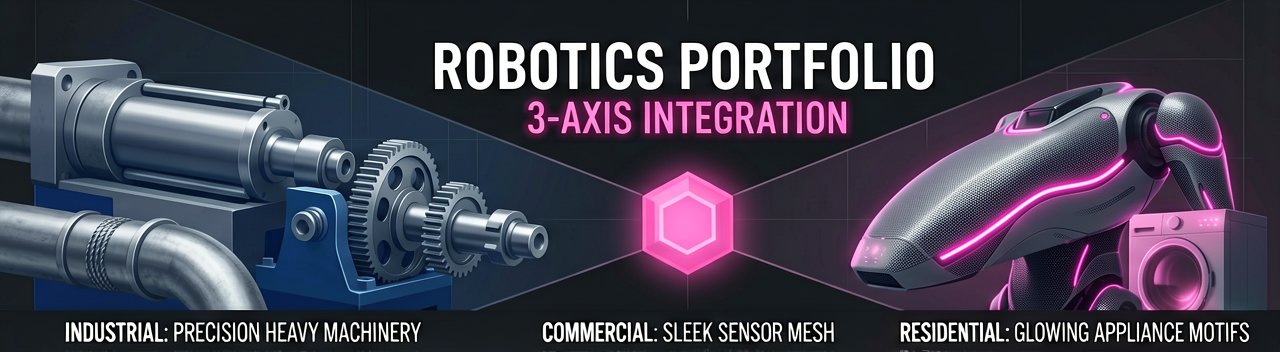
LG’s long-term commercialization strategy relies on a distinct three-pillar approach to market coverage. The company plans to merge its existing industrial and commercial robotics capabilities with a fresh wave of residential products managed directly by the new center. According to the strategic outline reported by MarketScreener, industrial robotics will remain anchored by its subsidiary Robostar, while commercial applications will stay centered on Bear Robotics, leaving the new central business unit to spearhead household applications.
Building the Full-Stack Supply Chain
To keep costs competitive and insulate itself from geopolitical supply shocks, the tech giant is leaning on its extensive manufacturing legacy. LG has designated 2026 as its official inaugural year for full-scale robotics expansion, transitioning from a simple machine manufacturer into a full-stack robotics solution provider. A major part of this transition includes the domestic, in-house production of actuators—the critical components responsible for mechanical movement—leveraging more than 60 years of foundational electric motor technology accumulated within its home appliance divisions. The company intends to eventually commercialize these components, supplying actuators to external clients across the broader tech industry.
Behind the Executive Realignments
The decision to skip the standard winter restructuring cycle highlights a deeper tension within LG’s broader corporate portfolio. For years, the company’s robotics ambitions felt fragmented, split across various business units that treated automation as a premium feature for home appliances or a niche B2B logistics solution. By yanking these disparate teams out of their comfortable silos and placing them directly under the CEO’s gaze, leadership is effectively demanding immediate commercial accountability. This is no longer a speculative R&D playground; it is a high-stakes bid to discover the next major revenue driver as global smartphone and traditional display markets plateau.
Industry insiders suggest that the sudden acceleration was also triggered by the breakneck pace of generative AI breakthroughs overseas. When OpenAI and various Silicon Valley startups began demonstrating foundation models that could instantly map physical spaces and interpret complex human commands, the old way of pre-programming robots became obsolete overnight. LG realized that its hardware prowess would mean very little if its machines lacked the modern cognitive architecture required to navigate chaotic consumer environments, prompting the urgent shift toward a unified data-driven software approach.
This structural urgency is further complicated by the delicate dance of managing external acquisitions alongside internal engineering pride. Navigating the integration of Bear Robotics—a Silicon Valley startup in which LG injected $60 million to capture the service robot sector—with the rigid corporate culture of Seoul's industrial mainstay, Robostar, requires immense bureaucratic finesse. The newly formed central hub acts as a diplomatic bridge, ensuring that cutting-edge software paradigms from California can actually interface with the high-volume manufacturing lines running in South Korea.
On the factory floor, the transition to producing proprietary actuators represents a massive financial gamble to achieve true vertical integration. Relying on third-party supply chains for precise mechanical joints has historically squeezed profit margins for robot manufacturers globally. By leveraging its decades of experience building durable motors for millions of household washing machines and refrigerators, LG hopes to achieve an economy of scale that Western robotics firms simply cannot match. If successful, this move could turn the company into a primary hardware supplier for rival tech firms, mirroring how its display division sells panels to its direct competitors.
Ultimately, the success of the Yangjae R&D data factory will determine whether this reorganization yields a true paradigm shift or just expensive marketing. Gathering the millions of hours of real-world physical interaction data needed to train a robust Robot Foundation Model is a monumental task that requires continuous computing power and massive capital expenditure. As the facility prepares to go online, the tech world will be watching closely to see if LG can successfully translate its massive footprint in global living rooms into the ultimate data pipeline for the next generation of physical intelligence.
Reading Between the Lines
While the press releases present a seamless vision of a software-defined future, the corporate reality of merging Silicon Valley agility with legacy South Korean industrialism is bound to hit some friction. LG’s decision to leave commercial applications with Bear Robotics while pulling household robotics into its own central unit creates an arbitrary boundary in the underlying technology. A robot navigating a crowded restaurant to deliver food relies on nearly identical spatial awareness and object-avoidance algorithms as a robot navigating a cluttered living room to fold laundry. Fragmenting these developmental paths across different corporate entities risks duplicating engineering efforts and creating incompatible software silos at a time when unified ecosystem execution is paramount.
Furthermore, the ambitious promise of a proprietary Robot Foundation Model trained at the upcoming Yangjae R&D Campus overlooks the massive data asymmetry plaguing the hardware industry. Tech giants specializing in pure software can scrape billions of images and text strings from the open internet for a nominal cost. Physical AI, conversely, requires high-fidelity spatial data and edge-case scenario training that cannot simply be downloaded. Unless LG plans to deploy millions of sensor-heavy devices into consumer homes to actively harvest spatial maps—a move that would trigger immediate and severe privacy backlashes—the data factory may find itself starved of the high-quality, real-world training inputs required to compete with heavily subsidized platforms from rival tech ecosystems.
There is also a palpable irony in LG leveraging its sixty-year legacy of manufacturing washing machine motors to corner the market on advanced robotic actuators. Translating the crude, repetitive rotational force of home appliances into the highly nuanced, multi-axis micro-movements required for humanoid joints or precise consumer manipulators is not a straight line. Industrial robotics firms spend decades refining the weight-to-torque ratios of their components, and assuming that consumer appliance expertise can easily pivot to supply the broader tech industry with competitive mechanical parts feels overly optimistic. It overlooks the deeply specialized engineering realities that separate a dependable kitchen appliance from an agile autonomous machine.
Ultimately, this organizational shakeup exposes a corporate culture reacting to external anxiety rather than executing a calm, pre-planned strategy. The mid-cycle restructuring timing is a tacit admission that previous, decentralized efforts were failing to gain commercial traction while rivals made rapid, highly publicized strides in physical intelligence. By consolidating power under the CEO, LG has certainly streamlined its decision-making pipeline, but it has also pinned the entire reputation of its next-generation growth engine onto a single corporate department. If this centralized gamble fails to produce an affordable, wildly successful consumer robot within the next few hardware cycles, the institutional fallout could stall the company's automation ambitions for a generation.
It turns out that teaching a machine to think like a human is actually the easy part; the real challenge is convincing a washing machine manufacturer that a robot needs to do more than just spin in circles, even if it does so very efficiently under direct executive supervision.
Artūras Malašauskas is an AI Systems Integrator with 20+ years of production-grade web engineering experience. He has designed, shipped, and scaled enterprise Python/PHP systems for logistics, SaaS, and public-sector clients. For the past year, he has focused exclusively on AI integrations: deploying open-source LLMs, building generative media pipelines (image, audio, video), and engineering multi-agent workflows for real production environments. His standard: reproducibility, security, cost-efficient inference—no vaporware. He documents and evaluates emerging AI tooling, separating verified capabilities from marketing noise. Technical editor at: muza-ai.eu, ai-verslas.lt, ai-naujinos.lt Connect on LinkedIn
Comments