Faraday Future’s Robotics Expansion Signals Shift in AI-Driven Industrial Automation
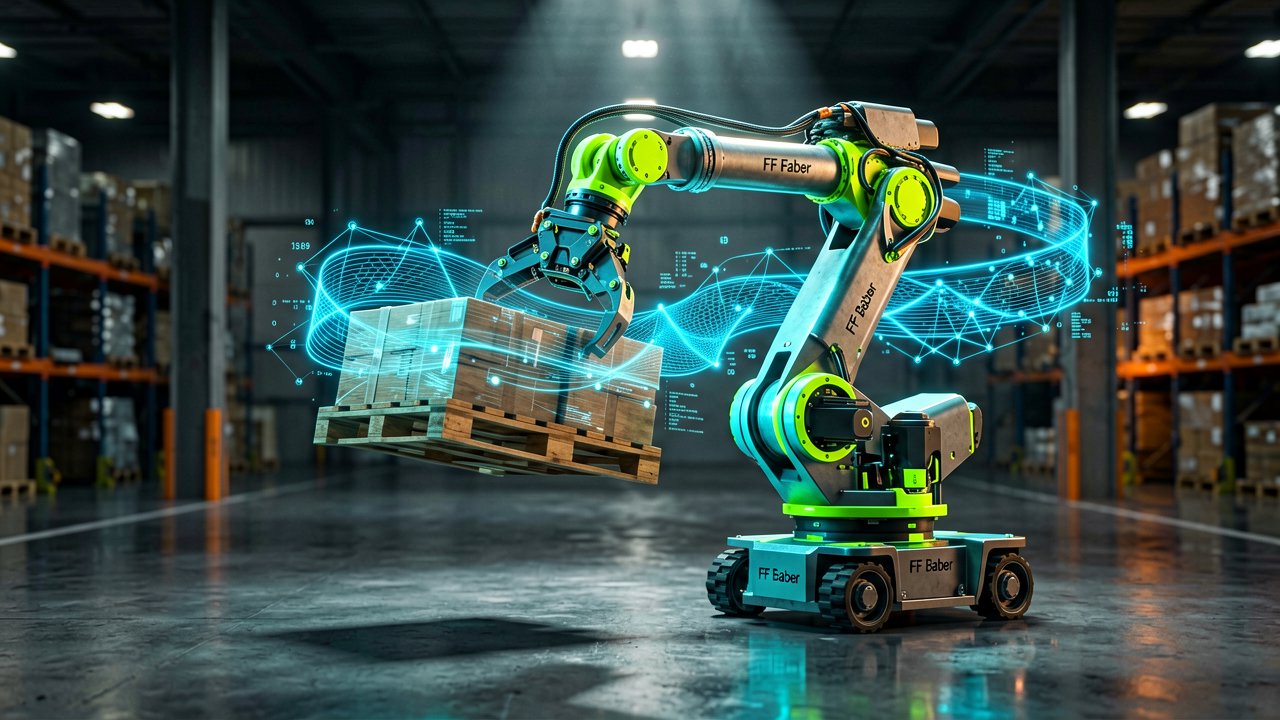
Faraday Future has officially transitioned into a comprehensive physical artificial intelligence developer by unveiling its expanded Embodied AI (EAI) Robot World platform at the Automate Show in Chicago. By introducing the industrial-grade FF Faber mobile manipulator alongside the All-New Futurist humanoid robot, the company has completed its multi-form six-series robotics portfolio. This calculated diversification bridges the gap between theoretical machine learning and heavy industrial applications, asserting a new competitive presence outside the traditional electric vehicle landscape.
The strategic expansion highlights an accelerating macroeconomic pivot toward hardware-software convergence, frequently termed Embodied AI. By integrating advanced mobility with precise manipulative limbs, these newly debuted platforms directly target acute operational bottlenecks across manufacturing, logistics, and facilities maintenance. Rather than viewing robotics as a secondary technical interest, Faraday Future is positioning its integrated ecosystem as a high-margin data and hardware subscription business designed to scale rapidly in commercial business-to-business sectors.
The Architecture of the EAI Robot World Platform
The core of this market shift relies on multi-form hardware configuration controlled by unified software intelligence. The newly launched Faraday Future Press Release confirms that the All-New Futurist humanoid stands 5 feet 8 inches tall, incorporates 31 degrees of freedom, and natively integrates the NVIDIA Sonic full-body motion control system. This structural engineering allows the platform to function for six continuous hours, offering academic and industrial research labs an immediate, highly sophisticated testing mechanism for complex locomotion algorithms.
Commercial Readiness and Industrial Application
While humanoid systems capture public attention, the newly introduced FF Faber series represents the immediate commercial catalyst for industrial floor integration. Combining a highly stable wheel-legged mobile base with a high-precision mechanical arm, the Faber series is built as a flexible workhorse optimized for loading tasks, warehousing logistics, and facility inspections. By making the Faber series immediately available for B2B commercial orders and delivery, the firm positions itself ahead of competitors still bound to localized pilot programs or early-stage field testing.

Ecosystem Moats and Long-Term Market Impact
The industrial strategy previewed in Chicago moves away from isolated hardware distribution, favoring a continuous monetization model that integrates hardware devices, localized software skills, and operational data pipelines. This unified ecosystem framework builds an iterative data flywheel: as more units deploy into active warehouse and manufacturing settings, collective machine learning data optimizes fleet orchestration software. By expanding from basic education quadrupeds to heavy industrial manipulators and humanoids, the developer is actively constructing a scalable, long-term technological defense against emerging automation startups and legacy hardware providers.
Deep-Dive Market Analysis
Behind the Scenes: The timing of Faraday Future's calculated entry into the Embodied AI (EAI) industrial arena is far from coincidental. For over a decade, the enterprise weathered intense public scrutiny regarding its luxury electric vehicle production timelines and complex balance sheets. By shifting core machine learning capital toward factories and warehouse logistics, leadership is engineering a classic corporate pivot. They are transitioning from a capital-heavy consumer automotive model to a highly agile, business-to-business hardware and automation software enterprise.
Industry stakeholders view this expansion as an assertive bid to capture early dominance in the emerging commercial machine learning space before traditional tech giants solidify their market footprints. A recent strategic shift highlighted by Los Angeles Business Journal underscores how geopolitical tensions have forced flexible tech firms to act as operational bridges, sourcing dual-country manufacturing support to scale their platforms quickly. This positioning allows the developer to bypass localized supply bottlenecks that currently constrain single-region robotic start-ups.
The introducing of the wheel-legged mobile arm series marks a pragmatic departure from competitors who focus almost exclusively on humanoid designs. While highly advanced bipedal platforms generate substantial media buzz, they frequently face prohibitive manufacturing costs and continuous engineering hurdles that delay practical warehouse implementation. Industrial floor operators require immediate, reliable utility, making the stable mobile manipulator format the actual volume driver for commercial automation integration over the next fiscal cycle.

By leveraging its native automotive software foundations to establish the underlying infrastructure for these systems, Faraday Future aims to create a deeply entrenched economic moat. According to statements detailing the ecosystem strategy on the Faraday Future Investor Relations portal, the ultimate goal is lowering developers' barriers to entry to rapidly build an open AI framework. If this multi-tier ecosystem successfully unites developers and industrial enterprises under a singular proprietary software environment, the firm can secure recurring subscription revenues that far outlast initial machinery sales.
Skeptical Assessment and Future Projections
Reading Between the Lines: The sudden pivot from a struggling luxury automotive manufacturer to an ambitious pioneer of industrial automation demands rigorous scrutiny. Historically, the enterprise has excelled at producing polished tech previews and broad ecosystem declarations, only to face severe capital crunches and production bottlenecks. While demonstrating a working humanoid robot and a mobile manipulator on an exhibition floor establishes physical existence, it does not solve the immense friction of deploying reliable hardware into demanding, high-throughput manufacturing lines.
This operational transition highlights a major strategic contradiction. The developer is attempting to position itself as an open platform for external machine learning developers while simultaneously launching proprietary hardware to compete with established robotics giants. Convincing third-party software engineers to build apps for an unproven framework will require massive financial incentives or significant upfront enterprise deployment, neither of which are easily achieved without a massive cash cushion or a mature, preexisting B2B customer base.
Furthermore, entering the industrial automation market forces the firm to compete directly with legacy giants like Fanuc, Kuka, and ABB, alongside well-funded, highly focused logistics innovators. These institutional incumbents already possess decades-old client relationships, comprehensive global servicing networks, and highly refined safety certifications. Convincing factory operators to swap field-tested machinery for a fledgling software ecosystem requires proving exceptional operational uptime, a metric that can take years of continuous field testing to reliably establish.
Ultimately, if this venture fails to move past the initial order phase into high-volume deployment, it risks being perceived as a public relations maneuver to distance the company from historical automotive setbacks. However, if the engineering teams can leverage their existing automotive sensor technology to deliver the mobile manipulator at a highly disruptive price point, they may carve out a viable niche in mid-tier warehousing. Success will not be measured by the sophistication of a humanoid robot's locomotion algorithms, but by the unglamorous efficiency of automated machinery moving crates across a loading dock without failing.
Building a functional vehicle company from scratch is famously one of the most difficult challenges in modern industry, so it only makes sense that the chosen remedy is to simultaneously master the equally complex world of humanoid robotics.
Artūras Malašauskas is an AI Systems Integrator with 20+ years of production-grade web engineering experience. He has designed, shipped, and scaled enterprise Python/PHP systems for logistics, SaaS, and public-sector clients. For the past year, he has focused exclusively on AI integrations: deploying open-source LLMs, building generative media pipelines (image, audio, video), and engineering multi-agent workflows for real production environments. His standard: reproducibility, security, cost-efficient inference—no vaporware. He documents and evaluates emerging AI tooling, separating verified capabilities from marketing noise. Technical editor at: muza-ai.eu, ai-verslas.lt, ai-naujinos.lt Connect on LinkedIn
Comments