Rockwell Automation Unveils FactoryTalk Orchestration to Bridge the Gap Between Shop Floor and Logistics
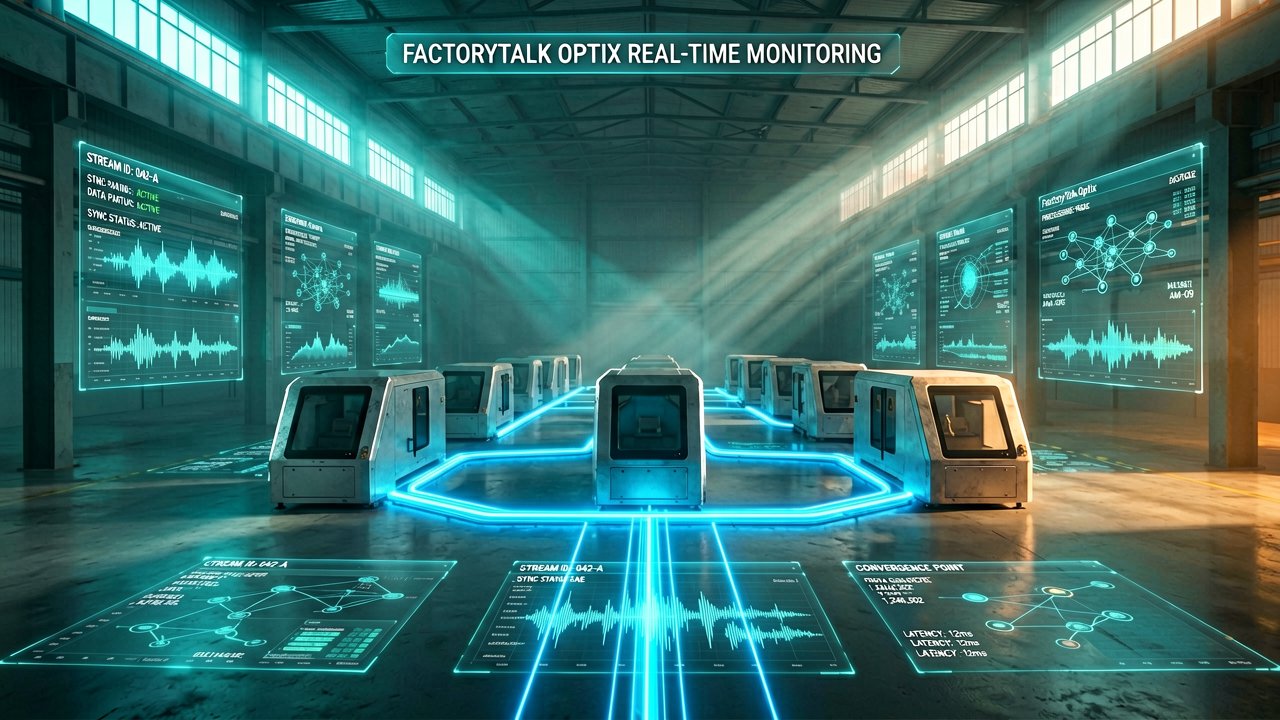
Rockwell Automation has launched its new FactoryTalk Orchestration software, aiming to unify fragmented manufacturing processes into integrated, autonomous ecosystems. Announced at the Automate trade show in Chicago, the platform addresses a critical challenge in modern industrial settings: the lack of seamless synchronization between localized machinery, autonomous material handling, and overarching enterprise systems. By leveraging real-time operational signals, the software coordinates end-to-end workflows to dramatically minimize warehouse bottlenecks and elevate overall operational responsiveness, as detailed by PR Newswire.
The strategic shift represented by this launch underlines an industry-wide transition away from isolated hardware deployment toward comprehensive software-driven orchestration. Built directly on the modern FactoryTalk Optix platform, the solution standardizes data connectivity across diverse hardware portfolios, including OTTO autonomous mobile robots (AMRs). According to market insights from MarTech Edge, tech-driven coordination layers, digital twins, and industrial AI are rapidly becoming foundational for next-generation smart factories looking to scale their throughput efficiently.
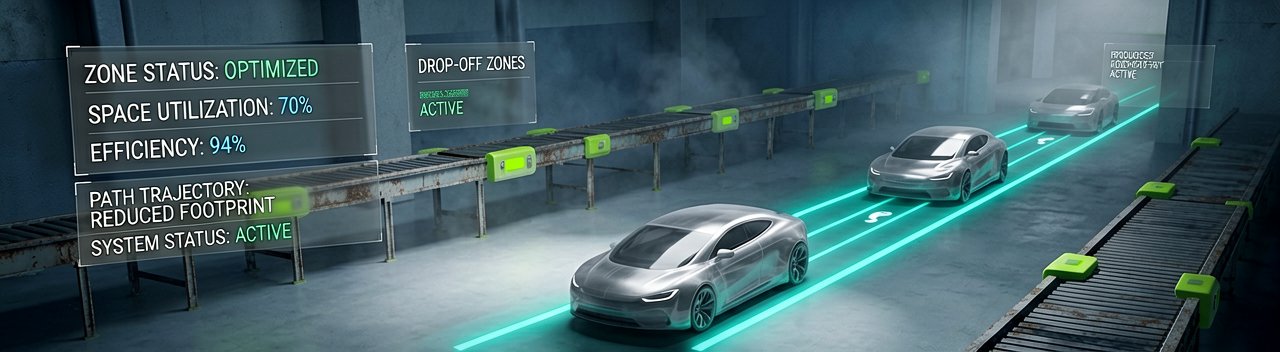
Early real-world implementations confirm the tangible economic impacts of unified production logistics. During initial pilot deployments at Rockwell’s internal manufacturing facility in Twinsburg, Ohio, the orchestration engine managed to improve drop-off zone space utilization by 70% while slashing overall material handling space requirements by half, as reported by Robotics 247. This proven reduction in physical footprint requirements highlights how software optimization can unlock hidden capacity within existing facilities without requiring costly brick-and-mortar expansions.
The Architecture of Autonomous Material Flow
At its core, FactoryTalk Orchestration serves as an intelligent intermediary layer that ingests real-time data from localized programmable logic controllers (PLCs) and routes it to autonomous material handling assets. Instead of running on rigid schedules, AMRs and conveyor systems respond dynamically to actual machine states and production output rates. This event-driven coordination ensures that components arrive exactly when needed, eliminating both component starvation at assembly lines and material congestion in transit paths.
Standardizing Connectivity via FactoryTalk Optix
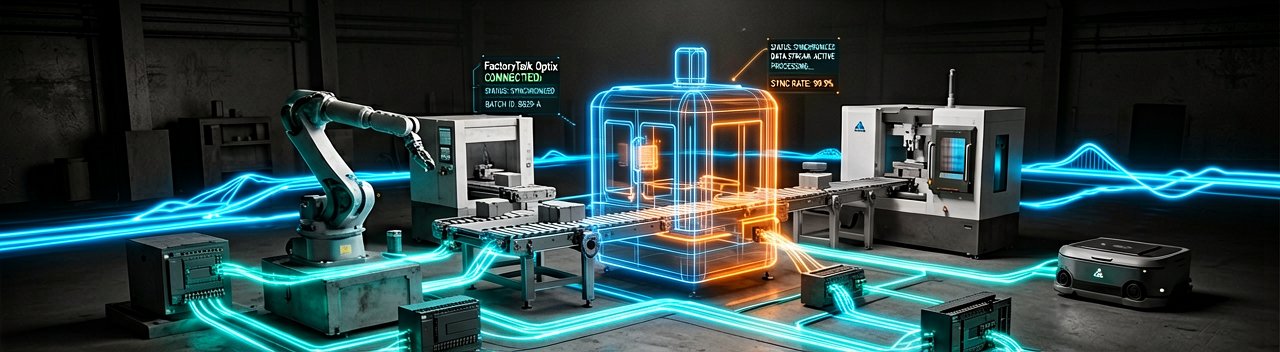
Historically, industrial environments have struggled with proprietary communication protocols that trap data within functional silos. By anchoring this software onto the open architecture of FactoryTalk Optix, Rockwell allows manufacturers to natively integrate multi-vendor equipment and enterprise resource planning (ERP) systems. The platform provides a standardized environment to deploy future ecosystem integrations, allowing companies to preserve their legacy hardware investments while steadily transitioning toward fully automated production logistics.
The Friction Between Automated Promise and Legacy Reality
Reading Between the Lines: While the narrative surrounding centralized industrial orchestration promises a flawless, self-correcting factory floor, it routinely glints over the messy reality of brownfield manufacturing environments. The assumption that enterprise software can seamlessly unify heterogeneous systems ignores the stubborn persistence of legacy infrastructure. Most operational plants are not pristine, greenfield testbeds; they are patchwork quilts of decades-old machinery, proprietary networks, and stubborn hardware silos that do not easily surrender to modern APIs. Forcing an elegant orchestration layer onto a facility still relying on rigid, hardwired logic controllers creates a technical mismatch that a simple software update cannot easily solve.
Furthermore, this push toward absolute automation introduces a hidden paradox regarding operational resilience. By tightening the coupling between real-time production signals and material handling fleets, manufacturers undeniably eliminate wasted buffer space and inventory overhead. However, this hyper-optimization also strips away the structural slack that traditionally insulated a factory from sudden shocks. When the margin for error is reduced to zero, a single network latency spike, a corrupted data packet, or a minor sensor misalignment can instantly cascade through the entire synchronized chain, turning a localized hiccup into an all-encompassing facility freeze.
There is also a palpable tension between the industry's open-architecture rhetoric and the commercial realities of ecosystem lock-in. While building on flexible foundations like FactoryTalk Optix lowers initial integration hurdles, it simultaneously functions as a sophisticated customer-retention mechanism. As an industrial enterprise embeds its operational workflows, custom logic, and robot dispatch rules deeper into a specific vendor's orchestration environment, the long-term cost of switching providers becomes prohibitively expensive. True interoperability remains an elusive ideal in a market where vendors must ultimately defend their software borders.
Looking ahead, the success of these platforms will not be decided by software capabilities alone, but by the digital literacy of the workforce left to maintain them. The traditional divide between information technology and operational technology teams remains a cultural bottleneck that tools cannot fix by decree. When a hyper-connected system suffers a failure, diagnosing whether the root cause lies in a mechanical fault, a localized wireless drop, or an enterprise cloud sync error requires a multidisciplinary skill set that remains frustratingly rare on the modern shop floor.
"The ultimate dream of the dark factory is a marvel of efficiency, right up until a rogue firmware update reminds us that when you perfectly synchronize every gear in the machine, you also perfectly synchronize how they jam."
Artūras Malašauskas is an AI Systems Integrator with 20+ years of production-grade web engineering experience. He has designed, shipped, and scaled enterprise Python/PHP systems for logistics, SaaS, and public-sector clients. For the past year, he has focused exclusively on AI integrations: deploying open-source LLMs, building generative media pipelines (image, audio, video), and engineering multi-agent workflows for real production environments. His standard: reproducibility, security, cost-efficient inference—no vaporware. He documents and evaluates emerging AI tooling, separating verified capabilities from marketing noise. Technical editor at: muza-ai.eu, ai-verslas.lt, ai-naujinos.lt Connect on LinkedIn
Comments