DeepSeek’s DSpark Framework Might Just Cure the Industry’s GPU Headache
The relentless demand for raw processing power has pushed global computing infrastructure to its absolute limit, leaving tech companies scrambling to secure any hardware they can find. Rather than waiting around for more hardware, the engineers at DeepSeek have decided to simply change how models utilize existing infrastructure. On June 27, 2026, the company launched DSpark, a speculative decoding framework developed in collaboration with researchers from Peking University that drastically optimizes artificial intelligence inference speeds by up to 85% without requiring a redesign of the underlying foundation models.
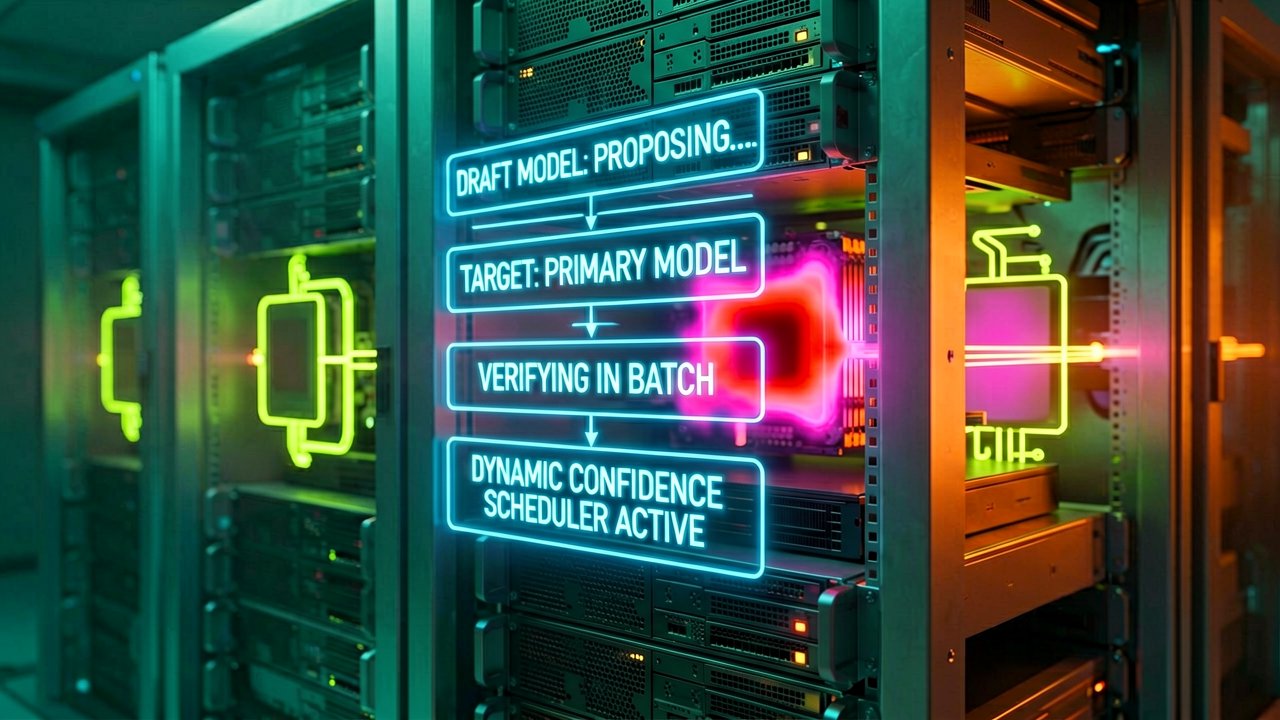
This software-driven breakthrough bypasses the conventional, slow method where a large language model meticulously generates text one word at a time, keeping massive chips firing continuously. Instead, the framework introduces a clever multi-stage architecture that leverages a lightweight draft model to quickly propose blocks of candidate text, which are then verified in batches by the primary model. According to a detailed technical breakdown published in the official DSpark Research Paper, this process relies on a unique semi-autoregressive generation method coupled with a specialized confidence scheduler, preventing the waste of precious processing cycles on poor text guesses.
Solving the Bottleneck at the Edge of High Demand
The true genius of the update lies in how it adapts to real-world deployment pressures. Conventional speculative decoding approaches often stumble during peak network traffic because checking rejected words still burns valuable processing capacity. DeepSeek solves this by deploying a hardware-aware scheduling system that checks more text paths when graphics cards are idle, but scales back operations when things get busy. Real-world traffic tests on the company's platform show that this dynamic balancing act boosts overall system throughput anywhere from 51% to over 400% under demanding constraints.
Industry developers looking to optimize their own operations can already download the new system, as the complete toolchain has been released publicly. The open-source code and model weights are accessible via the DeepSpec GitHub Repository and the corresponding Hugging Face Model Repository under a flexible MIT license. By demonstrating that substantial speed and efficiency gains can be achieved through clever engineering rather than massive hardware scaling, this release shifts the industry infrastructure focus away from expensive silicon hoarding and toward smarter, more sustainable architectural design.

Smarter Code Over Bigger Silicon
What Most Reports Miss: The DSpark breakthrough represents a philosophical pivot in an industry currently obsessed with brute-forcing its way to artificial general intelligence through sheer hardware accumulation. For the past several years, the tech sector's default playbook for handling compute deficits has been to throw more multi-thousand-dollar accelerator chips at the problem. By focusing heavily on inference efficiency, this software-driven architecture demonstrates that the looming hardware wall can be climbed through algorithmic ingenuity rather than endless capital expenditure.
This approach addresses a critical engineering reality that has quietly plagued large language model deployment: the memory bandwidth bottleneck. Traditional inference requires loading the model's massive weight parameters from high-bandwidth memory to the chip caches for every single token generated, a process that leaves expensive hardware sitting idle while waiting for data transfers. By implementing a semi-autoregressive framework that validates whole sequences of text simultaneously, the system dramatically increases compute-to-memory ratios, ensuring that infrastructure runs closer to its theoretical maximum potential.
From a stakeholder perspective, the open-sourcing of these toolchains changes the competitive dynamics between hyperscale cloud providers and independent developers. Venture-backed startups and research labs have faced increasingly prohibitive costs just to keep their systems responsive under load. This optimization lowers the barrier to entry by providing a blueprint for running state-of-the-art architectures on leaner, less expensive hardware clusters, effectively extending the lifecycle of previous-generation server fleets that companies were preparing to phase out.
Historical context shows that similar architectural shifts have defined previous eras of computing, where software optimization eventually rescued industries crippled by hardware limitations. Early mobile computing and game development similarly faced hard physical constraints before developers mastered spatial partitioning and dynamic resource allocation. By introducing a hardware-aware scheduling mechanism that intelligently dials down speculative paths during peak network congestion, this framework brings that same level of mature resource management to modern artificial intelligence infrastructure.

Ultimately, the collaborative release by DeepSeek and Peking University underscores a growing trend toward transparency in algorithmic efficiency. While some industry giants continue to treat their inference-optimization techniques as proprietary trade secrets to maintain a cloud pricing edge, making these mechanisms public pushes the entire ecosystem forward. This open methodology forces competing labs to optimize their own runtimes rather than relying on hardware exclusivity, steering the broader technological narrative away from silicon scarcity and back toward elegant software engineering.
The Hidden Cost of "Free" Efficiency
Reading Between the Lines: While an 85% boost in inference speed sounds like an unmitigated victory for cash-strapped developers, the reality of deploying speculative decoding in production is rarely a free lunch. The core contradiction of this architecture lies in its reliance on a lightweight draft model to predict the primary model's output. When the draft model guesses correctly, efficiency soars; when it guesses poorly, the system wastes valuable compute cycles validating and then discarding useless data, creating a hidden performance penalty that marketing materials rarely highlight.
This structural volatility means that the promised cost savings are highly dependent on the complexity of the task at hand. For predictable, highly structured inputs like standard code generation or basic template filling, the draft model maintains a high acceptance rate. However, when faced with highly creative writing, adversarial prompts, or complex logical reasoning, the draft model's accuracy plummates, causing the system to fallback to traditional token-by-token generation while saddling the infrastructure with the extra memory overhead of running two models simultaneously.
Furthermore, the long-term implication of software-side optimization is not necessarily a reduction in total hardware demand, but rather an acceleration of the Jevons paradox. Historically, making a resource more efficient does not lead to less consumption; it dramatically lowers the cost barrier, exploding demand and ultimately increasing total consumption. By making inference cheaper, frameworks like this will likely trigger a massive influx of new, highly complex agentic workflows that will ultimately consume whatever hardware capacity was just liberated.
There is also a subtle geopolitical and corporate strategy at play in making this technology open-source under an MIT license. By commoditizing the inference optimization layer, the creators effectively devalue the proprietary, closed-source runtime advantages held by Western cloud monopolies. It shifts the competitive moat away from specialized software engineering stacks and back to raw scale and data access, forcing competitors to rethink how they justify premium pricing for proprietary API access.
Ultimately, measured skepticism is required when assessing whether software tweaks can truly solve a physical supply chain crisis. Algorithmic efficiency buys the industry desperately needed breathing room, but it cannot manufacture silicon out of thin air. Until the underlying physical constraints of power grids and semiconductor fabrication plants are resolved, these clever engineering workarounds remain highly sophisticated band-aids on a fundamentally structural infrastructure deficit.
"We are trapped in a beautiful cycle of tech irony: engineering brilliant software to save us from a hardware shortage, only to realize the cheaper compute will just inspire developers to build even more bloated applications that demand another round of chips."
Artūras Malašauskas is an AI Systems Integrator with 20+ years of production-grade web engineering experience. He has designed, shipped, and scaled enterprise Python/PHP systems for logistics, SaaS, and public-sector clients. For the past year, he has focused exclusively on AI integrations: deploying open-source LLMs, building generative media pipelines (image, audio, video), and engineering multi-agent workflows for real production environments. His standard: reproducibility, security, cost-efficient inference—no vaporware. He documents and evaluates emerging AI tooling, separating verified capabilities from marketing noise. Technical editor at: muza-ai.eu, ai-verslas.lt, ai-naujinos.lt Connect on LinkedIn
Comments