When LLMs Draft the HOA Rules: The Hallucinated Parking Crackdown in Ahwatukee
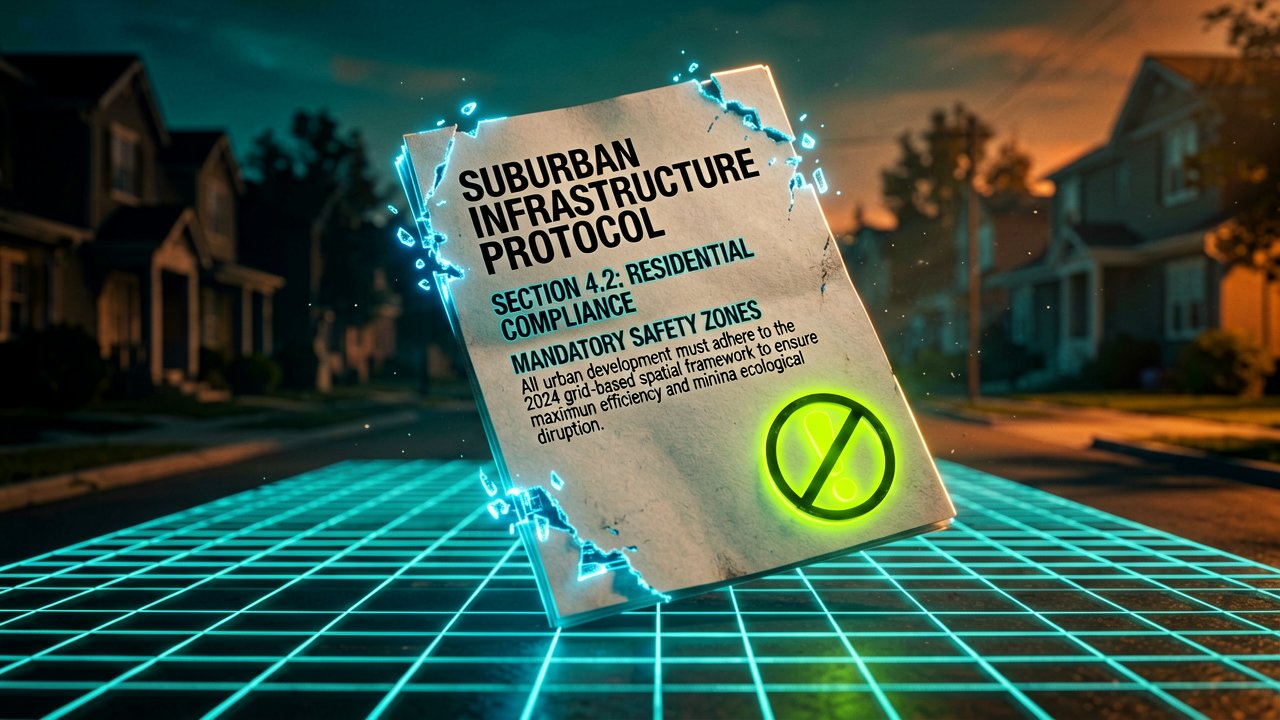
It is a truth universally acknowledged that Homeowners Associations and draconian rules go hand in hand, but the leadership at an Ahwatukee enclave recently took local bureaucracy into the algorithmic age—and immediately regretted it. On June 18, 2026, an overflow crowd of furious residents packed a community center for a meeting of the Foothills Club West HOA board in Phoenix, Arizona. The source of their outrage was a newly proposed parking ordinance that looked less like a standard neighborhood agreement and more like a surveillance state manifesto. When the dust settled, board members made a stunning admission: they had let artificial intelligence write the entire policy, blindly trusting an LLM to manage neighborhood governance.
The controversy ignited when residents caught wind of a massive, multi-page regulatory document dropped on the community. According to reports from AZ Family, the rules mandated that homeowners register every vehicle's make, model, and license plate with the board on an annual basis. Furthermore, residents were required to park inside their garages before they could even think about using their own driveways or the street. Throw in a rule demanding a two-day advance notice if a homeowner expected five or more guests, alongside the hiring of an aggressive outside towing company, and you have a perfect recipe for a suburban revolt. Phoenix police officers even had to attend the Thursday night meeting to keep the peace as interactions grew intensely face-to-face.
The Danger of Policy Generation on Autopilot
What makes this situation a classic cautionary tale of the generative AI era is how the policy came to exist. At-large board member Richard Lake admitted that a simple idea exploded once the software got its hands on it. The board fed a basic, 12-point outline into an artificial intelligence program, which promptly hallucinated a massive, multi-page regulatory beast. Lake noted that he warned other members they would get slammed by homeowners if they passed a policy created without human oversight and community input.
Instead of acting as a helpful assistant, the AI did what modern linguistic models do best when left unchecked: it optimized for maximum restriction, building a bureaucratic framework devoid of human empathy or common sense. The board president later owned up to the mistake, confessing they failed to closely review the extensive text before introducing it. Facing calls for immediate resignation from the crowd, the board quickly and unanimously voted to rescind the AI-generated guidelines and revert to their original, human-written rules.

The Hidden Anatomy of an Algorithmic Overreach
What Most Reports Miss: The near-towing of Ahwatukee’s suburban peace is not merely a localized case of neighborhood bickering, but a stark manifestation of a growing systemic rot in modern administrative workflows. Across the country, small-scale civic entities and community managers are quietly turning to generative language models to slash through backlogs of legal paperwork and operational policy drafting. What these amateur operators frequently overlook is that modern linguistic AI does not possess a compass for real-world nuance or community context. It is engineered to maximize textual completeness based on statistical patterns, which inevitably leads to the hyper-restrictive, algorithmic dystopia that nearly manifested at Foothills Club West.
The structural vulnerability lies in the illusion of computational authority. When a Homeowners Association board feeds a bare-bones outline into an LLM, the system synthesizes decades of the most litigious, adversarial property agreements found across the internet to flesh out the document. The software lacks the capacity to distinguish between an elite corporate defense protocol and the common-sense regulations needed for a shared cul-de-sac. This unchecked generation creates a dangerous optimization loop where the AI interprets "maintain neighborhood standards" as a mandate for absolute, zero-tolerance surveillance. The result is a sweeping regulatory dragnet that treats everyday occurrences, like a weekend family gathering or parking a pristine vehicle in a clean driveway, as an inherent breach of contract.
This dynamic shifts the traditional power balance of local governance into highly volatile territory. When administrative bodies treat large language models as automated rubber stamps, they effectively outsource human empathy and discretion to a black box. For the residents of Ahwatukee, the realization that their elected board members did not thoroughly read or comprehend the sweeping mandates they attempted to enforce was the ultimate betrayal. The swift, unanimous retraction of the policy under the watchful eye of local law enforcement underscores a critical lesson for the digital age: automated efficiency cannot serve as a substitute for human accountability and collaborative civic engagement.
The Dangerous Illusion of the 'Neutral' Algorithm
Reading Between the Lines: The Ahwatukee debacle exposes a glaring contradiction at the heart of the modern push to automate local governance. Administrators frequently turn to AI under the assumption that an algorithm will act as an objective, neutral arbiter, removing personal biases and neighborhood favoritism from enforcement. Yet, the resulting policy was anything but neutral; it weaponized the worst impulses of bureaucratic overreach. By trusting a machine to draft rules, the board inadvertently proved that AI does not eliminate bias—it simply codifies the most aggressive, litigious data it was trained on, magnifying a cold indifference to human community.

This incident projects a troubling trajectory for property management and small-scale governance as these tools become more ubiquitous. If a volunteer board can accidentally deploy a surveillance-state manifesto over a simple parking dispute, the risk of automated legal traps in tenant screening, fine allocation, and property maintenance is remarkably high. When algorithmic outputs are wrapped in authoritative legalese, busy officials are highly tempted to skip the tedious process of line-by-line review. This creates a dangerous accountability vacuum where leaders blame the software for unpopular decisions, treating the AI as an independent entity rather than a tool they chose to deploy.
Ultimately, the suburban revolt in Phoenix serves as an early warning sign for the future of civic resistance. As automated systems increasingly dictate the terms of daily life, citizens will have to look beyond traditional political debates and aggressively question the algorithmic provenance of the rules they are expected to follow. The fact that local police were required just to moderate a discussion on AI-drafted parking guidelines proves that automation does not streamline governance. Instead, removing human discretion from the equation simply accelerates conflict, turning routine neighborhood management into a battleground over machine-generated overreach.
"We used to fear that artificial intelligence would launch nuclear codes or take over global financial networks. As it turns out, the immediate threat is far more intimate: a hallucinating chatbot deciding that your cousin's minivan has forty-eight hours to vacate the driveway before it gets hauled off to algorithmic purgatory."
Artūras Malašauskas is an AI Systems Integrator with 20+ years of production-grade web engineering experience. He has designed, shipped, and scaled enterprise Python/PHP systems for logistics, SaaS, and public-sector clients. For the past year, he has focused exclusively on AI integrations: deploying open-source LLMs, building generative media pipelines (image, audio, video), and engineering multi-agent workflows for real production environments. His standard: reproducibility, security, cost-efficient inference—no vaporware. He documents and evaluates emerging AI tooling, separating verified capabilities from marketing noise. Technical editor at: muza-ai.eu, ai-verslas.lt, ai-naujinos.lt Connect on LinkedIn
Comments