The End of Fine-Tuning Bottlenecks: How Unsloth Liberates Open-Source AI Developers

Fine-tuning massive, open-source AI models has historically felt like trying to squeeze a camel through the eye of a needle. The processing bottlenecks, coupled with astronomical cloud compute bills, regularly block individual developers and small teams out of the generative AI boom entirely. Yet, as highlighted in a deep-dive review featured on QUASA MEDIA, a framework called Unsloth has quietly torn down these digital gates, delivering a massive blow to standard training inefficiencies. It isn't just a marginal step forward; it represents a paradigm shift in how open-source models are tailored to specific tasks.
Behind this performance surge is a complete ground-up rewrite of the underlying math stack. Instead of leaning on the standard, overly generalized PyTorch frameworks that waste precious computational power, the system deploys a customized, low-level Triton backpropagation engine. The architecture carefully optimizes parameter-efficient techniques like QLoRA and LoRA by focusing entirely on the personality layer of the model rather than altering its base structural DNA. This precision engineering means developers can bypass heavy developer environments and deploy no-code pipelines to ingest raw data directly, dramatically streamlining the path from simple documents to a fully tuned system.
Unmasking the Metrics
When it comes to hardware constraints, the performance gains transition from theoretical wizardry to absolute game-changers. Data published by the Unsloth Documentation reveals that the platform cuts VRAM overhead by roughly 70 percent while simultaneously boosting training velocities anywhere from 2 to 12 times depending on the specific model scale. Take a massive multi-expert configuration like the Qwen3 30B mixture variant: fine-tuning on a native PyTorch setup traditionally gobbles up 48 gigabytes of memory and takes nearly ten grueling hours to complete. Unsloth compresses that identical workload into just 17.5 gigabytes of VRAM and clears the entire queue in roughly 48 minutes, cleanly fitting complex corporate AI workflows onto accessible consumer-grade hardware.
Deep-Dive Technical Architecture
Behind the Scenes: The magic driving these eye-popping acceleration metrics boils down to a profound architectural rejection of PyTorch’s default autograd engine. While standard PyTorch models rely on dynamic computational graphs that allocate, store, and constantly clear massive intermediate activation tensors during the backward pass, Unsloth overrides this entire pipeline with hand-written, low-level OpenAI Triton kernels. By bypassing the standard overhead of the Python-C++ wrapper boundaries, the framework directly manipulates GPU registers and memory blocks, slashing the massive I/O overhead that typically chokes large language model fine-tuning workflows.
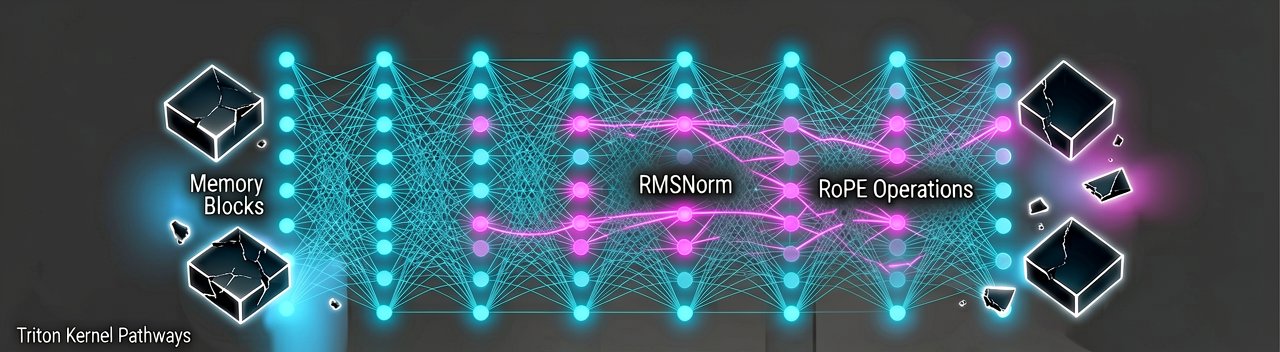
A core pillar of this efficiency lies in manual backpropagation overrides for critical, computationally expensive layers. Rather than trusting the compiler to automatically deduce gradients for mathematically intensive operations like Root Mean Square Normalization (RMSNorm) and RoPE (Rotary Position Embedding) vector mathematics, the system utilizes explicit, pre-calculated mathematical derivatives coded straight into GPU-executable Triton code. Doing so completely eliminates the need to cache large, redundant intermediate activations, freeing up precious gigabytes of VRAM that would otherwise sit uselessly in the hardware pipeline during a training epoch.
Memory optimization goes a step further through a highly specialized implementation of FlashAttention-2 integrated alongside custom Quantized Low-Rank Adaptation (QLoRA) memory mapping. Standard QLoRA implementations introduce immense precision degradation and performance penalties when constantly de-quantizing 4-bit weights into 16-bit float configurations for the forward pass, and then re-quantizing them on the fly during the backward pass. Unsloth solves this by fusing the de-quantization step directly into the matrix multiplication kernels themselves, keeping the data matrix fully resident inside the fast SRAM caches of the GPU and avoiding expensive round-trips to the slower High Bandwidth Memory (HBM).
From an execution standpoint, this system-level optimization transforms how gradient accumulation loops operate on local hardware. Because the custom kernels drastically limit memory fragmentation—a notorious culprit behind random Out-Of-Memory (OOM) crashes—the system can effortlessly scale token sequence lengths without triggering aggressive memory swapping routines. By keeping the entire mathematical workload heavily localized within the hardware's fast local caches, the system maintains a consistently high Tensor Core utilization rate, ensuring that the physical silicon is constantly performing meaningful matrix arithmetic rather than idling while waiting for memory transfers to clear.
Skepticism and Scalability Limits
Reading Between the Lines: While the promise of near-instantaneous fine-tuning on a solitary consumer GPU is intoxicating, a sober look at the architectural trade-offs reveals that these massive performance leaps are not a magic bullet for all AI development. The platform achieves its breathtaking velocity precisely by stripping out the generalized scaffolding that makes modern machine learning frameworks so resilient. By hyper-optimizing for specific, narrow hardware configurations and locking down the underlying mathematical kernels for a fixed subset of open-source architectures, developers are effectively trading framework flexibility for raw speed. It works beautifully right up until you try to introduce an unorthodox layer structure or an experimental attention mechanism that hasn't been hand-optimized into the codebase.

There is also a stark contradiction between the democratized rhetoric surrounding the open-source movement and the harsh realities of enterprise-scale deployment. Slashing local training times from ten hours down to forty-eight minutes is a massive win for rapid prototyping and hobbyists tinkering in their garages, but it barely moves the needle for organizations handling massive corporate datasets across hundreds of billions of parameters. When a project scales past the limits of a single machine and enters the territory of distributed, multi-node cluster training, the localized memory optimization advantages begin to dwindle. At that boundary, the primary bottlenecks shift entirely from internal GPU register speeds to network interconnect speeds and cluster synchronization latency.
Furthermore, relying heavily on parameter-efficient techniques like LoRA and QLoRA—the very mechanisms the platform excels at optimizing—comes with its own hidden cognitive debt. Industry consensus increasingly hints that while low-rank adaptations are incredibly adept at forcing a model to mimic a specific formatting style or tone, they regularly fall short when tasked with injecting genuinely deep, net-new conceptual knowledge into a base network. Teams rushing to adopt these accelerated workflows risk building a pipeline that creates models that look highly specialized on the surface, but suffer from brittle reasoning capabilities underneath. It creates a subtle illusion of progress where development cycles feel incredibly fast, yet the actual delta in model intelligence remains stubbornly flat.
The open-source AI community has successfully democratized training to the point where anyone can fine-tune a world-class language model over their lunch break for the price of a fancy sandwich—leaving us with only one major engineering bottleneck left to solve: figure out what on earth we actually want these hyper-optimized models to say.
Artūras Malašauskas is an AI Systems Integrator with 20+ years of production-grade web engineering experience. He has designed, shipped, and scaled enterprise Python/PHP systems for logistics, SaaS, and public-sector clients. For the past year, he has focused exclusively on AI integrations: deploying open-source LLMs, building generative media pipelines (image, audio, video), and engineering multi-agent workflows for real production environments. His standard: reproducibility, security, cost-efficient inference—no vaporware. He documents and evaluates emerging AI tooling, separating verified capabilities from marketing noise. Technical editor at: muza-ai.eu, ai-verslas.lt, ai-naujinos.lt Connect on LinkedIn
Comments