Powering the Machine: The AI Infrastructure Buildout and Its Environmental Crossroads
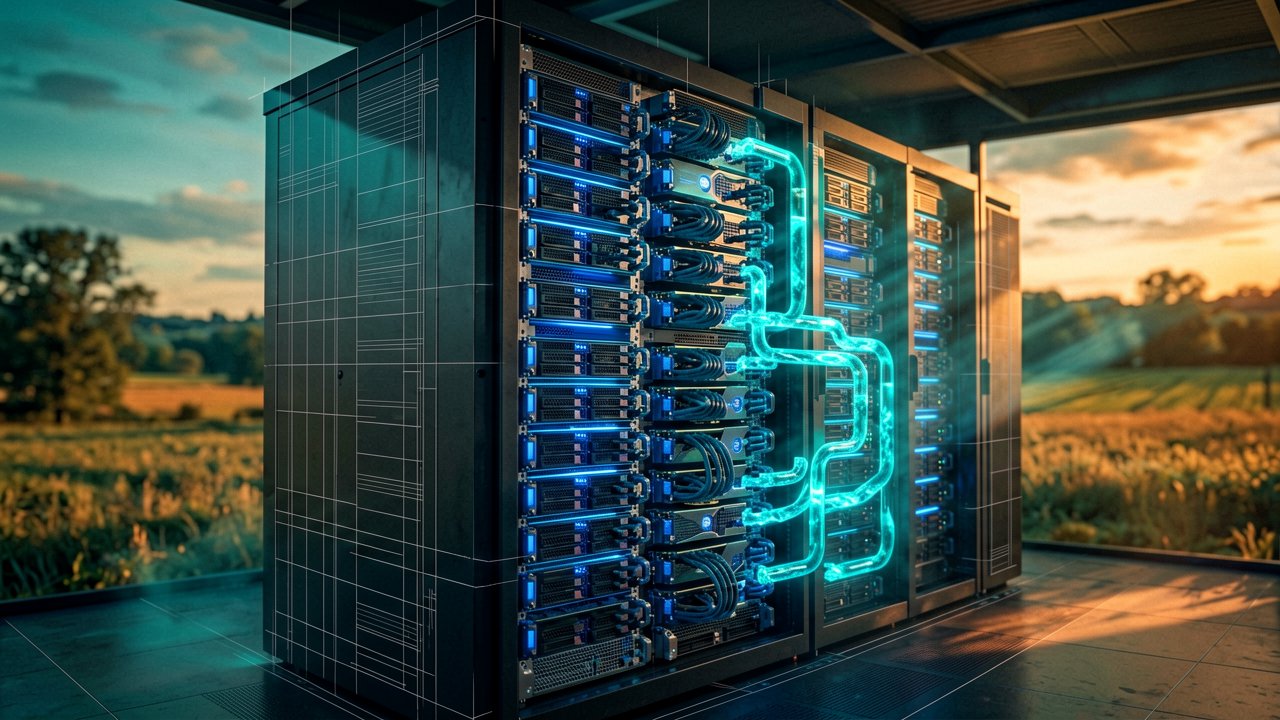
The global rush to scale artificial intelligence has shifted from a race for algorithmic dominance to an aggressive, capital-intensive scramble for physical infrastructure. According to the International Energy Agency (IEA), capital expenditure from the five largest technology companies—including Amazon Web Services, Google, Meta, and Microsoft—surpassed $400 billion in 2025 and is projected to surge by an additional 75% in 2026. This financial commitment is flowing directly into "AI factories," specialized hyperscale facilities equipped with advanced graphics processing units (GPUs) designed to handle highly demanding generative AI training and inference workloads.
This rapid infrastructure expansion is directly impacting global energy networks and natural resources. Data center electricity demand is projected to double from 485 terawatt-hours (TWh) in 2025 to 950 TWh by 2030, representing roughly 3% of all global electricity consumption by the end of the decade. The accelerated computing driving AI adoption is growing much faster than conventional workloads, with power demand from AI-focused facilities set to triple over the same period. This concentrated growth has triggered structural stresses on local grids and sparked public policy debates over resource allocation and community impacts.
The Realities of Grid Demands and Supply Bottlenecks
As massive clusters materialize, the sheer volume of power required by hyperscale facilities is outstripping local grid capacities. Regional concentrations are particularly severe; for instance, the Electric Power Research Institute (EPRI) projects that data centers could consume up to 59% of Virginia’s total electricity by 2030, while seven other U.S. states are expected to cross the 20% threshold. To secure reliable, round-the-clock power, tech firms are increasingly forced to balance their green energy mandates with regional energy availability. Although hyperscalers are investing heavily in future zero-emission technologies like Small Modular Reactors (SMRs), the IEA forecasts that approximately 40% of the additional power required by data centers through 2030 will still be met by natural gas and coal-based generation.
The Overlooked Footprint of Water and Land
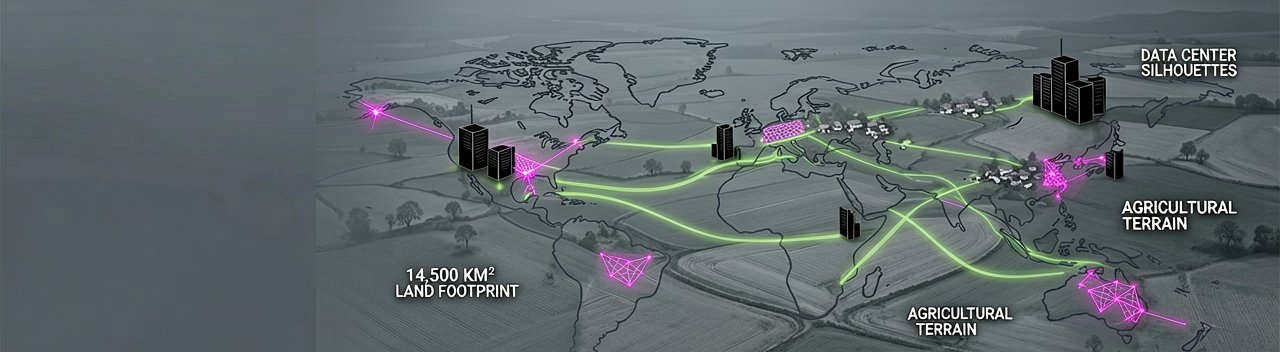
While carbon emissions dominate headlines, the cooling demands and physical footprints of AI data centers present urgent localized challenges. High-density server racks generate immense thermal loads, making liquid and evaporative cooling essential operational requirements. A major investigation by the United Nations University warns that by 2030, global AI-related data centers will incur a water footprint equivalent to the basic annual domestic needs of 1.3 billion people. Furthermore, the land footprint required for these facilities and their dedicated power supply chains is projected to exceed 14,500 square kilometers, driving real estate rezonings that frequently convert rural woodlands and agricultural green spaces into massive industrial zones.
Operational Efficiency Adjustments
In response to intensifying ecological constraints and public pushback, data center operators are shifting their tactical approaches to resource management. Transparency has become a critical focal point, as local utility customers increasingly absorb the grid infrastructure costs necessary to support concentrated data center loads. To mitigate resource strain, tech giants are experimenting with higher ambient operating temperatures and advanced cooling methods. For example, recent corporate sustainability data released by Amazon indicates that the company improved its water efficiency by 52% since 2021 by running facilities at up to 85 degrees Fahrenheit, allowing them to utilize passive air cooling and restrict water-intensive evaporative cooling to fewer than 10% of the days in a year. Achieving long-term alignment between rapid AI expansion and broader environmental sustainability will depend heavily on the continuous deployment of these architectural innovations and flexible grid integration strategies.
The Hidden Geometry of the Infrastructure Boom
Beneath the Silicon: The current buildout of artificial intelligence infrastructure is fundamentally reshaping the geography of industrial real estate. While early data centers were situated near major fiber-optic backbones in established tech hubs, the extreme power density required for generative AI training sets has forced developers into rural landscapes. Tech giants are purchasing thousands of contiguous acres of agricultural land, transforming quiet farming communities into highly secure, concrete campuses. This shift is driving intense competition for land, creating a new class of speculative real estate investors who buy up rural acreage solely for its proximity to high-voltage transmission lines.
This rapid migration into the heartlands has altered the traditional power dynamic between local municipalities and multi-billion-dollar technology corporations. Local government boards are increasingly caught between the allure of massive property tax revenues and fierce resistance from residents concerned about industrial noise, altered landscapes, and diminished resources. For rural towns, hosting a hyperscale facility can fund schools and infrastructure projects, but it often yields very few permanent local jobs once the initial construction phase concludes, sparking debates about the true long-term economic value of these modern industrial plants.
The operational reality inside these high-density facilities is also undergoing a profound architectural shift. Standard cloud computing infrastructure traditionally required roughly five to ten kilowatts per server rack. In stark contrast, next-generation AI clusters packed with advanced accelerators require up to one hundred kilowatts per rack, generating thermal loads that render conventional air conditioning completely obsolete. To prevent catastrophic hardware failure, engineers are redesigning facility internals to support direct-to-chip liquid cooling systems, introducing thousands of miles of internal plumbing that carry specialized fluids directly across live silicon.

This architectural overhaul has introduced a highly volatile variable into corporate sustainability accounting. While liquid cooling is vastly more energy-efficient than traditional air chillers, it demands a massive initial allocation of water to prime the loops, alongside ongoing consumption for regional heat rejection. Grid operators and environmental regulators are beginning to demand that hyperscalers provide granular, hourly disclosures regarding their local resource draw, rather than relying on annualized global averages that mask seasonal spikes and localized ecological strain.
Ultimately, the industry is entering an era of resource rationing where computational capacity is directly constrained by physical utility access. Tech executives are no longer asking if they can build a more powerful model; they are asking where on the planet they can find the continuous gigawatts required to run it. This constraint is forcing a strategic reevaluation of data center placement, driving some providers to explore remote international locations near abundant geothermal or hydroelectric sources, effectively decoupling the physical location of the machine from the users who query it.
The Sustainable Mirage of the Computing Renaissance
Reading Between the Lines: The corporate narrative surrounding the AI buildout relies heavily on a foundational assumption: that the efficiency gains of artificial intelligence will naturally offset its massive physical footprint. Silicon Valley routinely presents optimization algorithms as the ultimate cure for grid strain and resource depletion, suggesting that smarter scheduling and automated cooling will shrink the industry's ecological shadow. Yet, this technocratic optimism ignores Jevons’ Paradox, a well-documented economic phenomenon where increasing the efficiency of a resource actually accelerates its total consumption. As AI training and inference become cheaper and more efficient, the market response is not a reduction in power demand, but an exponential explosion in deployment scale.
This dynamic exposes a deep contradiction in the sustainability pledges of major tech firms. For years, hyperscalers have proudly touted their paths toward carbon neutrality, often using virtual Power Purchase Agreements (PPAs) to claim that their data centers run on 100% renewable energy. However, these financial instruments rarely match the hour-by-hour reality of a data center’s baseline power draw. When the sun sets or the wind dies down, these facilities must still draw uninterrupted gigawatts from the local grid, which is frequently stabilized by burning coal or natural gas. The current infrastructure rush has effectively forced a quiet retreat from aggressive near-term decarbonization targets, proving that when climate goals collide with the mandate for computational dominance, corporate strategy prioritizes the computing power every single time.
The resulting long-term implications point toward a highly fragmented and highly regulated energy landscape. As the public becomes increasingly aware of the massive resource disparity between household consumption and data center demands, the era of frictionless infrastructure expansion is coming to a close. Governments are already shifting from offering lucrative tax incentives to imposing strict operational caps, mandating real-time resource tracking, and requiring data centers to fund local grid upgrades. The tech sector's survival will no longer depend solely on who has the most sophisticated software architecture, but on who can navigate the complex, unyielding realities of local politics, physical supply chains, and absolute resource scarcity.
"We are witnessing the supreme irony of the digital age: an industry built on the ephemeral promise of the cloud is ultimately being tethered to earth by the unyielding laws of thermodynamics, discovering that while artificial intelligence can rewrite reality, it still can't negotiate with a circuit breaker."
Artūras Malašauskas is an AI Systems Integrator with 20+ years of production-grade web engineering experience. He has designed, shipped, and scaled enterprise Python/PHP systems for logistics, SaaS, and public-sector clients. For the past year, he has focused exclusively on AI integrations: deploying open-source LLMs, building generative media pipelines (image, audio, video), and engineering multi-agent workflows for real production environments. His standard: reproducibility, security, cost-efficient inference—no vaporware. He documents and evaluates emerging AI tooling, separating verified capabilities from marketing noise. Technical editor at: muza-ai.eu, ai-verslas.lt, ai-naujinos.lt Connect on LinkedIn
Comments