AICTE’s 41 Emerging Tech Certificates Signal Shift in Engineering Education Priorities

The All India Council for Technical Education (AICTE) has officially launched 41 new certificate programs focused on artificial intelligence, machine learning, data science, robotics, and other high-demand fields. Orchestrated under the AICTE-QIP-PG Certificate Programme in Emerging Areas, this initiative targets full-time regular and permanent faculty members across AICTE-approved degree and diploma institutions. With the application window closing on July 5, 2026, the strategic rollout intends to rapidly upskill core engineering educators to deliver industry-relevant education, resolving an acute shortage of qualified specialized instructors.
This systematic push represents a major structural recalibration within India's technical education ecosystem. Rather than adding standard curriculum mandates, the regulatory body is directly targeting the pedagogical roots by transforming educators from conventional domains like mechanical, civil, and electrical engineering into advanced technology mentors. Delivered through premium national entities including the Indian Institute of Science (IISc), IITs, NITs, and IIITs, these six-month hybrid courses bridge the historical gap between isolated textbook theories and rapid market iterations.
Market Impact and Academic Restructuring
The operational framework of these certifications introduces a rigorous 18-credit format balanced evenly between theoretical modules and practical, project-based applications. According to the official AICTE-QIP-PG Programme Guidelines, the coursework blends deep-tech awareness with execution, incorporating a mandatory four-week offline training phase at host institutions. By leveraging existing infrastructure at elite national institutes, the program ensures faculty gain localized, hands-on experience in specialized domains such as cyber-physical systems, intelligent transport, and drone technology without disrupting institutional operations.
Addressing the Technical Talent Shortage
Industry metrics frequently highlight that a substantial portion of Indian technical graduates lack immediate corporate readiness due to outdated academic guidance. By converting existing faculty into competent guides for data science, robotics, and 3D printing, institutions can establish state-of-the-art undergraduate and postgraduate tracks with minimal friction. This large-scale professional development campaign serves as a critical defense against systemic academic obsolescence, helping align public engineering training directly with global enterprise requirements.

Deep-Tech Integration in Core Engineering Classrooms
What Most Reports Miss: The true vulnerability within India’s tech education strategy is not a lack of students, but the geographic and institutional isolation of the educators themselves. Historically, technical updates in public curricula happen slowly, leaving frontline professors at regional diploma and degree colleges largely detached from high-speed industry shifts. By designing the AICTE-QIP-PG Certificate Programme in Emerging Areas as a zero-fee incentive backed entirely by council funding, regulators are systematically lowering the financial barriers that often prevent lower-tier colleges from modernizing their engineering staff.
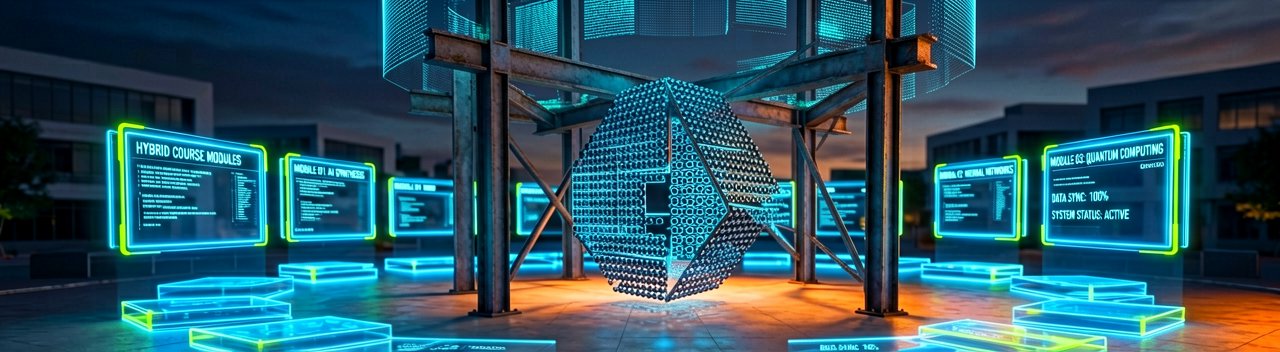
This operational blueprint shifts away from traditional, short-term faculty development workshops toward a high-stakes, 18-credit professional framework. Professors from conventional domains like mechanical, chemical, and civil engineering are now required to dedicate six full months to intense computational upskilling. The hybrid structure combines twenty weeks of online theory with four intensive weeks of hands-on laboratory work directly inside elite campuses such as the Indian Institute of Science (IISc), IITs, NITs, and IIITs. This ensures that educators do not merely study machine learning or quantum computing on paper, but physically construct models and run simulations on national-grade research infrastructure.
Balancing Industry Demands with Academic Scale
The strategic expandability of the 41 certificate courses highlights a structural push to build localized tech ecosystems far beyond India's primary software hubs. According to updated AICTE Scheme Guidelines, the council has integrated computer science, management domains, and applied sciences into the program's scope. This expansion addresses a crucial market reality: deep technologies like cyber-physical systems, drone tracking, and 3D printing are no longer isolated to computer science departments, but are actively redefining supply chain management and industrial manufacturing operations worldwide.
By transforming permanent faculty members into capable instructors of advanced tech, AICTE is creating an effective multiplier effect across thousands of approved technical colleges. When a single professor completes specialized coursework in intelligent IoT, computer vision, or semiconductor fabrication, they bring that curriculum and practical lab design back to their home institution. This institutional transformation helps local engineering programs quickly launch specialized tracks without facing the massive costs of hiring new, industry-salaried Ph.D. holders. Over time, this targeted faculty upskilling acts as a stable foundation for developing the highly skilled engineering talent pool required by global technology companies.
The Execution Gap in Mass Upskilling
Reading Between the Lines: The ambition to transform thousands of conventional engineering professors into vanguard AI and robotics instructors within six months relies on a highly optimistic assumption. It presumes that academic institutions can simply absorb advanced technologies without completely rewriting their rigid administrative DNA. While the council’s curriculum framework covers highly sought-after domains like quantum computing and semiconductor design, a persistent contradiction remains. Frontline faculty members return from elite IIT laboratories to home colleges that frequently lack basic high-performance computing clusters or steady research funding, creating a stark disconnect between a professor's newly acquired certifications and their actual classroom infrastructure.
Furthermore, evaluating this initiative solely on the volume of certificates issued overlooks a more complex behavioral challenge. Engineering departments across India have historically functioned on strict seniority structures where conventional specializations dictate institutional power. Forcing veteran professors of classical mechanics or thermodynamics to rapidly adopt advanced data pipelines and machine learning algorithms creates visible friction. Without parallel, mandatory updates to regional university examination models, these advanced 18-credit certifications risk becoming mere administrative badges on faculty resumes rather than catalyst tools for dynamic classroom instruction.
The broader economic implications also introduce a clear competitive irony. If this hybrid training successfully elevates a professor's technical capabilities to true industry standards, the public education system must immediately compete with private corporate hiring. The widening salary gap between state-regulated academic scales and the lucrative packages offered by international tech firms for AI and robotics talent presents a permanent retention risk. Ultimately, the council's aggressive push to build a massive, upskilled academic workforce may unintentionally create a highly efficient, government-funded pipeline that channels top technical talent straight out of academia and directly into private enterprise.
"In the grand tradition of technical education, we are confidently training tomorrow's faculty on yesterday's administrative models to teach next week's technology. If the strategy succeeds, our classrooms will finally have cutting-edge instructors—assuming, of course, the private sector doesn't hire them first."
Artūras Malašauskas is an AI Systems Integrator with 20+ years of production-grade web engineering experience. He has designed, shipped, and scaled enterprise Python/PHP systems for logistics, SaaS, and public-sector clients. For the past year, he has focused exclusively on AI integrations: deploying open-source LLMs, building generative media pipelines (image, audio, video), and engineering multi-agent workflows for real production environments. His standard: reproducibility, security, cost-efficient inference—no vaporware. He documents and evaluates emerging AI tooling, separating verified capabilities from marketing noise. Technical editor at: muza-ai.eu, ai-verslas.lt, ai-naujinos.lt Connect on LinkedIn
Comments