Global AI Governance Takes Shape: May’s Regulatory Milestones Reshape Tech Landscape

The global artificial intelligence industry is rapidly transitioning from localized, voluntary self-regulation to a legally mandated, cross-border compliance framework. According to the Tech Policy Press May 2026 Global Digital Policy Roundup, multi-jurisdictional updates are restructuring cross-border data flows and foundational AI ethics frameworks. Organizations must now pivot from high-level ethical principles to auditable operational controls to maintain market access across G7 economies and European territories.
This wave of regulatory formalization coincides with a significant expansion in sovereign tech procurement and defense deployment. In the United States, commercial AI systems reached a milestone as the Department of Defense secured operational agreements to deploy leading models on highly classified military networks, as documented by . This dual track—balancing strict civil consumer protections against high-stakes defense applications—creates a fragmented yet highly lucrative landscape where enterprise developers must carefully isolate their deployment pipelines.
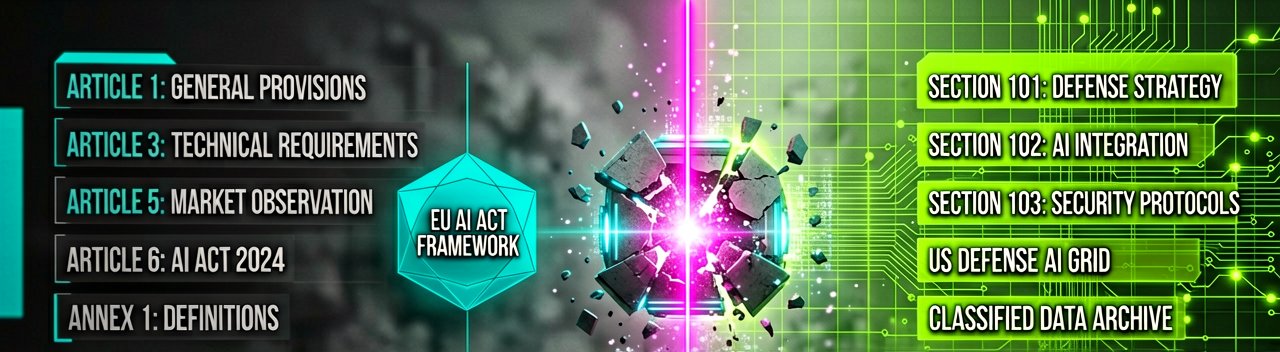
Meanwhile, the consolidation of international regulatory timelines is removing long-standing compliance ambiguities for multinational corporations. The political agreement on the European Union's "AI Omnibus" simplification package, details of which are maintained by the European Union, establishes concrete enforcement dates for high-risk system implementations. These synchronized global efforts are transforming AI risk management from an abstract governance exercise into a core driver of corporate strategy and technical architecture.
Transatlantic Alignment and the Evolution of Trust Mechanisms
G7 Industry, Digital, and Technology Ministers recently established unified principles targeting digital spaces for minors, emphasizing safety-by-design and mechanisms to curb AI-generated non-consensual content. In parallel, the United Kingdom enacted the Data Protection Act Regulations regarding AI and Automated Decision-Making, instructing the Information Commissioner's Office to implement binding codes of practice. These cross-border shifts, tracked by Tech Policy Press, require enterprises to embed robust age-assurance features and content-provenance tracking directly into generative AI pipelines.

The EU AI Omnibus and Operational Timelines
A major breakthrough occurred when European negotiators clinched a provisional agreement on the "Digital Omnibus on AI" to simplify enforcement and streamline the upcoming mandates of the EU AI Act. As outlined by the European Union, these adjustments establish definite target dates for high-risk AI applications in sectors like biometrics and critical infrastructure. This alignment gives corporate boards a concrete window to transition from theory to continuous lifecycle monitoring and evidence-ready governance.
Defense Integration and Sovereign Data Infrastructure
The strategic landscape saw further complexity as the Pentagon formalized pacts with major tech providers to integrate AI systems into highly classified networks, reflecting an "AI-first" operational doctrine recorded by Tech Policy Press. Simultaneously, financial regulators like the Bank of England and the Financial Conduct Authority issued joint guidance concerning frontier model risks and cyber resilience. This convergence of cybersecurity, national security, and data governance forces providers to build highly segregated data architectures that respect localized security protocols.
Behind the Scenes: Beyond the sweeping declarations of global ministers lies a highly fragmented compliance battlefield where corporate legal teams and software engineers are scrambling to re-architect foundational pipelines. The consensus reached by G7 digital ministers mandates strict safety-by-design architectures to detect and suppress AI-generated non-consensual content, as detailed by . This shift moves the regulatory burden of proof directly into the pre-deployment phase, requiring automated content validation. Consequently, developers must integrate deterministic filters and data-tagging protocols into enterprise applications to maintain compliance across multiple international jurisdictions.
Antitrust Disruption and Data Sovereignty Frictions
Antitrust regulators are matching this content scrutiny with aggressive structural investigations into the commercial economics of foundational models. According to the overview, South Korea’s Fair Trade Commission has initiated an inquiry across dozens of AI developers and service providers to dissect anti-competitive transaction practices. This investigation indicates that global regulators are moving beyond traditional consumer privacy concerns to address the core business agreements governing API distribution. Enterprise buyers can expect shifts in contract flexibility as state authorities target vertical integration to protect local ecosystems.
Simultaneously, amendments to South Korea's Personal Information Protection Act demonstrate a distinct dual-track strategy to manage domestic AI growth. Legislative updates allow the state to levy severe fines of up to 0.3 percent of average daily turnover on uncooperative controllers while providing financial and technical subsidies for small-scale AI model training, as tracked by . This regulatory asymmetry highlights a broader global trend where governments aggressively penalize non-compliance among dominant foreign tech firms while shielding domestic startups. Navigating these regional distinctions requires highly localized data handling architectures.
The National Security Imperative and Early-Access Auditing
In the United States, the regulatory focus has shifted decisively toward national security and state-supervised vulnerability scanning. A planned executive order highlighted in the US Tech Policy Roundup institutes a voluntary protocol for frontier AI developers to grant federal agencies early access to systems up to 90 days before public release. This initiative establishes a classified benchmarking process coordinated by the National Security Agency, the National Institute of Standards and Technology, and other executive bodies. For commercial developers, this introduces a complex pre-clearance horizon that forces corporate roadmaps to account for extensive state security audits before launching any next-generation model.
Reading Between the Lines: The prevailing narrative surrounding May's regulatory milestones paints a picture of a harmonized global architecture, yet a closer examination reveals a widening chasm between public diplomacy and sovereign self-interest. While G7 communiqués trumpet unified safety standards, individual member states are quietly weaponizing these frameworks to protect local market shares and secure domestic supply chains. This diplomatic theater masks a stark reality: multinational tech enterprises are not moving toward a single, streamlined global compliance standard, but rather toward a deeply fragmented environment where a model cleared in Washington may be functionally illegal in Brussels or Seoul.
The Sovereign Cloud and the Illusion of Interoperability
This contradiction is most visible in the tension between European risk-mitigation mandates and the United States' aggressive integration of frontier AI into defense infrastructure. The European Union's focus on auditable civil protections, streamlined under the provisional "AI Omnibus" package, presumes a transparent, verifiable ecosystem. However, this ideal collides directly with the Pentagon’s classified deployment strategies, which naturally reject third-party auditing and external oversight. Consequently, foundational model developers are forced into an unsustainable architectural split, maintaining separate, heavily siloed codebases to satisfy mutually exclusive definitions of trustworthy AI.
Furthermore, the aggressive enforcement postures adopted by Asian regulators expose the limits of Western-centric governance frameworks. The South Korean Fair Trade Commission’s sweeping investigation into AI transaction practices, paired with PIPA amendments that penalize foreign entities while subsidizing domestic training data, underscores a broader shift toward regulatory protectionism. Compliance is no longer just about mitigating algorithmic bias or ensuring data privacy; it has become a geopolitical tool used to discipline foreign technology monopolies under the guise of ethical oversight.
Ultimately, these regulatory frameworks may inadvertently stifle the very safety and transparency they aim to enforce. By imposing massive operational overhead and lengthy pre-clearance windows—such as the proposed 90-day federal security review in the United States—governments are raising the barrier to entry so high that only a handful of well-capitalized tech giants can survive. This creates a regulatory paradox where state intervention, designed to curb the unchecked power of Big Tech, actually solidifies their market monopolies by legally locking out open-source alternatives and agile startups that cannot afford army-sized compliance departments.
In the end, the grand quest for global AI governance resembles less a synchronized orchestra and more a high-stakes game of geopolitical musical chairs, where the music is composed of dense legal jargon and the only certifiable winners are the corporate defense attorneys billing by the hour.
Artūras Malašauskas is an AI Systems Integrator with 20+ years of production-grade web engineering experience. He has designed, shipped, and scaled enterprise Python/PHP systems for logistics, SaaS, and public-sector clients. For the past year, he has focused exclusively on AI integrations: deploying open-source LLMs, building generative media pipelines (image, audio, video), and engineering multi-agent workflows for real production environments. His standard: reproducibility, security, cost-efficient inference—no vaporware. He documents and evaluates emerging AI tooling, separating verified capabilities from marketing noise. Technical editor at: muza-ai.eu, ai-verslas.lt, ai-naujinos.lt Connect on LinkedIn
Comments