The Cyber Arms Race: Demystifying the AI Architectures Shielding the Enterprise
We've officially crossed the rubicon where human-guided security frameworks can no longer keep pace with automated digital extortion. As machine-speed threats rewrite the defensive playbook, enterprises are forced to fight code with code. The modern threat landscape isn’t just expanding; it's evolving into an environment of highly orchestrated, multi-stage cyber campaigns that exploit everything from legacy vulnerabilities to complex cloud identities.
At the center of this battle sits the next generation of Security Operations Centers, built entirely around agentic artificial intelligence. This shift moves past basic threshold alerts and places adaptive, self-learning models right on the digital frontline. The goal is no longer just stopping an attack at the perimeter, but out-thinking an adversary that's already operating deep within internal networks.
The Blueprints of Autonomous Defense
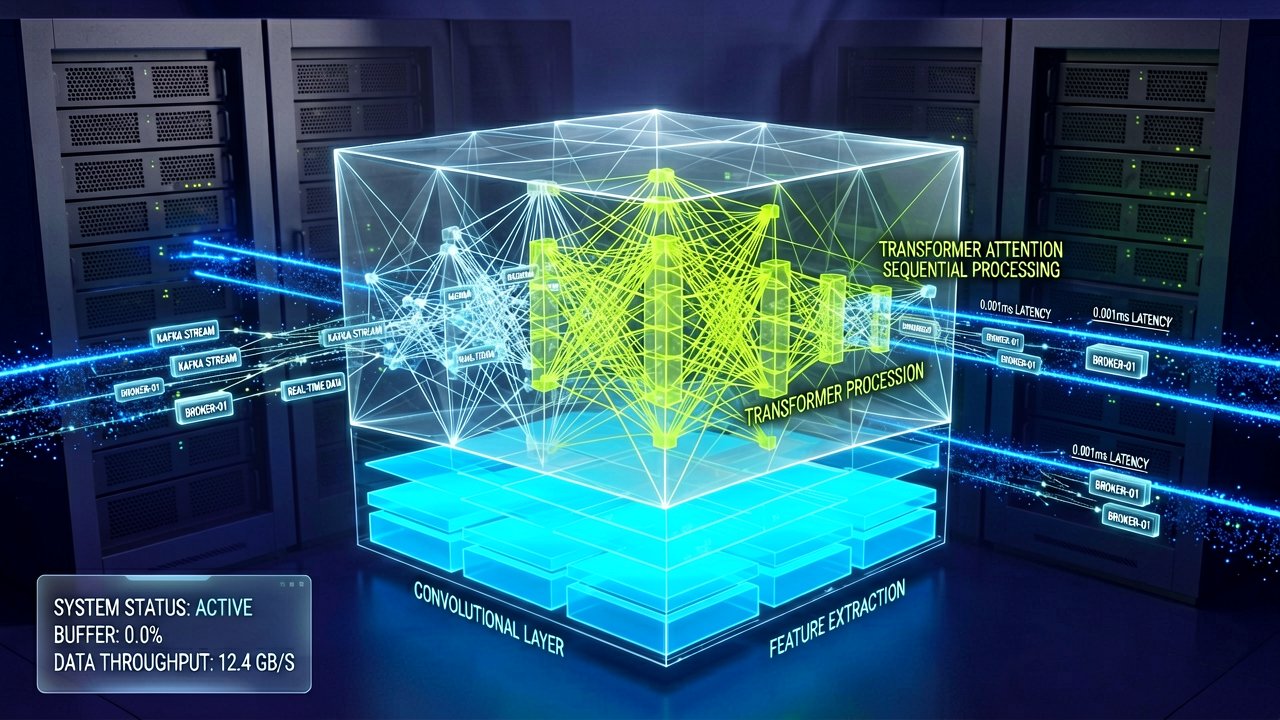
To understand how modern machine learning thwarts these next-gen attacks, you have to look closely at the underlying architecture. Today’s sophisticated defense systems rely on a hybrid pipeline. They combine lightweight convolutional neural networks for immediate, edge-based threat classification with bidirectional long short-term memory networks and transformer-based attention models to monitor real-time behavior. By ingesting massive volumes of raw system telemetry across distributed environments, these frameworks build an active baseline of typical operational behavior. They flag subtle anomalies—like strange process executions, data movements, or unusual login times—that traditional signature-based firewalls completely miss.
This structural change becomes vital as attackers focus less on initial entry and more on deeper network manipulation. According to a comprehensive research report published by Anthropic, malicious actors are increasingly leveraging AI in the later, more complex post-compromise stages of their operations. The study revealed that 6.5% of analyzed threat actors used AI explicitly to assist with lateral movement inside compromised networks, lowering the barrier to entry for highly technical techniques. To counter this, defensive models are structured to enforce zero-trust policies dynamically, using extended detection and response architectures that analyze identity relationships and cloud-native workloads concurrently.
The Real-World Metrics of Machine-Speed Triage
When you look at actual performance metrics, the impact of these automated systems becomes clear. Integrating machine learning into security tools reduces alert fatigue and optimizes triage workloads by up to 60%. Instead of sorting through thousands of disconnected daily events, analysts interact with unified, pre-correlated event chains. Data published by StationX shows that AI-augmented security teams detect incoming threats 50% faster than those relying on manual methods, helping blunt the impact of polymorphic malware and automated botnets.
The financial argument for moving to these automated pipelines is equally compelling. Organizations utilizing fully integrated security automation see dramatic reductions in total breach expenses. According to data tracked by IBM, AI and automation capabilities reduce average breach costs by roughly $1.90 million compared to organizations still relying on standard, manual incident response protocols. This capability transforms cybersecurity from a costly insurance policy into a critical, data-driven operational advantage.
The Vulnerability in the Armor
However, no technology is a silver bullet, and this rapid shift introduces fresh vulnerabilities. As defensive tools rely more heavily on continuous data ingestion, the machine learning models themselves become high-value targets for specialized attacks. Threat actors are actively trying to bypass these tools through data poisoning, model inversion, and evasion tactics designed to feed synthetic "normal" data into tracking models to hide malicious activity. This creates a continuous cycle of adaptation, forcing engineering teams to run extensive adversarial testing and implement strict data governance frameworks to ensure training data remains untainted.
The core challenge for leadership isn't just buying the right tools, but managing the operational friction between automated intelligence and human oversight. True resilience requires a balanced approach where AI handles roughly 70% of repetitive preparatory tasks and automated threat hunting, while human analysts retain the final 30% for strategic investigation and context-heavy judgment. Organizations that successfully build this collaborative pipeline can turn their security infrastructure into an evolving, proactive defense system capable of weathering the storm of fully automated cyber warfare.

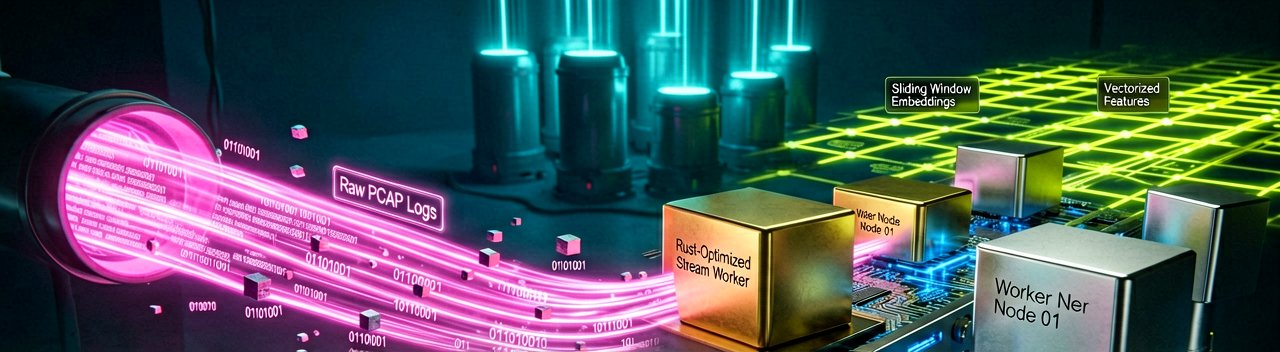
Behind the Scenes: Building an AI defensive engine that operates effectively at the enterprise perimeter requires far more than just connecting a pretrained model to a standard logging platform. At the systems level, engineers face a massive data throughput bottleneck. A typical global infrastructure generates millions of network events every second, requiring a deeply optimized data pipeline. This infrastructure relies on a real-time data streaming setup, often using Apache Kafka, coupled with low-latency time-series feature stores to ingest high-velocity data. Systems engineers focus heavily on writing custom stream-processing workers in languages like Rust or C++. These workers parse raw PCAP files and JSON audit logs into vectorized data shapes right at the ingestion layer, minimizing memory copies before the data ever reaches the inference engine.
To run real-time inference across this massive volume of network telemetry without crashing the system, engineers must avoid standard Python runtimes for core execution. Instead, production models are converted into highly optimized, compiled intermediate representations using frameworks like TensorRT or ONNX Runtime. This conversion pipeline applies intense pruning to remove redundant neural network pathways and uses 8-bit integer quantization to shrink the memory footprint of the models. By running these optimized models directly on specialized enterprise hardware, teams can slash inference latency from hundreds of milliseconds down to sub-millisecond windows. This architectural speed is what allows the defensive system to intercept malicious packets mid-stream, rather than just generating a retroactive alert after a data breach has already occurred.
Beyond raw execution speed, managing the memory layer presents its own set of complex engineering challenges. Security systems analyze long-running, multi-stage attacks by maintaining persistent context using Graph Neural Networks and customized attention windows. Storing entire raw connection histories in memory quickly exhausts hardware resources, so engineers use rolling, time-decaying feature hashes and sliding window embeddings. When a new system event arrives, the pipeline quickly computes its cosine similarity against an existing pool of active behavioral vectors. This allows the system to recognize when a sequence of seemingly harmless actions, spread across multiple days and user accounts, is actually a coordinated lateral movement attempt. The architecture can then isolate a compromised container or revoke an access token in milliseconds without requiring any manual human intervention.
Reading Between the Lines: The industry’s rush toward fully autonomous cyber defense glosses over a glaring paradox: we are building incredibly complex, black-box systems to protect infrastructures whose primary weakness is a lack of visibility. Security vendors routinely pitch machine learning as a silver bullet that eliminates the need for human oversight, yet these models are fundamentally reactive, trained entirely on historical data. This creates a dangerous strategic blind spot. By relying on historical telemetry to predict future threats, organizations risk building rigid digital fortresses optimized to defeat yesterday's adversaries while remaining completely exposed to novel, out-of-distribution attack vectors designed specifically to exploit model assumptions.
This reliance on automated triage also introduces an unspoken operational risk: the systematic deskilling of the Security Operations Center. As junior analysts spend their days merely rubber-stamping AI-generated incident summaries rather than digging through raw packet captures and system logs, the industry is inadvertently creating a workforce unable to function when the automation fails. If a sophisticated adversary successfully poisons a training pipeline or executes an evasion attack that renders the AI blind, the human team left in charge may lack the foundational, hands-on diagnostic skills required to hunt the threat manually. This shift doesn't actually eliminate operational risk; it simply concentrates it into the integrity of the machine learning pipeline itself.
Furthermore, the economic reality of maintaining these next-generation defensive platforms threatens to widen the security gap between global conglomerates and everyone else. The computational heavy lifting required to run continuous, real-time graph inference and multi-modal behavioral tracking demands massive cloud budgets or incredibly expensive on-premise hardware. While Fortune 100 enterprises can afford to train, fine-tune, and constantly audit their proprietary defensive models, mid-market organizations are forced to rely on generic, off-the-shelf security solutions. This creates a stratified ecosystem where smaller businesses become soft targets, running commoditized models that sophisticated threat groups can easily reverse-engineer and bypass in local testing environments.
The ultimate irony of the modern enterprise is spending millions on an advanced, self-healing artificial intelligence infrastructure, only to have the entire network brought down because an overworked executive clicked a blurry link promising free coffee.
Artūras Malašauskas is an AI Systems Integrator with 20+ years of production-grade web engineering experience. He has designed, shipped, and scaled enterprise Python/PHP systems for logistics, SaaS, and public-sector clients. For the past year, he has focused exclusively on AI integrations: deploying open-source LLMs, building generative media pipelines (image, audio, video), and engineering multi-agent workflows for real production environments. His standard: reproducibility, security, cost-efficient inference—no vaporware. He documents and evaluates emerging AI tooling, separating verified capabilities from marketing noise. Technical editor at: muza-ai.eu, ai-verslas.lt, ai-naujinos.lt Connect on LinkedIn
Comments