MediaTek Dimensity 8550 Debuts with Gemini Nano V3 AI Support, Set to Power Next-Gen Devices
On May 27, 2026, semiconductor giant MediaTek officially pulled back the curtain on its newest mid-range powerhouse, the Dimensity 8550. This piece of silicon targets premium mid-range Android smartphones, aiming to democratize Google's highly demanding Gemini Intelligence ecosystem. The rollout represents a strategic leap forward, bringing complex, agent-like artificial intelligence features down from the wallet-busting flagship tier to more accessible, consumer-friendly devices.
The Architecture and Silicon Under the Hood
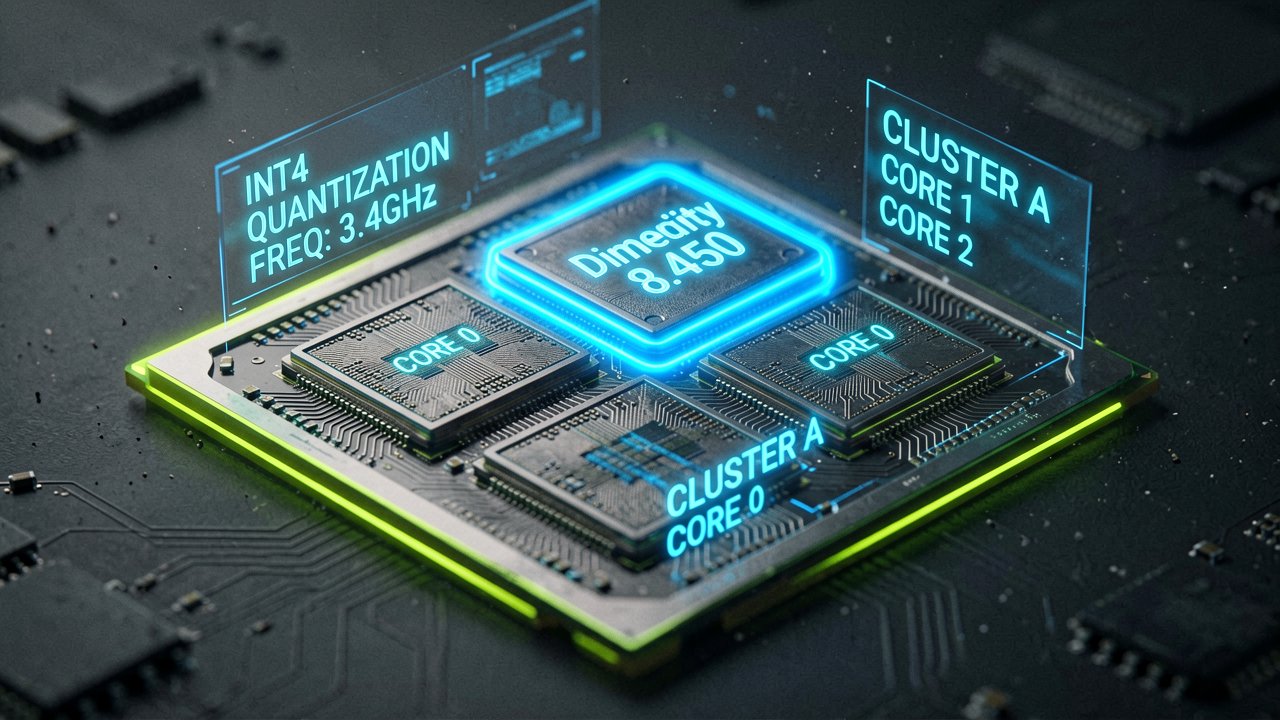
To understand what makes the Dimensity 8550 tick, you have to look closely at its predecessor, the Dimensity 8500. Fabricated on TSMC’s robust 4nm N4P process node, the new chip keeps the raw computing foundation virtually identical to the previous generation. It is packed with an "All Big Core" CPU design that omits small efficiency cores entirely. Instead, the layout utilizes eight Arm Cortex-A725 cores configured in a three-cluster setup. The prime core sprints up to 3.4GHz with 1MB of L2 cache, backed by three mid-cores clocked at 3.2GHz, and four clocking in at a more conservative 2.2GHz. On-device gaming and visuals are driven by the familiar Arm Mali-G720 MC8 GPU, pushing 1440p+ displays up to a buttery smooth 144Hz refresh rate.
What separates this refresh from last year's hardware is an explicitly engineered "LLM Booster" integrated alongside the existing MediaTek NPU 880. Google’s latest on-device AI ecosystem, Gemini Nano V3, requires serious structural optimization to manage memory and compute parameters efficiently. MediaTek resolved this hurdle not by redesigning the core NPU from scratch, but by tuning the hardware pipeline with advanced software and hardware compression techniques. This includes mixed-precision INT4 quantization, speculative decoding for faster inference, and native support for Diffusion Transformers. By integrating these specific optimizations, the chip dramatically accelerates Large Language Model execution without hammering the battery.
Bringing Flagship AI to Mid-Range Phones
What Most Reports Miss: This release is a calculated business move designed to counter the growing sentiment that local AI features are an exclusive luxury for thousand-dollar flagships. Earlier this year, complex system prerequisites left mid-range buyers looking at standard cloud-connected tools rather than true, on-device intelligence. By pairing the optimized NPU with rapid LPDDR5X RAM speeds hitting 9,600Mbps and snappy UFS 4.0 storage, MediaTek is engineering a loophole. They are giving phone manufacturers the exact hardware foundation required to run deeply integrated, privacy-focused AI models without forcing consumers to pay top-tier premiums.

Smartphone manufacturers are already jumping at the opportunity to implement the new silicon. According to early ecosystem reports, initial devices running on the Dimensity 8550 platform are already breaking cover. The Chinese market variants of the Honor 600 Pro and the OPPO Reno 16 5G are among the very first commercial handsets utilizing the chip to run local Gemini Nano V3 tasks. These devices showcase the processor's ability to handle up to 320MP camera sensors via the Imagiq 1080 ISP, alongside modern 5G Advanced connectivity and Wi-Fi 6E networks.
While online community consensus from tech enthusiasts on platforms like occasionally labels incremental chip refreshes as marketing spin, the real-world implications point elsewhere. For the average user, the architectural fine-tuning means tasks like native grammar checking, offline predictive text, localized dictation, and smart photo editing happen instantly on-device. This approach keeps data off remote corporate servers and heavily slashes latency. MediaTek is focusing its engineering efforts exactly where the market is moving, showing that refining an existing node for modern software demands is often a much smarter play than over-engineering raw speed.
On May 27, 2026, semiconductor giant MediaTek officially pulled back the curtain on its newest mid-range powerhouse, the Dimensity 8550. This piece of silicon targets premium mid-range Android smartphones, aiming to democratize Google's highly demanding Gemini Intelligence ecosystem. The rollout represents a strategic leap forward, bringing complex, agent-like artificial intelligence features down from the wallet-busting flagship tier to more accessible, consumer-friendly devices.
The Architecture and Silicon Under the Hood
To understand what makes the Dimensity 8550 tick, you have to look closely at its predecessor, the Dimensity 8500. Fabricated on TSMC’s robust 4nm N4P process node, the new chip keeps the raw computing foundation virtually identical to the previous generation. It is packed with an "All Big Core" CPU design that omits small efficiency cores entirely. Instead, the layout utilizes eight Arm Cortex-A725 cores configured in a three-cluster setup. The prime core sprints up to 3.4GHz with 1MB of L2 cache, backed by three mid-cores clocked at 3.2GHz, and four clocking in at a more conservative 2.2GHz. On-device gaming and visuals are driven by the familiar Arm Mali-G720 MC8 GPU, pushing 1440p+ displays up to a buttery smooth 144Hz refresh rate.
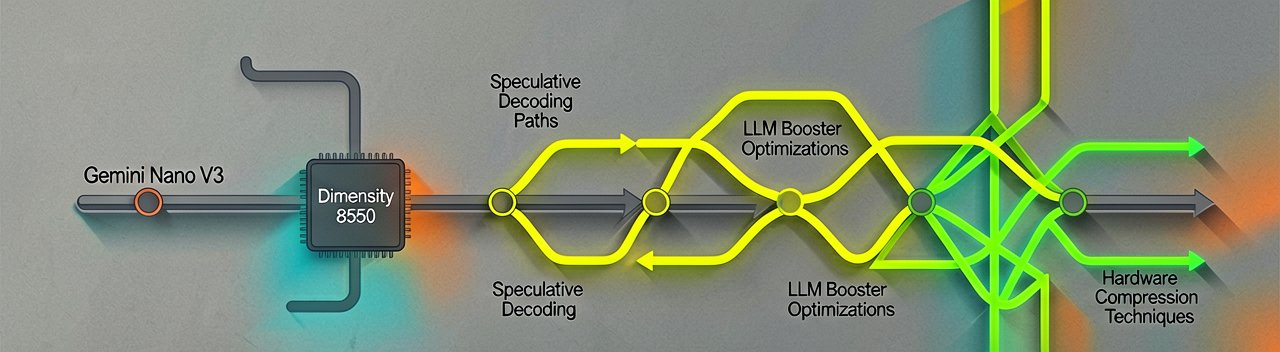
What separates this refresh from last year's hardware is an explicitly engineered "LLM Booster" integrated alongside the existing MediaTek NPU 880. Google’s latest on-device AI ecosystem, Gemini Nano V3, requires serious structural optimization to manage memory and compute parameters efficiently. MediaTek resolved this hurdle not by redesigning the core NPU from scratch, but by tuning the hardware pipeline with advanced software and hardware compression techniques. This includes mixed-precision INT4 quantization, speculative decoding for faster inference, and native support for Diffusion Transformers. By integrating these specific optimizations, the chip dramatically accelerates Large Language Model execution without hammering the battery.
Bringing Flagship AI to Mid-Range Phones
What Most Reports Miss: This release is a calculated business move designed to counter the growing sentiment that local AI features are an exclusive luxury for thousand-dollar flagships. Earlier this year, complex system prerequisites left mid-range buyers looking at standard cloud-connected tools rather than true, on-device intelligence. By pairing the optimized NPU with rapid LPDDR5X RAM speeds hitting 9,600Mbps and snappy UFS 4.0 storage, MediaTek is engineering a loophole. They are giving phone manufacturers the exact hardware foundation required to run deeply integrated, privacy-focused AI models without forcing consumers to pay top-tier premiums.
Smartphone manufacturers are already jumping at the opportunity to implement the new silicon. According to early ecosystem reports, initial devices running on the Dimensity 8550 platform are already breaking cover. The Chinese market variants of the Honor 600 Pro and the OPPO Reno 16 5G are among the very first commercial handsets utilizing the chip to run local Gemini Nano V3 tasks. These devices showcase the processor's ability to handle up to 320MP camera sensors via the Imagiq 1080 ISP, alongside modern 5G Advanced connectivity and Wi-Fi 6E networks.
While online community consensus from tech enthusiasts on platforms like occasionally labels incremental chip refreshes as marketing spin, the real-world implications point elsewhere. For the average user, the architectural fine-tuning means tasks like native grammar checking, offline predictive text, localized dictation, and smart photo editing happen instantly on-device. This approach keeps data off remote corporate servers and heavily slashes latency. MediaTek is focusing its engineering efforts exactly where the market is moving, showing that refining an existing node for modern software demands is often a much smarter play than over-engineering raw speed.
The Realities of the Mid-Range AI Illusion
Reading Between the Lines: The celebration surrounding flagship-tier AI trickling down to mid-range devices glosses over a gaping logistical contradiction. Google’s Gemini Nano V3 is an undeniable memory hog, requiring immense chunks of system RAM to be permanently carved out and dedicated exclusively to local AI inference tasks. While the Dimensity 8550 technically supports blazing-fast memory speeds, phone brands targeting tighter mid-range budgets rarely equip their base models with the 12GB or 16GB of physical RAM necessary to let these models breathe. This creates a severe fragmentation problem where the chip is entirely capable of running local intelligence, but the actual phone in your hand might restrict it out of financial necessity.
There is also a palpable irony in MediaTek relying on an identical CPU and GPU configuration to handle this next-gen intelligence layer. By using software patches and INT4 quantization tricks to force Gemini Nano V3 into the same hardware footprint as last year, the company is treating silicon design as a game of optimization rather than evolution. If early benchmarks of quantized models on flagship chips are any indication, shrinking a model down to fit lighter hardware often results in a distinct loss of contextual nuance and accuracy. Users expecting a seamless, all-knowing digital agent might instead find themselves interacting with a heavily watered-down assistant that struggles with complex, multi-turn conversations.
Ultimately, this launch positions MediaTek beautifully in marketing brochures, but shifting the processing burden to local silicon changes the fundamental nature of device longevity. Constantly running local LLM inference engines, even with specialized boosters, subjects mid-range thermal cooling systems to sustained workloads they were never traditionally built to handle. Over time, the aggressive caching and heavy memory paging required by on-device AI will test the durability of mid-range UFS storage drives. The industry is rushing ahead to sell the promise of localized AI, seemingly content to let consumers find out later how these demanding tasks impact their phone's long-term health and daily battery degradation.
We are rapidly entering an era where your mid-range phone has enough local intelligence to write your corporate emails, edit your vacation photos, and perfectly predict your next text message—assuming, of course, that the continuous background processing leaves it with enough battery life to stay turned on until lunchtime.
Artūras Malašauskas is an AI Systems Integrator with 20+ years of production-grade web engineering experience. He has designed, shipped, and scaled enterprise Python/PHP systems for logistics, SaaS, and public-sector clients. For the past year, he has focused exclusively on AI integrations: deploying open-source LLMs, building generative media pipelines (image, audio, video), and engineering multi-agent workflows for real production environments. His standard: reproducibility, security, cost-efficient inference—no vaporware. He documents and evaluates emerging AI tooling, separating verified capabilities from marketing noise. Technical editor at: muza-ai.eu, ai-verslas.lt, ai-naujinos.lt Connect on LinkedIn
Comments