The Silicon Horizon: How Neural Dawn Weaponizes Arm’s Next-Gen Hardware to Revolutionize Mobile Rendering

Mobile gaming has long lived in the shadow of its desktop and console siblings, shackled by strict thermal limits and a power budget that rarely pushes past five watts. For years, the dream of running true real-time ray tracing on a device that fits in your pocket seemed like a fool's errand. However, a major structural shift is arriving, and it is doing so via a joint technological showcase from Arm and Sumo Digital called Neural Dawn. Rather than squeezing more brute-force transistors into the silicon, Arm is aiming to fundamentally alter the mobile rendering pipeline by leveraging hardware-level machine learning.
Historically, mobile chips have relied on standard compute shaders to execute AI workloads, a compromise that invariably leads to sluggish performance and rapidly draining batteries. To shatter this bottleneck, Arm’s upcoming mobile architecture integrates dedicated neural accelerators directly into its next-generation Arm Mali GPUs, which will anchor the upcoming Arm Compute Subsystems (CSS) for mobile platforms later this year. By introducing specialized hardware akin to the tensor cores found in desktop graphics cards, Arm allows neural graphics and raw rasterization compute to share the heavy lifting within a strict thermal envelope.
Architectural Magic and the Power Budget Savings
The visual centerpiece of this architectural evolution is the successful porting of Unreal Engine’s complex MegaLights technology to a handheld format. Neural Dawn operates as a fully production-grade, four-level Android experience where a research scientist navigates an intricately lit, collapsing cave network. To make hundreds of dynamic lights and ray-traced shadows viable on a smartphone, Arm's neural graphics stack steps in to handle the heavy mathematical lifting. Because rendering these advanced effects natively at 1080p would instantly melt a phone's battery, the game processes the core graphics at a much lower baseline resolution, leaving the heavy lifting of reconstruction to dedicated AI hardware.
This is where the performance metrics move from theoretical marketing to raw reality. Utilizing Arm's Neural Super Sampling and Denoising (NSSD), the silicon can upscale an image from 540p to a crisp 1080p in a mere 4 milliseconds per frame, slashing the overall GPU rendering workload by up to 50 percent according to an official report from Arm Newsroom. By reclaiming half of the graphics budget, mobile game developers no longer have to compromise on artistic vision or target unplayably low frame rates. Furthermore, the architecture deploys Neural Frame Rate Upscaling (NFRU) to intelligently interpolate intermediate frames, effectively doubling perceived motion fluidity without placing additional stress on the physical graphics core.

A Practical Playbook for the Future Ecosystem
What makes this rollout particularly significant for the broader industry is Arm's commitment to avoiding the closed-source fragmentation that frequently plagues desktop graphics ecosystems. The tools driving this demonstration are completely open, providing game creators with direct access via specialized Unreal Engine plug-ins and Vulkan API emulation tools. Instead of leaving developers to guess how to properly balance neural upscaling against native battery life, the lessons gleaned from this project have been compiled into a comprehensive development kit. While premium flagship smartphones landing later this year will be the first to flex this hardware, the technology establishes a concrete foundation for a future where mobile hardware finally stands toe-to-toe with dedicated home consoles.
Behind the Scenes: The architectural magic underpinning this mobile transformation relies on a radical restructuring of the memory subsystem and a strict approach to compute pipelining. For a systems engineer, the primary enemy on mobile platforms is not raw ALU cycle count, but rather the immense power drawn by off-chip DRAM access. In traditional rendering setups, high-fidelity geometry and dynamic lighting passes force the GPU to constantly read from and write to system memory, creating a massive bandwidth bottleneck. To mitigate this data movement, the next-generation Arm Mali GPU architecture introduces an enlarged unified cache tier that keeps critical frame metadata on-chip during the neural inference cycle.
The core computational optimization happens at the precision level during the execution of the Neural Super Sampling and Denoising pipeline. Instead of relying on standard 32-bit floating-point math, the neural graphics pipelines leverage mixed-precision execution, dynamically shifting between FP16 and INT8 calculations depending on the specific rendering pass. For edge detection and structural high-contrast areas, FP16 maintains geometric sharpness without clipping artifacts, while the more forgiving color-space interpolation and ambient denoising are packed into INT8 registers. This dual-pipeline execution doubles the throughput of the tensor units, effectively halving the latency of the frame reconstruction pass.
Low-Level Pipelining and API Integration
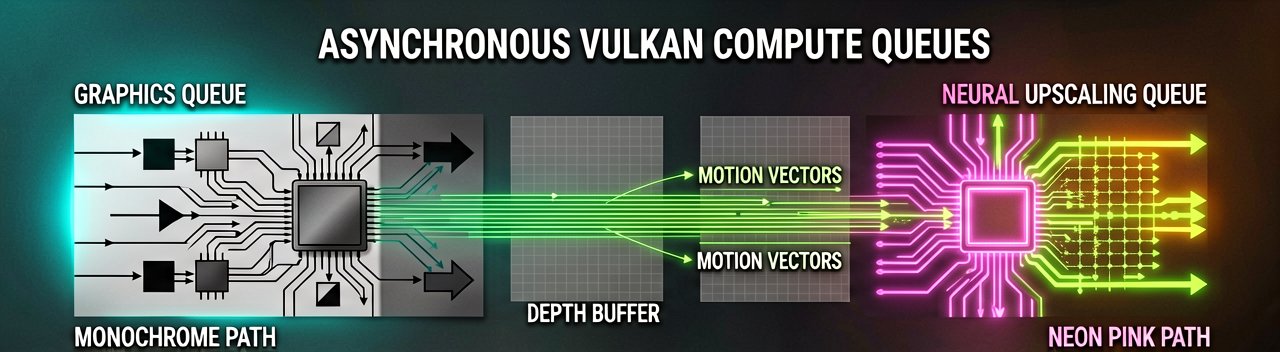
To prevent the CPU from stalling while waiting for neural workloads to finish, the integration utilizes asynchronous compute queues via the Vulkan API. The game engine submits the traditional rasterization commands to the graphics queue, while simultaneously feeding historical frame vectors, depth buffers, and motion vectors to the dedicated compute queue for AI processing. This asynchronous execution model guarantees that the physical shading units are never sitting idle, filling what would otherwise be wasted bubbles in the GPU pipeline with productive upscaling calculation.
Memory virtualization also plays a decisive role in keeping the frame times consistent under heavy thermal strain. By implementing advanced descriptor indexing and sparse texture binding within the Unreal Engine sub-routines, the engine allocates fixed chunks of VRAM exclusively for the neural weights of the upscaling models. This prevents the operating system from aggressively paging memory during fast camera movements, ensuring a steady stream of input data to the hardware accelerators and eliminating the micro-stuttering that frequently breaks immersion in demanding mobile titles.
Reading Between the Lines: The industry’s rush to crown neural rendering as the savior of mobile gaming ignores a glaring hardware contradiction. Silicon vendors love to showcase immaculate, sustained frame rates inside air-conditioned demonstration booths, but the reality of a smartphone trapped in a consumer's warm hand is a different beast entirely. While offloading rasterization to dedicated AI hardware reduces the thermal load on the traditional GPU cores, those neural accelerators still draw power and generate heat on the exact same system-on-chip. If the thermal envelope of the device is already maxed out by an intense 3D game loop, adding a continuous stream of high-frequency AI inference cycles could simply shift the throttling bottleneck from the graphics engine to the neural processing unit.
Furthermore, the reliance on open-source Vulkan extensions and generic plug-ins introduces an optimization paradox that developers will have to untangle. In the console space, engineers write code for fixed, identical hardware targets, allowing them to squeeze every ounce of performance out of the silicon. The Android ecosystem, conversely, remains hopelessly fragmented across multiple generations of chipsets, display refresh rates, and varying memory bandwidth limits. An upscale routine that takes exactly 4 milliseconds on a flagship development board might take three times longer on a mid-range phone from a different manufacturer, forcing developers to maintain parallel code paths and largely defeating the purpose of a unified, AI-driven rendering standard.
The Real-World Cost of Simulated Pixels
There is also an unspoken aesthetic trade-off when a game relies so heavily on hallucinated frames and reconstructed pixels to hit its performance metrics. Micro-stuttering, ghosting around fast-moving character models, and a distinct lack of texture clarity in fine geometric details are common side effects of aggressive temporal upscaling. While these visual artifacts might pass unnoticed on a tiny, fast-moving smartphone display during casual play, they become glaringly obvious during complex, dark scenes like the subterranean environments shown in the tech demo. The industry must carefully consider whether pushing for heavy desktop features like ray tracing is worth sacrificing the crisp, native sharpness that mobile gamers have come to expect from modern high-density OLED panels.
Ultimately, the true success of this architectural shift will not be measured by synthetic benchmarks, but by developer adoption rates. Writing highly optimized, mixed-precision Vulkan pipelines requires a specialized skill set that many mobile studios, accustomed to rapid development cycles and aggressive monetization models, may be reluctant to invest in. If only a handful of premium, flagship-exclusive titles leverage these advanced neural units, the hardware will remain an expensive gimmick rather than an industry-wide revolution. Arm has built an undeniably impressive piece of silicon engineering, but convincing a fractured industry to fundamentally rewrite its rendering pipelines remains the highest hurdle of all.
It turns out that the future of pocket-sized photorealism isn't about pushing more pixels, but rather about teaching a tiny piece of silicon how to guess what those pixels should have looked like in the first place—assuming your phone doesn't melt your phone case first.
Artūras Malašauskas is an AI Systems Integrator with 20+ years of production-grade web engineering experience. He has designed, shipped, and scaled enterprise Python/PHP systems for logistics, SaaS, and public-sector clients. For the past year, he has focused exclusively on AI integrations: deploying open-source LLMs, building generative media pipelines (image, audio, video), and engineering multi-agent workflows for real production environments. His standard: reproducibility, security, cost-efficient inference—no vaporware. He documents and evaluates emerging AI tooling, separating verified capabilities from marketing noise. Technical editor at: muza-ai.eu, ai-verslas.lt, ai-naujinos.lt Connect on LinkedIn
Comments