Silicon Symbiosis: Deconstructing the Zhenwu M890 Architecture and Qwen3.7-Max’s 35-Hour Marathon
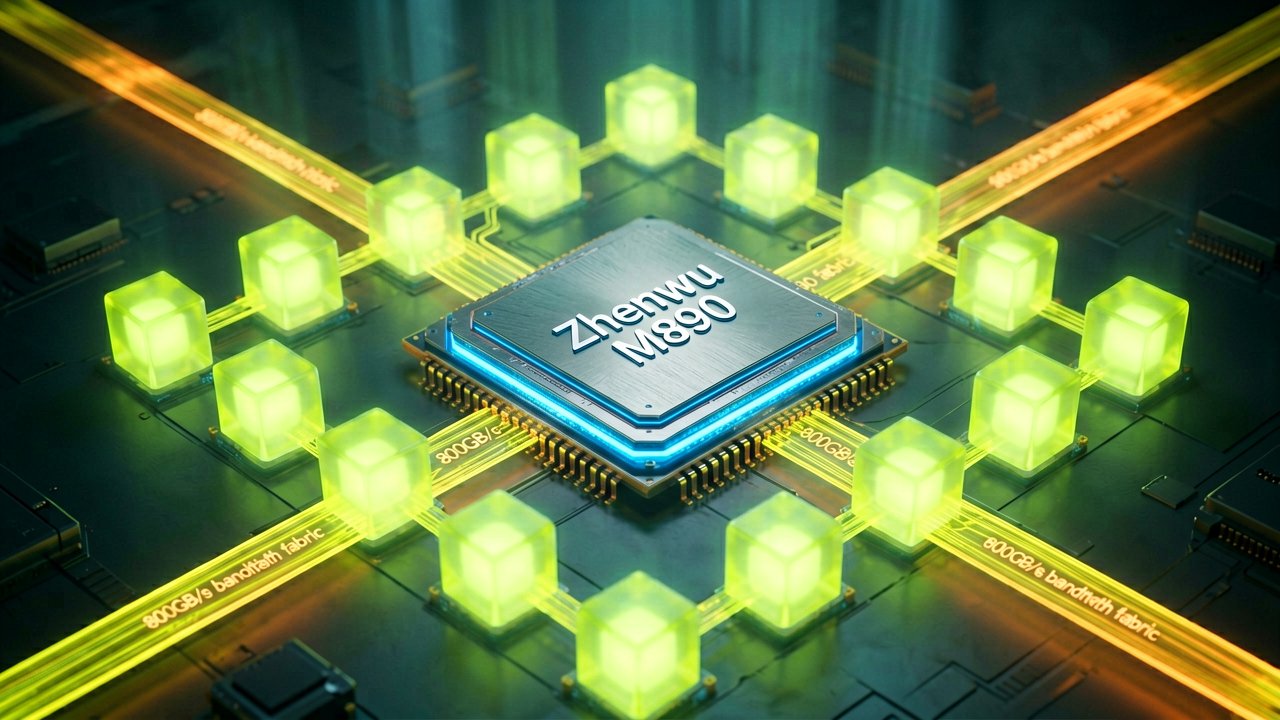
Alibaba Cloud didn't just drop new hardware and a shiny software update at its annual summit; it showcased a fundamentally unified approach to the next era of computing. In an industry plagued by fragmented hardware-software development loops, the simultaneous unveiling of the custom-designed Zhenwu M890 AI accelerator and the proprietary Qwen3.7-Max large language model signals a profound shift. This combination isn't merely an incremental upgrade designed to navigate ongoing geopolitical chip bans. Instead, it is a deliberate, highly specialized blueprint built to withstand the punishing demands of long-horizon agentic workflows, moving past the simple prompt-and-response mechanics of yesteryear into true operational independence.
The true standout of the announcement wasn't the raw specifications, but rather an unprecedented engineering demonstration reported by TechTimes . Alibaba tasked Qwen3.7-Max with writing, compiling, and optimizing a critical performance software stack for the brand-new, completely undocumented Zhenwu silicon. Operating inside an isolated environment without human guidance, the model autonomously iterated across a grueling 35-hour marathon. This recursive loop—where an AI model designs and perfects the software infrastructure that makes its own underlying silicon run efficiently—unveils a self-optimizing "AI factory" concept that changes how we think about full-stack engineering.
Under the Hood of the Zhenwu M890 Silicon
Developed by T-Head, Alibaba's dedicated chip design subsidiary, the Zhenwu M890 is built to handle heavy concurrent training and inference workloads. Analysis from CNBC confirms that the processor delivers a three-fold performance increase over its predecessor, the Zhenwu 810E. To achieve this, the architecture shifts away from specialized inference processing toward balanced, large-scale token generation and agent coordination.
- Memory Allocation: The chip carries 144GB of high-speed GPU memory, an upgrade from the 96GB found on the previous generation, providing the essential capacity to retain vast context windows.
- Interchip Bandwidth: A massive 800GB per second fabric handles interchip communication, easing memory-bottlenecked operations when models coordinate across complex agent networks.
- Precision Framework: The silicon introduces native support for multiple data precision formats, scaling efficiently from standard FP32 all the way down to low-precision FP4 computation.
- Scale Infrastructure: Alibaba packages 128 of these accelerators into its new Panjiu AL128 server rack, pooling individual nodes into petabyte-per-second single-rack bandwidth systems.
The 35-Hour Operation: Breaking the Agentic Horizon
Standard language models frequently fall into repetitive logical loops or forget early instructions after a few dozen turns. To counter this, Alibaba engineered Qwen3.7-Max specifically for long-horizon agent tasks, boosting its context window to a massive 1 million tokens. The model's endurance was tested by letting it optimize an Extend Attention compute kernel from scratch on the newly minted Zhenwu M890 platform.
Details published by the Qwen Team show that the model executed 1,158 tool calls and 432 individual kernel evaluations over 35 continuous hours. When compilation failed, the model self-diagnosed the errors, combed through CUDA documentation, and reworked the code. It executed five separate architectural redesigns of the software kernel. By the time it finished, the AI-generated code yielded a 10x geometric mean speedup compared to standard reference implementations. This level of autonomy proves that long-running AI agents can reliably solve intricate, multi-file software engineering problems without human intervention.
What Most Reports Miss: The Architectural Synergy
The true genius of the Zhenwu M890 development cycle is not found in the raw transistor counts or the impressive 35-hour operational metric, but rather in how the silicon and the model were engineered to co-evolve. Historically, hardware teams spent years designing a chip before handing the physical silicon over to software engineers who then spent months compiling libraries for a target model. Alibaba inverted this sluggish cascade. By utilizing early-stage hardware emulators, the Qwen engineering team shaped the microarchitecture of the M890 to specifically mirror the attention-mechanism bottlenecks inherent to their latest models, effectively treating chip design and transformer architecture as two halves of a singular software system.
This deep hardware-software co-design addresses a massive financial pain point for enterprise cloud providers. In standard AI data centers, GPUs frequently sit idle for microseconds waiting for data to travel across the PCIe bus or between disparate memory pools, a costly inefficiency known as the "von Neumann bottleneck." The Zhenwu M890 eliminates this by embedding a specialized scheduler directly into the silicon logic. This scheduler allows the Qwen3.7-Max model to dynamically reconfigure cache priorities on the fly during long-horizon reasoning phases. When the model shifts from processing broad context to executing precision logic, the underlying hardware instantly shifts its layout to maximize memory throughput for that specific computational pattern.
Industry insiders view this tight vertical integration as a vital defensive play against tightening global trade restrictions. By developing custom silicon via T-Head and deploying proprietary algorithms, Alibaba has insulated its cloud infrastructure from external supply chain disruptions while slashing the astronomical premiums typically paid to dominant merchant silicon vendors. This strategy closely mirrors the vertical integration paths taken by Western hyper-scalers like Google with its Tensor Processing Units and Amazon Web Services with its Trainium chips, yet Alibaba has executed this transition at a far faster pace out of sheer geopolitical necessity.
Ultimately, the successful 35-hour autonomous optimization marathon serves as a loud wake-up call for the broader software engineering industry. This experiment proved that when an advanced model is granted deep, unrestricted access to the underlying instruction set architecture of specialized silicon, the pace of optimization accelerates exponentially. Human engineers would have taken weeks of trial, error, and collaborative debugging to achieve a 10x speedup on an undocumented chip architecture. By handing the keys over to a self-correcting agentic loop, Alibaba has demonstrated that the future of semiconductor optimization belongs to the machines themselves.
Reading Between the Lines: The Illusion of Independence
While Alibaba’s 35-hour autonomous marathon is undeniably an engineering triumph, the industry's rush to label this a "fully autonomous AI factory" ignores several glaring operational realities. The narrative implies a pristine, self-contained loop where the machine acts with true agency. However, the reality of long-horizon execution is heavily dependent on carefully pre-engineered safety rails, highly structured tool environments, and deterministic reward functions curated by human engineers. Qwen3.7-Max did not decide to optimize an Extend Attention kernel; it was pointed at a specific, bounded mathematical problem with a clearly defined success metric. True autonomy remains a marketing horizon, not a current technical reality.
Furthermore, this vertical integration strategy introduces a dangerous paradox regarding system fragility and lock-in. Hyper-customizing the software stack to the specific quirks of the Zhenwu M890 architecture creates a highly efficient but remarkably brittle ecosystem. If Alibaba needs to pivot its hardware strategy due to sudden supply chain disruptions or sudden shifts in transistor availability, the hyper-optimized code generation scripts developed by Qwen3.7-Max could instantly become legacy technical debt. The more an AI model customizes code to a proprietary silicon layout, the harder it becomes for an enterprise to migrate workloads to industry-standard merchant silicon or alternative cloud providers.
There is also the unresolved question of resource irony. Using a massive, power-hungry frontier model like Qwen3.7-Max for 35 continuous hours to squeeze efficiency gains out of a hardware kernel represents a staggering upfront energy expenditure. Hyper-scalers rarely publish the exact carbon footprint or the computing cost required to run these multi-day optimization marathons. If a model consumes megawatts of power just to discover a 10x speedup for a localized chip library, the true net-positive ROI of the operation might take months, if not years, of high-volume inference execution to actually break even.
We must also look skeptically at the broader implications for the global developer workforce. Alibaba’s demonstration proves that low-level infrastructure engineering—the grueling, precise work of writing compilers and optimizing hardware kernels—is highly vulnerable to automation. Yet, the developers who build the debugging sandboxes and evaluate the failure modes of these AI agents are more critical than ever. The industry is not eliminating human oversight; it is merely shifting the human's role from the active writer of code to the exhausted supervisor of an indefatigable, fast-talking digital intern.
"We are rapidly entering an era where hardware is too complex for humans to optimize, and software is too vast for humans to write. We can only hope that when the machines finish rewriting their own chip architectures, they remember to leave a legacy port open for the humans who pay the electricity bill."
Artūras Malašauskas is an AI Systems Integrator with 20+ years of production-grade web engineering experience. He has designed, shipped, and scaled enterprise Python/PHP systems for logistics, SaaS, and public-sector clients. For the past year, he has focused exclusively on AI integrations: deploying open-source LLMs, building generative media pipelines (image, audio, video), and engineering multi-agent workflows for real production environments. His standard: reproducibility, security, cost-efficient inference—no vaporware. He documents and evaluates emerging AI tooling, separating verified capabilities from marketing noise. Technical editor at: muza-ai.eu, ai-verslas.lt, ai-naujinos.lt Connect on LinkedIn
Comments