Alibaba’s Full-Stack Play: How Built-in Silicon and Qwen3.7-Max Codified the 'Agent Era'
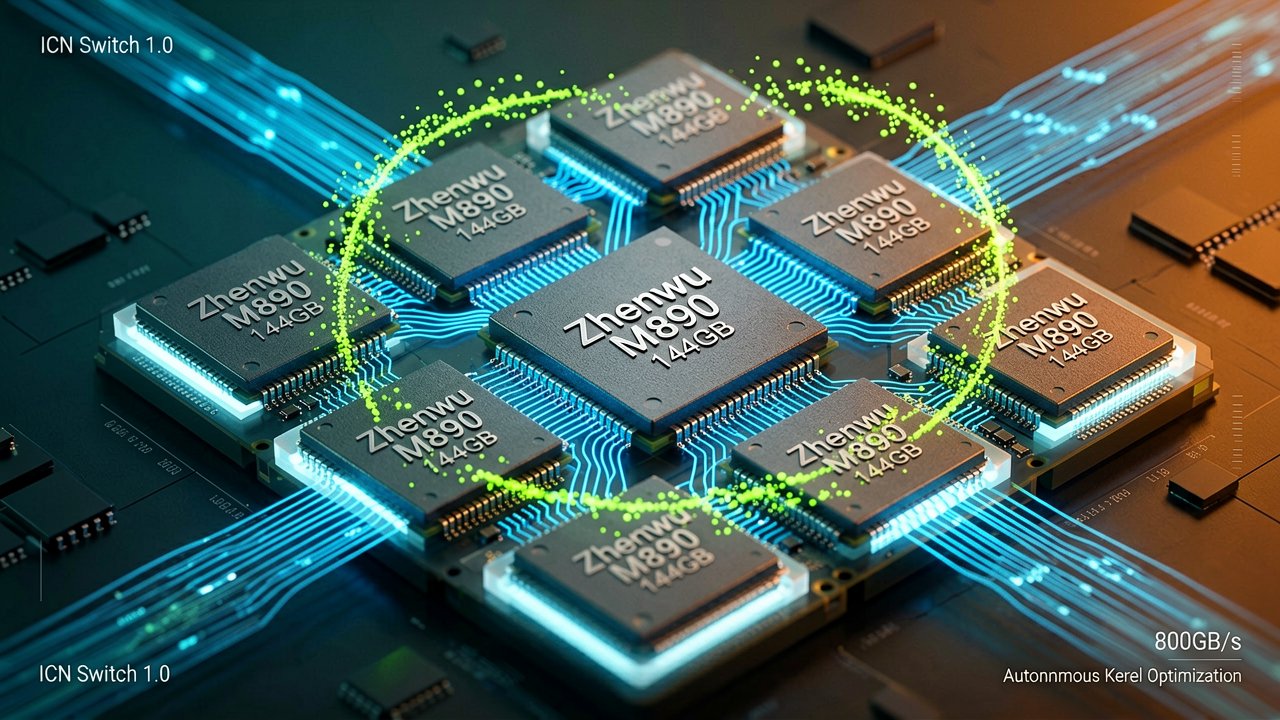
Alibaba is aggressively executing a comprehensive technology strategy designed to claim total sovereignty over its artificial intelligence ecosystem. At its recent cloud summit in Hangzhou, the e-commerce and cloud infrastructure behemoth introduced its most formidable hardware-and-software combination yet: the custom-designed Zhenwu M890 AI accelerator alongside its flagship frontier LLM, Qwen3.7-Max. This isn't just a standard hardware refresh or an incremental software update. Instead, it marks a highly coordinated attempt to outmaneuver aggressive U.S. export controls by building an entirely self-sufficient, top-to-bottom Chinese AI stack. Observers monitoring the transition point out that Alibaba's approach essentially positions it as a localized, vertical superpower capable of handling everything from physical silicon up to multi-step agentic operations.
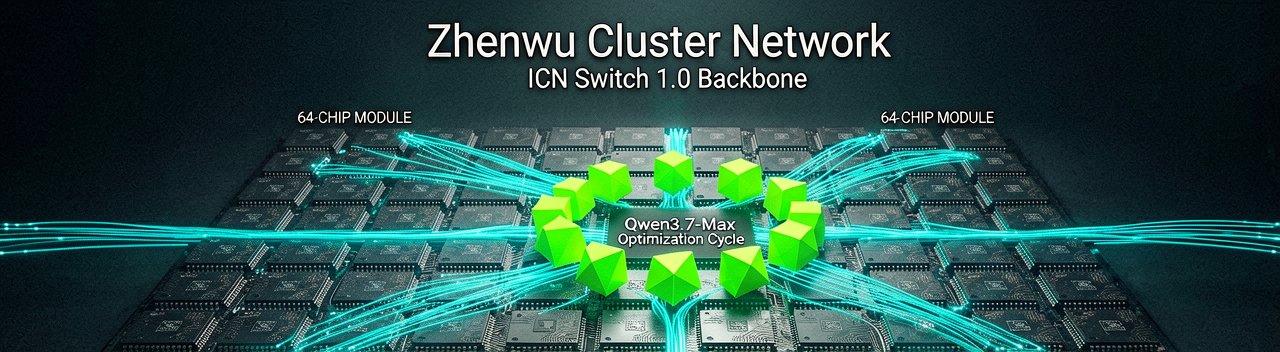
The engineering focal point of the announcement is the Zhenwu M890, a silicon powerhouse developed by Alibaba’s dedicated chip design subsidiary, T-Head. According to an in-depth breakdown by Quartz, the new chip boasts 144GB of high-performance GPU memory and an impressive interchip bandwidth of 800GB per second, generating roughly three times the performance output of its immediate predecessor, the Zhenwu 810E. When paired with T-Head's custom ICN Switch 1.0, the architecture can seamlessly tie 64 accelerators together into a full-bandwidth, congestion-free network. Industrial scale-up is already well underway. Alibaba has reportedly delivered over 560,000 Zhenwu units to roughly 400 external enterprise clients spanning automotive and financial sectors, transforming what began as an internal mitigation strategy into a fully commercialized, domestic alternative to forbidden Western silicon.
The Autonomous Loop and the Software Engine
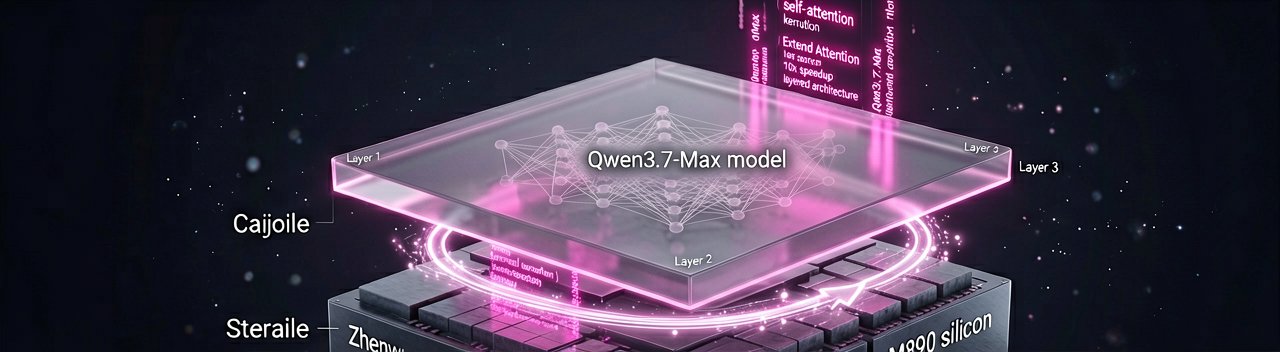
Where this rollout transitions from standard enterprise news into true tech journalism intrigue is the tight, recursive integration between the physical hardware and the new Qwen3.7-Max large language model. Rather than showcasing the model via typical static benchmarks, Alibaba demonstrated its capability by setting it loose on its own, previously undocumented chip architecture. As documented by Tech Times, Qwen3.7-Max ran autonomously for 35 hours straight on the Zhenwu platform without any human intervention. During this marathon engineering run, the AI model executed 1,158 tool calls and five distinct architectural redesigns to write and optimize its own performance-critical software stack. The final output delivered a stunning 10x speedup on an Extend Attention kernel compared to standard reference implementations. In short, the model proved it can reliably optimize the very chips that keep it running.
This long-horizon autonomy underscores why Alibaba proudly calls Qwen3.7-Max its definitive foundation for the "agent era." The model features a massive 1-million-token context window alongside a robust 64K maximum output limit, offering developers plenty of canvas to process sprawling codebases or automate complex multi-step workflows. Furthermore, Alibaba’s development team deliberately made Qwen3.7-Max scaffold-agnostic. Rather than locking developers into a proprietary environment, the flagship model is built to operate as a drop-in intelligence layer across external frameworks like Anthropic’s Claude Code, OpenClaw, or Hermes Agent. As Washington continues to tighten its regulatory grip on advanced chip shipments, Alibaba is demonstrating that real architectural independence comes from owning both the code and the silicon.
Behind the Scenes of the Domestic Supply Chain Pivot
The sudden ascent of the Zhenwu M890 reveals a profound geopolitical calculus that traditional product reviews rarely capture. For years, domestic tech giants treated custom silicon as a secondary fallback plan—a hedge against theoretical supply disruptions while they happily relied on Western standard-bearers. However, the relentless tightening of unilateral export restrictions transformed T-Head from an experimental research division into a critical line of defense for the company’s cloud infrastructure. By pushing the Zhenwu series into mass commercialization across hundreds of enterprise clients, Alibaba is effectively underwriting the maturation of a localized supply chain. This move helps the broader domestic market absorb the shock of missing out on cutting-edge global iterations.
Industry insiders point out that the real breakthrough with the M890 is not just the raw performance metrics, but how it solves the persistent "interconnect bottleneck" that has historically plagued alternative chips. When building massive server clusters, chips must talk to each other instantly; otherwise, processing power drops off a cliff. By coupling the hardware with the proprietary ICN Switch 1.0, engineers circumvented these bandwidth chokepoints without relying on restricted Western networking IP. This architectural workaround shows a level of maturity that suggests domestic semiconductor designers are no longer just copying global blueprints, but are actively inventing their own physical routing paradigms out of sheer necessity.
From a stakeholder perspective, the autonomous coding run performed by Qwen3.7-Max is a carefully orchestrated proof-of-concept meant to reassure anxious enterprise clients. Transitioning an established business from familiar software environments to an untried, custom-silicon ecosystem is notoriously expensive and prone to bugs. By showcasing a model that can autonomously diagnose, rewrite, and optimize its own kernels, Alibaba is sending a clear signal to the market. The company is demonstrating that software-defined automation can dramatically lower migration costs, absorb the friction of architectural shifts, and optimize performance far faster than human engineering teams ever could on their own.
Ultimately, this unified launch shifts the nature of competition in the cloud sector from isolated hardware or software leadership to full-stack vertical integration. Alibaba is betting that the future of enterprise AI does not belong to those who build the biggest models or the fastest chips in a vacuum, but to those who control the entire loop. By demonstrating that its flagship model can directly enhance the efficiency of the very silicon it inhabits, the company has established a self-improving technical flywheel. This closed loop could very well insulate its cloud ecosystem from future regulatory storms while establishing a new baseline for high-horizon agentic autonomy.
Reading Between the Lines of the Automated Breakthrough
The narrative of an artificial intelligence model flawlessly optimizing its own underlying silicon makes for an undeniable public relations triumph, but it glints with a bit of corporate theater. While a tenfold speedup on an Extend Attention kernel is technically impressive, specialized kernels represent highly isolated, low-hanging fruit in the grand scheme of software engineering. Alibaba's heavily promoted 35-hour autonomous run intentionally obscures the massive, human-engineered guardrails required to keep Qwen3.7-Max from hallucinating its code into a dead end. Celebrating this as total engineering autonomy overlooks the reality that human architects still design the sandbox, define the success metrics, and carefully curate the toolsets the model is allowed to touch.
Furthermore, this vertical integration strategy exposes a glaring structural contradiction within Alibaba’s broader business model. The company has aggressively championed an open-source, scaffold-agnostic philosophy for the Qwen model family to attract global developers who rely on diverse infrastructure. Yet, the true efficiency gains of Qwen3.7-Max are increasingly locked behind the proprietary, closed-loop architecture of T-Head’s custom hardware. Alibaba is essentially trying to ride two horses at once: positioning itself as the open, flexible champion of the developer community while simultaneously building a highly restrictive, vertically integrated walled garden reminiscent of Western technology monopolies.
This full-stack pivot also carries significant long-term operational risks that measured observers cannot ignore. By tying its frontier software advancement so tightly to domestic silicon production, Alibaba is effectively pinning its future competitiveness to the yields and lithography limits of local chip foundries. Should domestic hardware manufacturing hit a geopolitical or technological ceiling, the evolution of the Qwen software stack could inadvertently choke. For all the praise surrounding hardware-software co-design, tightly coupled systems mean that a bottleneck in one layer inevitably cripples progress in the other.
If this self-optimizing loop fails to scale beyond isolated kernel patches into systemic, full-scale architectural design, the economic calculus changes dramatically. Enterprise clients might appreciate the national sentiment of a fully domestic stack, but global market realities still demand cost efficiency and raw computational power. If the Zhenwu and Qwen combination cannot maintain pace with unconstrained global computing platforms, the domestic tech push risks becoming a highly expensive, subsidized enclave. Alibaba has undeniably proven it can build a functional, self-improving life raft; whether that raft can outrun a luxury cruise liner in the open market remains a fiercely contested proposition.
"We are officially entering an era where the hardware engineers build the chips, the software engineers write the prompts, and the AI spends the weekend rewrite-coding the entire infrastructure just to prove everyone else was being terribly inefficient."
Artūras Malašauskas is an AI Systems Integrator with 20+ years of production-grade web engineering experience. He has designed, shipped, and scaled enterprise Python/PHP systems for logistics, SaaS, and public-sector clients. For the past year, he has focused exclusively on AI integrations: deploying open-source LLMs, building generative media pipelines (image, audio, video), and engineering multi-agent workflows for real production environments. His standard: reproducibility, security, cost-efficient inference—no vaporware. He documents and evaluates emerging AI tooling, separating verified capabilities from marketing noise. Technical editor at: muza-ai.eu, ai-verslas.lt, ai-naujinos.lt Connect on LinkedIn
Comments