Inside Google’s Beam Lab, an AI Face Appears
For years, Google’s Project Starline—now officially rebranded as Google Beam—has felt like a sci-fi magic trick. Step into a specialized booth, look at a massive light-field display, and you are suddenly making direct, stereoscopic eye contact with another human being located thousands of miles away. But during a recent, exclusive tour of Google's Mountain View labs, the engineering team threw a massive curveball into the telepresence mix. This time, the life-sized, hyper-realistic person staring back from across the virtual desk wasn't a human being at all. It was an artificial intelligence agent named Sophie.
Dressed in a dark turtleneck and rendered with startlingly humanlike body language, Sophie represents a massive shift in how we might soon interact with generative AI. According to a firsthand account by The Verge, this experimental "Beam video agent" can see everything in the room, read text off a physical phone screen held up to its cameras, and seamlessly hold conversations in multiple languages. It takes the abstract concept of a large language model and gives it a literal face, transforming a sterile chat prompt into a deeply immersive, spatial dialogue.
The Architecture of an Uncanny Conversation
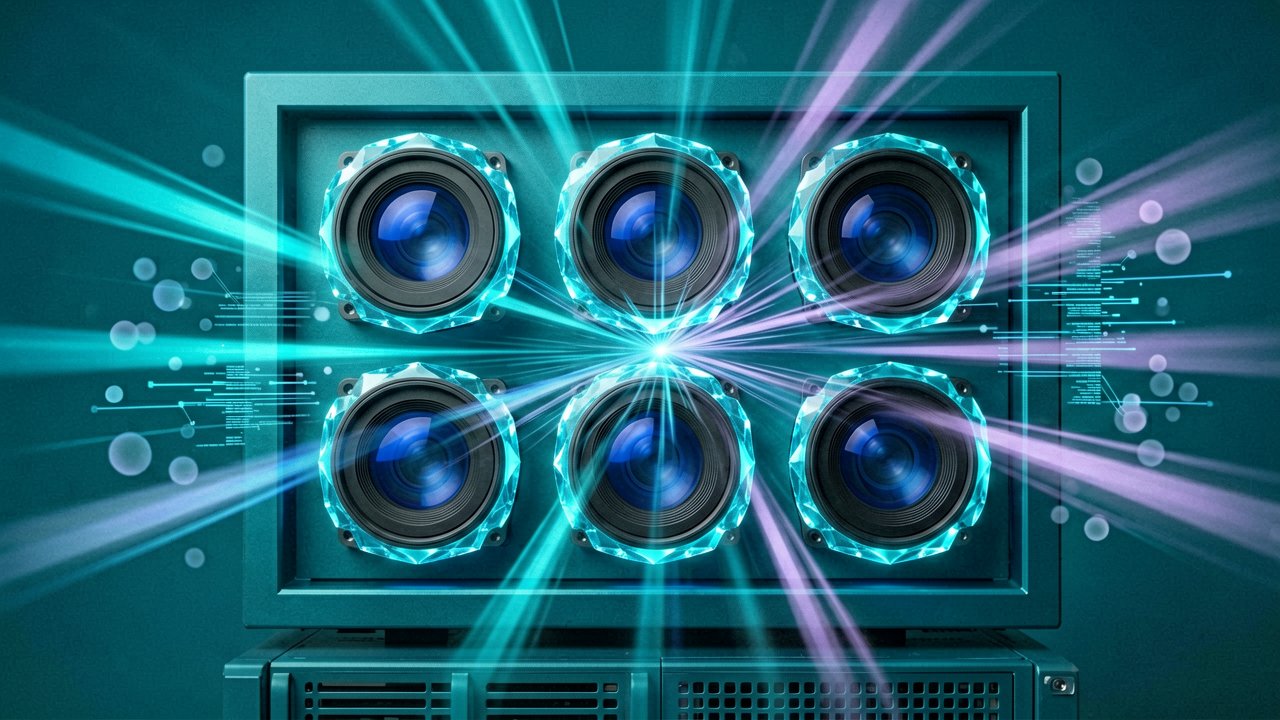
What Most Reports Miss: The magic of Sophie isn't just the underlying code of the AI, but the sheer computational muscle required to push a virtual persona through Google's complex hardware stack. The physical framework relies on the upcoming enterprise hardware built in partnership with HP, known as the HP Dimension. Originally slated for enterprise rollouts at a steep $24,999 price tag, the rig uses an array of six specialized 2D cameras and a custom 65-inch lenticular display to generate a real-time, volumetric 3D illusion without requiring any bulky VR headsets or AR glasses.
While standard Beam calls stitch together six distinct camera feeds to map a real person's geometry into the cloud at 60 frames per second, animating an AI agent requires entirely different algorithmic heavy lifting. Google’s servers must procedurally generate the agent's facial expressions, micro-movements, and eye contact on the fly, matching the visual output perfectly with the viewer's head movements. Right now, the tech is so fresh that the Sophie demo still runs in a highly optimized 2D mode on the display, though Google confirms the ultimate goal is full, stereoscopic 3D integration.

Behind the locked doors of the Beam Lab, the scale of this engineering push is fully apparent. Visitors noted massive server racks undergoing accelerated stress testing and robotic arms systematically mimicking human head-tracking to refine the system’s millimeter-level precision. Andrew Nartker, the general manager of Google Beam, emphasized that the project remains deeply experimental, with internal teams already testing these volumetric agents inside virtual reality environments to bridge the gap between physical meeting spaces and the metaverse.
Despite the jaw-dropping tech, massive hurdles remain before Sophie or her digital peers make it into your local corporate boardroom. Google has noticeably held back from announcing any formal commercial release date or pricing structures for its video agents, keeping the project firmly labeled as a proof-of-concept. For now, the tech serves as an elegant, slightly eerie glimpse into a future where talking to a machine feels exactly like pulling up a chair with an old friend.
The Uncanny Valley of Corporate Telepresence
Reading Between the Lines: The tech industry’s sudden obsession with giving AI a human face masks a profound contradiction in corporate logic. For years, enterprise software giants have pitched AI as the ultimate tool for asynchronous efficiency—a way to replace long, grueling meetings with automated summaries, text-based workflows, and immediate chat scripts. Yet, with projects like Google’s Beam Lab agents, the engineering directive shifts to recreating the exact time-consuming, face-to-face rituals that data-driven organizations have spent a decade trying to optimize away. We are building hyper-advanced, multi-million-dollar holographic hardware specifically to slow down machine communication to the speed of human speech.
This push for high-fidelity facial simulation also ignores a fundamental psychological barrier. Human beings are evolutionary hardwired to spot micro-expressions, muscle tensions, and tiny irregularities in eye contact. While standard Beam calls succeed because they map actual human bone structure, synthesizing these quirks artificially risks plunging the user straight into the deepest trenches of the uncanny valley. The moment a conversational agent pauses for half a second too long to calculate a response, or its digital eyes fail to dilate correctly to simulated room lighting, the illusion fractures, transforming what should be a seamless corporate collaboration into a subtle, low-grade horror movie.
Furthermore, the logistical bottleneck of this technology cannot be ignored. Google and HP may envision a future of volumetric boardrooms, but the reality of a massive 65-inch specialized display and a dense array of cameras makes the setup inherently elitist, confined to C-suite executives and ultra-wealthy enterprise clients. If AI agents require specialized, hardware-heavy infrastructure just to feel "human," they run counter to the democratized, software-first distribution model that made large language models an overnight global phenomenon. The tech risks becoming a spectacular, localized boardroom novelty rather than a ubiquitous workplace utility.
Ultimately, the true test for these digital personas will not be their visual fidelity, but their underlying utility. A life-sized, beautifully rendered AI agent that occasionally hallucinates corporate data or misunderstands a critical spreadsheet is merely a more expensive version of a broken chatbot. Google is gambling that visual empathy will compensate for the inherent limitations of generative AI, betting that we will trust a machine more simply because it looks us in the eye while delivering an answer.
We are rapidly approaching a workplace future where you can look your synthetic AI coworker dead in the eye across a virtual desk, only to realize that despite twenty cameras and a twenty-five-thousand-dollar holographic screen, it still doesn't know how to fix the office printer.
Artūras Malašauskas is an AI Systems Integrator with 20+ years of production-grade web engineering experience. He has designed, shipped, and scaled enterprise Python/PHP systems for logistics, SaaS, and public-sector clients. For the past year, he has focused exclusively on AI integrations: deploying open-source LLMs, building generative media pipelines (image, audio, video), and engineering multi-agent workflows for real production environments. His standard: reproducibility, security, cost-efficient inference—no vaporware. He documents and evaluates emerging AI tooling, separating verified capabilities from marketing noise. Technical editor at: muza-ai.eu, ai-verslas.lt, ai-naujinos.lt Connect on LinkedIn
Comments