Throw and Go: Teledyne FLIR’s FirstLook 125 Rewrites the Tactical Recon Playbook

Modern tactical reconnaissance is no longer about creeping around corners and praying there is not a trap waiting on the other side. Instead, it is about throwing a rugged, heavily armored sensor package directly into harm's way before putting personnel at risk. Unveiled at SOF Week, the brand-new FirstLook 125 throwable unmanned ground vehicle from Business Wire highlights a massive shift in how frontline operators gather intelligence. Weighing just 5.7 pounds, this pint-sized powerhouse can survive 16-foot drops onto solid concrete, flip itself right side up instantly, and start streaming encrypted video back to its user.
What makes the FirstLook 125 particularly interesting to anyone tracking military hardware is not just its ability to take a beating, but how it connects to the broader tactical ecosystem. Teledyne FLIR Defense designed this ground robot to share an operational architecture and a common controller with their Black Hornet 4 nano-drone. This means a single operator can seamlessy switch between flying a miniature helicopter over a compound and driving a rugged UGV through a shattered window, all using the exact same handheld console. It eliminates the clunky, multi-screen setups that have plagued dismounted infantry units for a generation.
Built for the Dirt and Denied Environments
On the mobility front, the FirstLook 125 uses rugged, articulated flippers to climb over rubble, push through dense debris, and scale stairwells that would trap simpler wheeled platforms. The robot carries an upgraded day-and-night electro-optical and infrared camera suite alongside integrated illumination, meaning low-light or smoke-filled rooms do not blind the operator. Because modern battlefields are increasingly defined by electronic warfare, the system relies on encrypted, low-latency video and control links to keep operating reliably even when GPS is knocked completely offline.
What Most Reports Miss: The Convergence of Air and Ground Intelligence
While a rugged, throwable robot is inherently fascinating to hardware enthusiasts, the real story here is the subtle unification of disparate military tech. For decades, ground-based tactical robots and aerial nano-drones operated as entirely separate silos, often manufactured by competing defense contractors. This forced dismounted squads to pack their rucksacks with distinct controllers, charging cradles, and proprietary radio transmitters. Teledyne FLIR’s decision to unify the FirstLook 125 with the Black Hornet 4 drone ecosystem solves a massive logistical headache for elite operators who measure success by ounces carried on their backs.

This push toward a single control interface reflects a broader, urgent shift within modern infantry doctrine. Defense analysts frequently note that cognitive overload is one of the greatest hazards facing soldiers in high-stress urban combat. When a unit comes under fire, an operator does not have the luxury of fumbling through multiple menus or swapping out distinct handheld monitors to switch from an aerial view to a ground view. By streamlining the user experience into a single tactical controller, the system dramatically lowers the time it takes to build situational awareness when seconds count.
From a manufacturing and engineering perspective, this rollout also marks the evolution of the legacy FirstLook platform, which has seen service globally for over a decade. Earlier iterations were lauded for their toughness but lacked the computational horsepower required for modern electronic warfare environments. This upgraded iteration brings updated digital architecture capable of handling heavier encryption algorithms, ensuring that captured video feeds cannot be easily intercepted or jammed by sophisticated near-peer adversaries using localized electronic countermeasures.
Ultimately, the deployment of these unified systems signals where tactical intelligence is heading. Instead of treating unmanned systems as independent tools deployed for niche scenarios, modern militaries are moving toward holistic, multi-domain squads where air and ground assets complement each other automatically. A drone maps the rooftop sniper positions from above, while a throwable robot clears the booby-trapped basement below, all feeding data into the same digital map shared by the team.
Reading Between the Lines: The Cost of Ultimate Durability
While the prospect of a single operator seamlessly toggling between an airborne drone and a throwable ground robot sounds like a seamless tactical utopia, the reality on the ground often collides with severe logistical and financial bottlenecks. Defense contractors excel at showcasing sleek, integrated ecosystems in promotional videos, but implementing these systems at scale across conventional units introduces massive budgetary strain. Miniature tech engineered to survive a 16-foot drop onto concrete requires exotic materials and tight manufacturing tolerances, translating to a unit cost that often makes field commanders hesitant to actually risk the hardware in the chaotic environments it was built to endure.
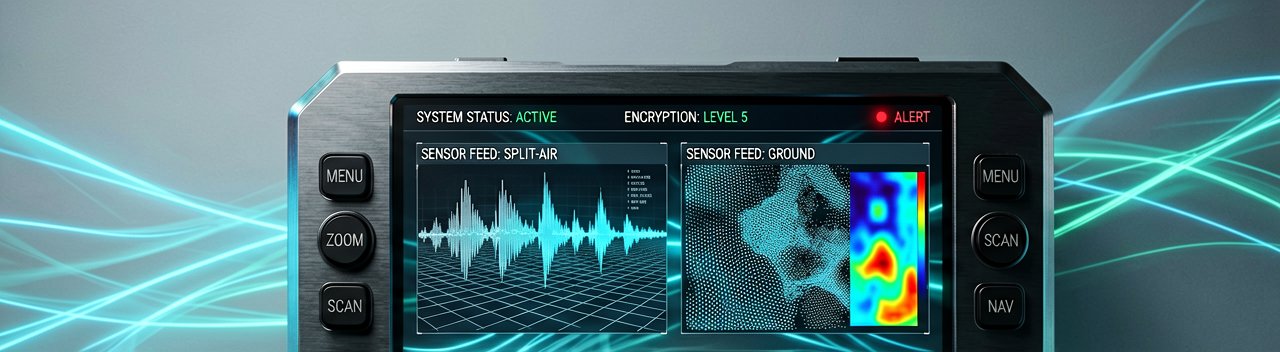
Furthermore, the reliance on a single, centralized controller introduces a critical single point of failure that contradicts the basic military principle of redundancy. If the universal tactical console is damaged, captured, or suffers a battery failure, the entire local unmanned ecosystem—both the aerial eye-in-the-sky and the ground-level scout—instantly becomes expensive, non-functional dead weight in an operator's pack. Splitting capabilities across independent systems may be clunky, but it ensures that a single piece of shrapnel cannot blind an entire unit across multiple operational domains simultaneously.
There is also an inherent tension between the demand for advanced, data-heavy features and the constraints of a jammed electronic environment. Teledyne FLIR heavily emphasizes high-definition video streaming and complex encryption, yet the laws of physics dictate that high-bandwidth signals are the easiest to detect, trace, and disrupt. In a high-intensity conflict against an adversary equipped with sophisticated electronic warfare capabilities, radiating a persistent, localized signal from a ground robot can inadvertently turn a stealthy scout into a homing beacon for enemy artillery, exposing the very squad it was deployed to protect.
Looking ahead, the success of this unified tactical concept will depend entirely on software adaptability rather than hardware ruggedness. As AI-driven counter-drone and anti-robot systems mature at a blistering pace, hardware platforms that cannot rapidly patch their communication protocols will face obsolescence long before their physical chassis wear out. The true test for the FirstLook 125 will not be whether it can survive a tumble down a flight of concrete stairs, but whether its digital backbone can survive the invisible, rapidly mutating electronic warfare landscape of tomorrow's battlefield.
"We have finally achieved the pinnacle of modern infantry engineering: a multi-thousand-dollar robot designed explicitly to be thrown out a window, leaving operators to hope the encryption holds longer than the battery life, and that nobody forgets the proprietary charging cable back at the base."
Artūras Malašauskas is an AI Systems Integrator with 20+ years of production-grade web engineering experience. He has designed, shipped, and scaled enterprise Python/PHP systems for logistics, SaaS, and public-sector clients. For the past year, he has focused exclusively on AI integrations: deploying open-source LLMs, building generative media pipelines (image, audio, video), and engineering multi-agent workflows for real production environments. His standard: reproducibility, security, cost-efficient inference—no vaporware. He documents and evaluates emerging AI tooling, separating verified capabilities from marketing noise. Technical editor at: muza-ai.eu, ai-verslas.lt, ai-naujinos.lt Connect on LinkedIn
Comments