Alibaba’s New Zhenwu M890 Silicon Proves China’s AI Market Won't Wait for Nvidia
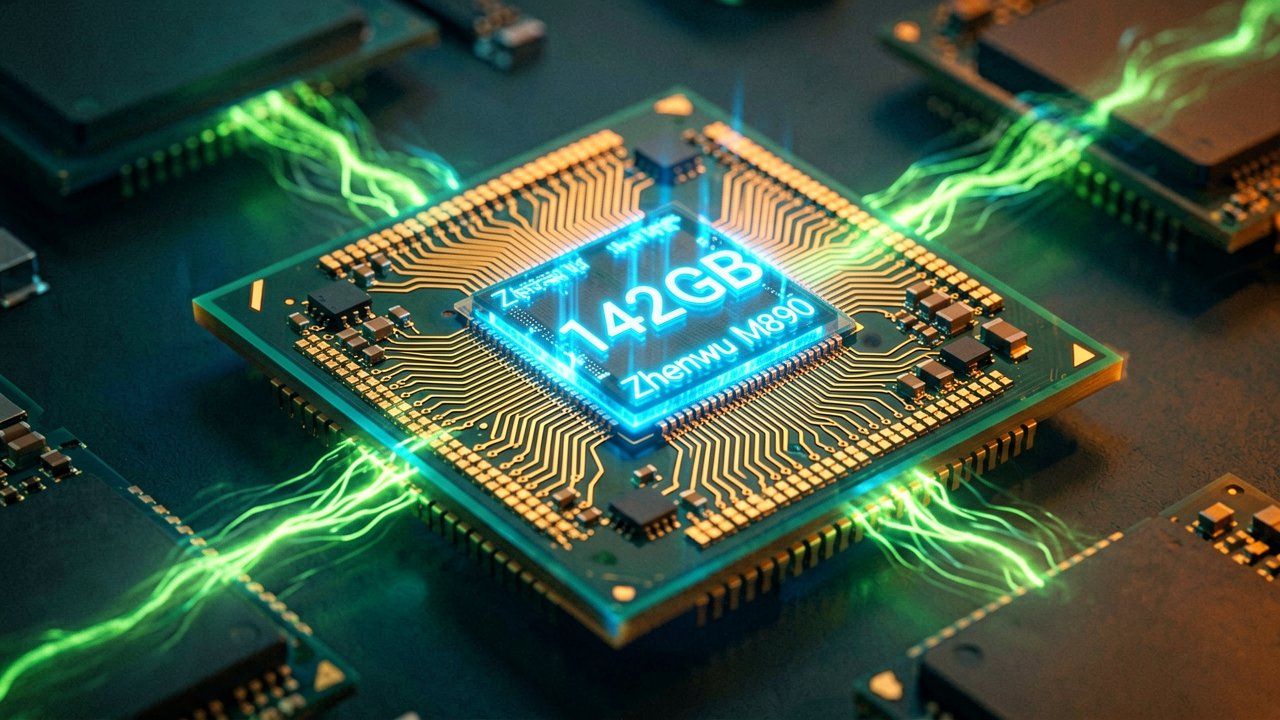
Alibaba isn't just letting Washington’s export blocks dictate the future of its cloud empire. At its annual Cloud Summit in Hangzhou, the e-commerce and technology behemoth rolled out its latest piece of homegrown hardware: the Zhenwu M890 AI chip. Developed by its semiconductor design division, T-Head, the new processor lands at a critically strategic moment. It represents a massive triple-performance leap over its predecessor, the Zhenwu 810E, and arrives just as Western access to the domestic Chinese market hits unprecedented gridlock, as reported by CNBC.
Instead of merely acting as a stopgap, the Zhenwu M890 brings serious engineering muscle to the table. Packaged with a hefty 144 gigabytes of GPU memory and an inter-chip network bandwidth of 800 gigabytes per second, this accelerator shifts focus significantly. While older hardware mainly scrambled to handle basic inference, the M890 tackles both heavy-duty model training and inference. Alibaba claims the architecture is specifically optimized for "agentic AI"—the next-generation autonomous software layers requiring relentless memory pipelines to coordinate multi-step tasks over long hours without losing context. To prove the point, the company paired the hardware reveal with a sneak peek at its upcoming Qwen3.7-Max model, which is engineered to run complex coding tasks continuously for up to 35 hours.
The geopolitical subtext here is impossible to ignore. As Washington's sweeping bans shut off top-tier architectures like Nvidia's Blackwell or Rubin lines, Chinese enterprise buyers have faced an infrastructure vacuum. Industry analysts note that while the M890 may not trade blows on pure raw silicon power with un-degraded Western flagships, it doesn't actually have to. By offering a localized, high-bandwidth "Plan B," Alibaba is shielding the domestic ecosystem from unpredictable regulatory shifting sands. This strategy appears to be gaining traction; T-Head confirmed it has already shipped over 560,000 units across the Zhenwu family to more than 400 major corporate accounts, as detailed by Reuters.
A Full-Stack Roadmap Beyond the Regulatory Vacuum
What makes this launch notable isn't just a single chip, but the aggressive multi-year roadmap Alibaba laid out alongside it. T-Head intends to match the annualized release cadence of its Western peers by introducing the Zhenwu V900 in late 2027—promising another threefold performance jump—followed closely by a J900 variant slated for 2028. This long-term product path is crucial for local automotive, financial, and telecom industries that need tech stability to build out multi-year development pipelines, notes reporting from the The Wall Street Journal.
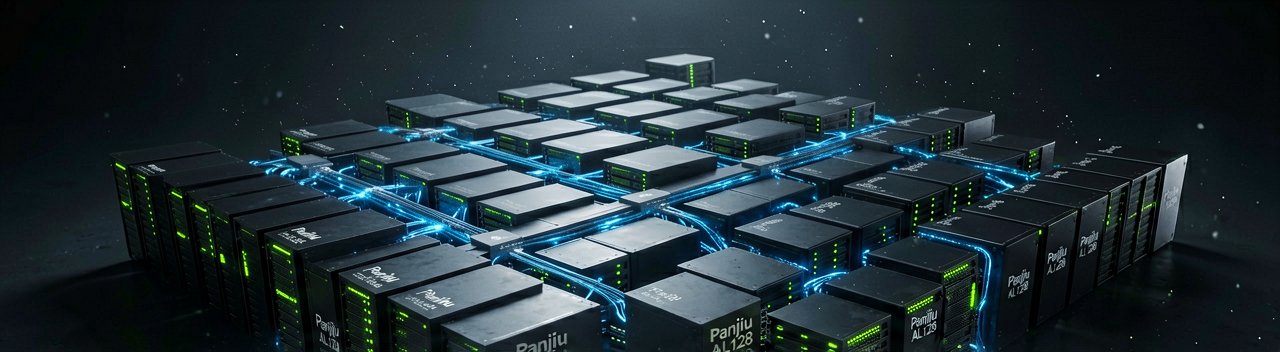
By controlling everything from the custom parallel architecture up to the foundational LLMs, the company is positioning itself as a rare full-stack provider capable of thriving completely within its own ecosystem. The broader commercial rollout relies heavily on the Panjiu AL128, a newly introduced hyperscale server node that clusters 128 of these new accelerators together using proprietary ICN Switch silicon. This combination reduces interconnect latency down to the nanosecond level, giving Chinese developers a highly viable sandbox to scale complex AI workloads without relying on American supply chains.
Behind the Scenes: The launch of the Zhenwu M890 reveals a profound shift in China’s domestic silicon strategy, moving away from frantic crisis management toward structured, long-term engineering independence. When Washington first restricted Nvidia’s flagship architectures, domestic cloud providers scrambled to hoard downgraded chips like the H20 or patch together legacy nodes. Alibaba’s T-Head division has spent the last two years realizing that surviving on American scraps is a dead end. The M890 is the first clear evidence of a pivot toward an isolated ecosystem built around high-bandwidth interconnects and tight software-hardware co-design.
Industry insiders point out that the real battleground isn't the raw floating-point performance of a single die, but the architecture of the interconnects linking them. Western restrictions deliberately targeted chip-to-chip communication speeds to prevent Chinese tech firms from building massive training clusters. Alibaba countered this bottleneck by pairing the M890 with its custom Panjiu AL128 server nodes and proprietary ICN Switch silicon. By optimizing the network fabric at the cluster level, engineers can squeeze maximum efficiency out of thousands of localized nodes, effectively mitigating the individual performance gap between domestic silicon and restricted Western hardware.
This localized cohesion is exactly what enterprise clients are looking for as they face mounting compliance risks. For major Chinese banks, state-owned telecom operators, and autonomous driving startups, deploying models on imported hardware now carries a high risk of sudden supply chain disruption. Stakeholders close to Alibaba’s cloud division report that the 400 corporate accounts adopting the Zhenwu family are prioritizing operational stability over sheer compute speed. Knowing that T-Head has a multi-year roadmap extending to the J900 variant in 2028 provides these enterprises with the predictability required to invest in long-term AI infrastructure.
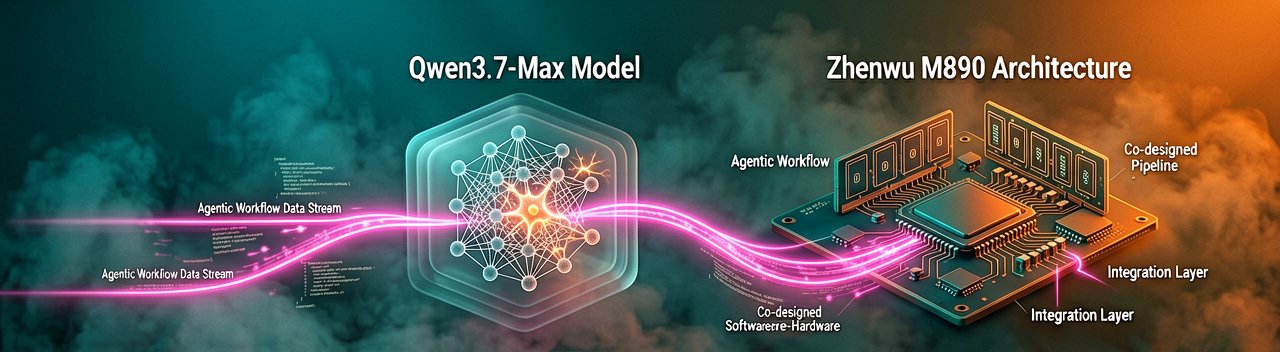
Historically, Chinese chipmakers struggled not with hardware specifications, but with software maturity. Nvidia’s dominant position is fortified by CUDA, a deeply entrenched software platform that developers have used for over a decade. To bypass this barrier, Alibaba has integrated the M890 seamlessly with its open-source Qwen model lineup. By offering a unified stack where the AI model is built natively on the underlying hardware, developers do not need to spend months rewriting code to fit unfamiliar silicon. This integration is designed to accelerate deployment timelines for local tech hubs, making the transition away from Western software layers painless.
Furthermore, the decision to optimize the M890 for long-running, autonomous agentic workloads highlights a pragmatic view of where the global AI market is heading. While Western tech giants continue to chase massive parameter counts requiring immense power grids, Alibaba is focusing on specialized operational efficiency. Designing hardware capable of running complex coding or analytical tasks continuously for 35 hours shows an intent to capture the enterprise workflow market. T-Head is positioning its silicon not as a vanity project for academic research, but as a practical workhorse for commercial automation.
Ultimately, the rollout of this new silicon changes the competitive dynamic within the Chinese mainland. Tech companies are no longer just competing on model benchmarks; they are competing on the security of their supply chains. As Alibaba deploys the M890 across its public cloud zones, it sets a brand new standard for domestic hyperscalers. The strategy proves that independent infrastructure is no longer a distant geopolitical ideal, but a commercial reality that is actively shaping the next generation of industrial AI applications.
Reading Between the Lines: The triumphant narrative surrounding Alibaba’s custom silicon obscures a messy, capital-intensive reality. While shipping 560,000 units across the Zhenwu family sounds impressive on a corporate ledger, it masks the severe manufacturing bottlenecks plaguing domestic semiconductor fabrication. Alibaba designs impressive architecture through T-Head, but it remains dependent on domestic foundries that are themselves choked by global lithography tool bans. Scaling production to meet the demands of China's massive tech sector requires more than brilliant design; it demands a mature, high-yield manufacturing supply chain that cannot be willed into existence overnight through press releases.
A glaring contradiction lies in Alibaba’s dual role as a cloud provider and a semiconductor champion. By forcing its public cloud customers toward homegrown Zhenwu silicon, Alibaba risks alienating developers who are deeply comfortable with Western software environments. Even with native optimization for the Qwen model family, forcing enterprise clients to pivot away from globally standardized frameworks is a risky gamble. If local developers find that the M890 requires too much custom configuration or lacks the raw flexibility of illicitly imported global hardware, Alibaba’s full-stack ecosystem could easily turn into a digital sandbox that clients tolerate rather than embrace.
Furthermore, the aggressive roadmap stretching out to the J900 variant in 2028 assumes that Western technology will remain static. While Alibaba plans its threefold performance leaps, global competitors are pouring hundreds of billions of dollars into advanced packaging, liquid cooling, and neuromorphic computing architectures. The danger for China's domestic market is the institutionalization of a permanent technology gap. By isolating its development roadmap to survive within a regulatory vacuum, Alibaba might succeed in shielding itself from Washington, but it simultaneously risks locking Chinese enterprise buyers into a localized loop that lags a generation behind global standards.
There is also the economic burden of this forced self-reliance to consider. Developing proprietary networking switches, custom server nodes, and successive generations of AI chips simultaneously drains capital that would otherwise fund breakthrough algorithmic research. Silicon development is a notoriously low-margin, high-risk game when volume is restricted to a single domestic market. If the Chinese enterprise sector experiences an economic cooling, or if AI monetization fails to meet hyper-inflated expectations, the immense fixed costs of running a bespoke semiconductor foundry pipeline could become a heavy anchor on Alibaba's broader cloud profitability.
Yet, looking past the skepticism, the geopolitical forcing function might achieve exactly what Beijing intends: a decoupled, completely functional parallel tech universe. Even if the Zhenwu M890 runs hotter, consumes more power, and requires more clustering to match Western computational benchmarks, it provides an baseline level of operational survival. For a state focused on national security and technological sovereignty, efficiency and profit margins are secondary considerations. Alibaba is effectively building a massive digital fortress, and while the interior walls might look a bit unpolished compared to the global standard, they are thick enough to withstand external geopolitical shocks.
Building a completely independent semiconductor ecosystem to escape foreign sanctions is a lot like constructing a submarine out of local timber: it is an extraordinary feat of domestic engineering, and everyone will applaud your ingenuity, right up until you have to take it into deep water.
Artūras Malašauskas is an AI Systems Integrator with 20+ years of production-grade web engineering experience. He has designed, shipped, and scaled enterprise Python/PHP systems for logistics, SaaS, and public-sector clients. For the past year, he has focused exclusively on AI integrations: deploying open-source LLMs, building generative media pipelines (image, audio, video), and engineering multi-agent workflows for real production environments. His standard: reproducibility, security, cost-efficient inference—no vaporware. He documents and evaluates emerging AI tooling, separating verified capabilities from marketing noise. Technical editor at: muza-ai.eu, ai-verslas.lt, ai-naujinos.lt Connect on LinkedIn
Comments