Apple’s MGIE Release: A Sharp Turn Toward Open AI Collaboration
For a company that usually keeps its software secrets locked behind a polished glass wall in Cupertino, Apple’s latest move feels like a genuine breath of fresh air. They’ve gone and released an open-source AI image editing model called MGIE—short for MLLM-Guided Image Editing—developed in cahoots with researchers from the University of California, Santa Barbara. It isn’t just a fancy filter tool; it’s a sophisticated system that translates your plain-English requests into precise, pixel-level adjustments. Instead of wrestling with sliders or complex selection tools, you can tell the AI to "make the sky more moody" or "add a lightning reflection to the water," and it actually understands the nuance of those commands. This is Apple stepping into the arena occupied by giants like Adobe, but doing so with a transparency we aren't used to seeing from them.
The tech under the hood is what makes this really sing. By leveraging Multimodal Large Language Models (MLLMs), the system can bridge the gap between human language and visual data. According to reports from Mashable, the model is already available on GitHub and even has a live demo on Hugging Face for those who want to see it in action without digging into the code. This kind of "show your work" approach suggests Apple is serious about contributing to the broader research community rather than just building another walled garden feature. It’s a smart play—by putting the weights out there for developers to poke and prod, they’re essentially crowdsourcing the refinement of a tool that will likely find its way into the Photos app on your next iPhone.
Why This Matters for the Creative Workflow
What sets MGIE apart from your run-of-the-mill generative AI is its focus on instruction-based editing rather than just generating images from scratch. It handles everything from global optimizations—like tweaking brightness or contrast—to local edits like changing someone's hair color or removing a stray background object. Because the model is open-sourced, it offers a layer of accountability and potential for customization that proprietary tools often lack. It’s an interesting pivot for a company that has long championed on-device privacy; by releasing the research publicly, they’re setting a standard for how these models should interpret user intent without necessarily needing a constant tether to a giant corporate server.
The Strategy Behind the Source
The Quiet Pivot: For decades, the "Apple Way" was defined by absolute secrecy and the construction of high-walled gardens where every line of code was a proprietary treasure. However, the release of MGIE marks a significant shift in posture. By open-sourcing this model, Apple isn't just releasing a tool; they are signaling to the global research community that Cupertino is a viable home for top-tier AI talent. In a market where researchers from OpenAI, Google, and Meta move between firms based on the freedom to publish, Apple has realized that keeping everything behind closed doors was becoming a recruiting liability. This move allows them to claim a stake in the open-source movement while keeping their hardware-integrated secrets for a later date.

Historically, Apple has been criticized for being "late" to the generative AI party, but industry veterans know they rarely care about being first—they care about being refined. MGIE showcases this philosophy by focusing on the friction points of traditional editing. Most generative models struggle with "edit fatigue," where a user asks for a small change and the AI accidentally regenerates the entire face or background. By using MLLMs to interpret specific linguistic instructions, Apple is effectively trying to solve the "lost in translation" problem that plagues current text-to-image workflows. They aren't trying to replace the artist; they are trying to replace the manual labor of the selection tool.
From a stakeholder perspective, this release serves as a strategic "soft launch" for the AI features rumored for upcoming iOS iterations. According to insights from The Verge, the model's ability to handle both global photo enhancements and local object modification suggests a dual-purpose future. For the average user, it means "Siri, make this photo look professional." For the power user, it means a more responsive, intelligent canvas. By letting the open-source community stress-test the model on various hardware configurations now, Apple gathers invaluable data on how these instructions are misinterpreted, allowing them to iron out the kinks before the software hits hundreds of millions of consumer devices.
There is also the matter of on-device processing, a hill that Apple is willing to die on for the sake of privacy. MGIE’s architecture, while currently resource-intensive, is clearly designed with an eye toward the Neural Engine found in Apple’s silicon. While competitors like Adobe Firefly rely heavily on cloud-based credits and server-side rendering, Apple is positioning itself to own the local AI space. Releasing the model weights allows third-party developers to begin optimizing these processes for Mac and iPad hardware, effectively creating an ecosystem of MGIE-powered apps before Apple even ships its own first-party implementation.
Ultimately, this isn't just about a smarter way to crop a photo or change a background color. It is about the evolution of the interface itself. We are moving toward a "declarative" era of computing, where the user describes the desired outcome and the machine handles the execution. MGIE is a foundational brick in that wall. By bridging the gap between a vague human thought and a specific digital pixel, Apple is laying the groundwork for a future where the keyboard and mouse—and even the touch screen—are secondary to the clarity of a spoken command. The polish we see here is just the beginning of a much larger integration of linguistic intelligence across the entire Apple software stack.
The Reality Check: Compute and Control
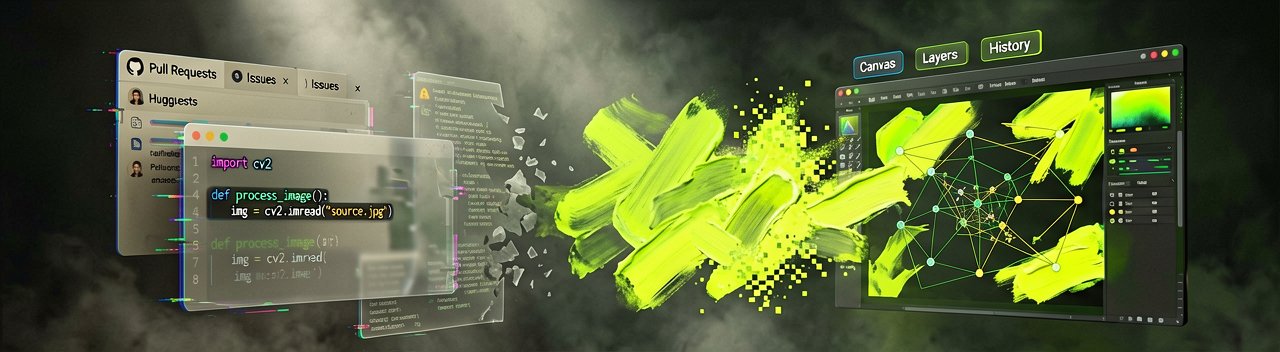
Reading Between the Lines: While the tech world is quick to applaud Apple’s newfound "openness," a healthy dose of skepticism reveals this move is as much about pragmatism as it is about progress. Releasing MGIE into the wild is a low-risk, high-reward gamble for a company that remains arguably the most vertically integrated entity on the planet. By offering the model through GitHub and Hugging Face, Apple essentially turns the global research community into an unpaid QA department. They get to observe how the model fails in diverse environments without the reputational hit of a "Beta" tag on a flagship product. It is a calculated outsourcing of the "hallucination problem" that haunts every generative AI project today.
There is also a glaring contradiction in the narrative of accessibility. Apple champions on-device privacy, yet the current computational demands of MLLM-guided editing are immense. As noted by VentureBeat, the model requires significant resources to run smoothly, which sits at odds with the average consumer's aging iPhone or entry-level MacBook. This creates a bottleneck: Apple is open-sourcing the software, but the "hardware tax" required to actually utilize these features at scale remains firmly in place. It suggests a future where AI features are used as the primary lever to drive a massive hardware upgrade cycle, forcing users to buy the latest silicon just to experience "natural" editing.
Furthermore, we have to consider the "black box" of the training data. While the model architecture is out in the open, the specific curation of datasets that allow Apple-vetted AI to understand "aesthetic" commands remains a proprietary mystery. There is a fine line between an AI that helps you edit and an AI that enforces a specific "Apple look" on all visual media. If every user tells the AI to "make this look professional," and every device uses the same underlying weights to interpret that word, we risk a homogenization of digital photography where the machine's consensus overrides individual creative intent. Apple’s release provides the engine, but they are still very much holding the steering wheel on visual style.
The long-term implication is a subtle shift in the definition of "skill." For decades, mastery of Photoshop was a badge of technical honor; with MGIE, the skill shifts from manual dexterity to linguistic precision. However, this relies on the assumption that an AI can truly grasp the subjective nature of human language across different cultures and contexts. A "moody" sky in London looks very different from one in Los Angeles. By centralizing the interpretation of these descriptors into a single model, Apple isn't just making editing easier—they are establishing themselves as the linguistic arbiter of visual art. It’s a bold power play disguised as a gift to the open-source community.
Ultimately, the industry should be wary of viewing this as a total pivot in philosophy. Apple’s history suggests that once a technology is sufficiently refined by the public, it is often pulled back into the fold, polished, and rebranded as a "revolutionary" proprietary feature. This open-source moment is likely a pit stop, not the final destination. It serves the immediate need to bridge the gap with competitors, but the end goal remains the same: ensuring that when you want to change the world one pixel at a time, you’re doing it on a device with a silver fruit on the back.
It’s truly heartwarming to see Apple share its toys with the other children, though one suspects they’re mostly interested in seeing which ones we break first so they don’t have to fix them on their own time.
Artūras Malašauskas is an AI Systems Integrator with 20+ years of production-grade web engineering experience. He has designed, shipped, and scaled enterprise Python/PHP systems for logistics, SaaS, and public-sector clients. For the past year, he has focused exclusively on AI integrations: deploying open-source LLMs, building generative media pipelines (image, audio, video), and engineering multi-agent workflows for real production environments. His standard: reproducibility, security, cost-efficient inference—no vaporware. He documents and evaluates emerging AI tooling, separating verified capabilities from marketing noise. Technical editor at: muza-ai.eu, ai-verslas.lt, ai-naujinos.lt Connect on LinkedIn
Comments