Acemate Turns Its AI Rally Partner Into a Full-Time Coach With New Drill System
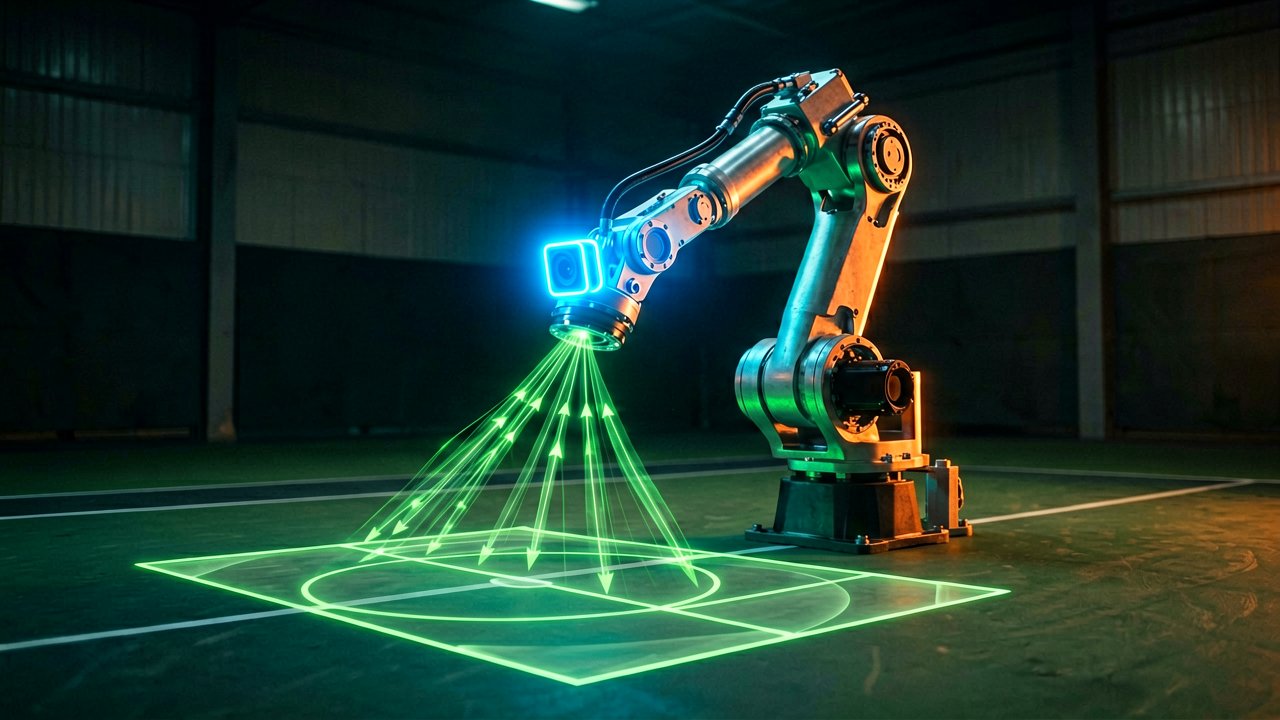
The days of aimlessly hitting neon yellow balls against a machine that doesn't care where they land are officially numbered. Acemate, the robotics firm that made waves with its "human-like" rally partner, has just dropped a massive software update that pivots the hardware from a simple sparring partner to a data-obsessed coach. This new "Drill Mode" is less about keeping the ball in play and more about putting it exactly where it hurts, introducing a scored training ecosystem that finally gives solo sessions a sense of consequence.
It’s a smart move for a company that already secured its spot on TIME's Best Inventions of 2025 list. Before this update, using the Acemate was a bit like playing a practice set without keeping score—fun, but lacked a certain edge. Now, the system uses its dual 4K cameras to track every shot in real-time, mapping them against specific target zones. If you’re not hitting the mark, your session score will reflect it, turning a lonely afternoon at the local courts into a gamified quest for technical perfection.
Precision Over Parameters
The genius of the new system lies in its "Training Templates." Instead of making you fiddle with knobs for topspin rates or ball depth—settings that frankly feel more like homework than sports—you just pick a goal like "cross-court precision" and go. According to details released by PR Newswire, the app now handles the technical heavy lifting, adjusting the robot's responses dynamically to ensure every rep actually counts toward a measurable skill. It’s the difference between "hitting balls" and "training," and for the self-taught player, that's a massive distinction.
Closing the Feedback Loop
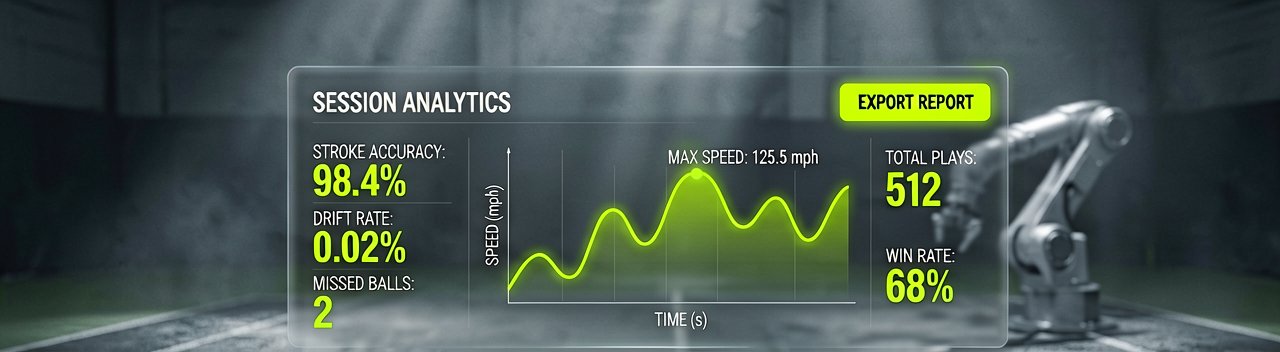
Post-session data is where the update really earns its keep. Once you’ve finished sweating through a bucket of balls, the app serves up a comprehensive breakdown covering net clearance, ball speed, and accuracy rates. This creates a legitimate feedback loop that’s been missing from the DIY tennis world. While the machine’s $2,499 price tag remains a hurdle for casual weekend warriors, this shift toward a "coaching ecosystem" makes the investment much easier to justify for anyone serious about climbing the NTRP ladder without a hundred-dollar-an-hour private instructor.
The Hidden Engineering of Human Error
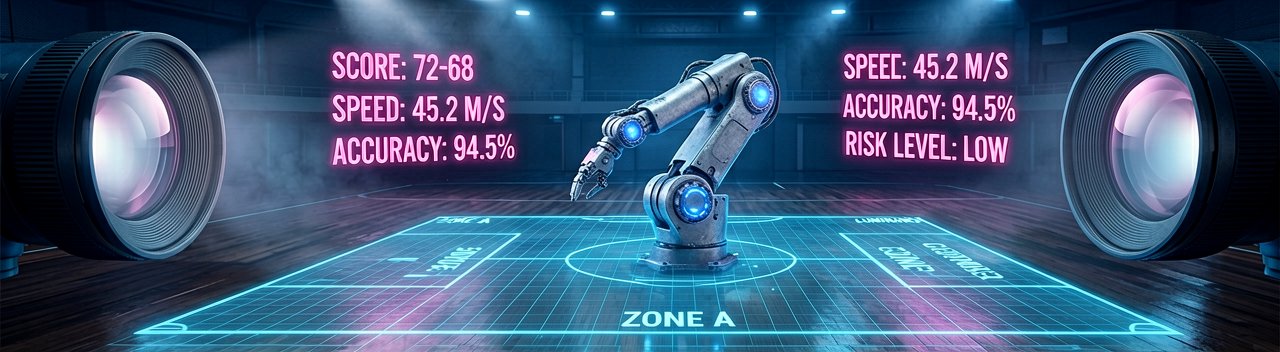
Beyond the Spec Sheet: What most surface-level reports miss is the intentional complexity baked into the Acemate’s physics engine. Unlike a traditional "lobster" machine that uses spinning wheels to launch balls with surgical—and frankly, unrealistic—consistency, the Acemate utilizes a pneumatic system paired with a multi-axis robotic arm. This setup isn't just for show; it’s designed to replicate the slight variations in depth and pace that even a pro-level player produces. By introducing "Drill Mode," the developers are now forcing the user to react to these micro-variations while maintaining a score, a challenge that mimics the mental fatigue of a third-set tiebreak.
From a historical perspective, tennis tech has long suffered from a "closed-loop" problem where the equipment doesn't talk back to the athlete. We’ve had smart racquets and wearable sensors for a decade, but they typically provided data in a vacuum, often hours after the session ended. Acemate’s pivot into scored training represents a shift toward "Live-Instructional Tech," where the hardware adjusts its difficulty based on the player’s real-time accuracy. It effectively eliminates the "junk ball" syndrome—that plateau where players get very good at hitting predictable shots but crumble when a ball comes in with a different spin profile.
Industry insiders suggest that this move is a direct shot at the traditional club pro business model. While a human coach can offer psychological encouragement, they cannot manually track the net clearance and RPM of 500 consecutive forehands with 99% accuracy. By commoditizing this level of granular data, Acemate is positioning itself as a supplement to high-performance academies rather than just a toy for the wealthy suburbanite. It’s an aggressive play for the "serious amateur" market—the demographic that values measurable progress over social hitting sessions.
The integration of the dual 4K camera system also hints at a broader computer vision trend that started with Hawk-Eye but has finally trickled down to portable hardware. To make "Drill Mode" work, the onboard processor has to solve complex triangulation problems in milliseconds, accounting for wind resistance and ambient light. This isn't just a ball machine with a brain; it's a mobile laboratory. The fact that this can now be controlled via a smartphone app underscores how much the barrier to entry for elite-level sports science has collapsed in the last three years.
Ultimately, the success of this system hinges on the "stickiness" of its social features. Acemate is reportedly leaning into global leaderboards, allowing a player in London to compete in the same "Cross-Court Burner" drill as someone in Los Angeles. This creates a virtual competitive circuit that gives solo training a social weight it has never had before. For the first time, the "lonely" grind of the practice court has a digital audience, turning repetitive motion into a verifiable rank on a global stage.
The Paradox of Automated Perfection
The Reality Check: While the tech world is quick to hail every AI integration as a revolution, there is a fundamental friction in trying to automate a sport defined by human chaos. Acemate’s new scoring system assumes that tennis is a game of repeatable geometry, but any seasoned player knows that a "perfect" shot on paper is often a tactical blunder in a real match. By incentivizing players to hit specific digital targets, there is a legitimate risk that the system is training "ball strikers" rather than "match players." It risks creating a generation of athletes who are statistically elite against a robot but lack the improvisational grit required when a human opponent starts slicing the ball into their feet.
Furthermore, the reliance on high-fidelity 4K cameras and real-time processing introduces a fragile dependency on environment. A slight shift in the sun’s position or a flickering court light can theoretically throw off the "accurate" scoring that Acemate promises. For a system priced as a premium investment, any discrepancy between a player’s perceived performance and the machine’s data output could lead to more frustration than improvement. We are essentially trusting a black box to tell us how "good" we are, potentially overriding the intuitive "feel" for the ball that has been the cornerstone of tennis coaching for over a century.
There is also the looming question of data fatigue. We are currently living through an era of "quantified self" overreach, where every heartbeat and footstep is logged, analyzed, and graphed. Adding tennis drills to this list might eventually turn a recreational escape into another high-pressure data entry job. If every missed forehand is logged on a global leaderboard, the court ceases to be a place of play and becomes a high-stakes performance audit. It’s a brilliant engineering feat, certainly, but it forces us to consider whether we are improving the athlete or simply turning the athlete into a more efficient peripheral for the software.
Looking forward, the implication of this tech likely points toward a fragmented coaching landscape. If the AI can handle the "what" and the "how" of technical drills, the human coach is relegated to the "why"—the strategy and the mental fortitude. This might sounds like a harmonious partnership, but it’s more likely to create a class divide in the sport. Those who can afford the $2,500 robot will have a massive data-driven advantage, while everyone else continues to hit against a wall, hoping for the best. The democratization of elite training is a noble pitch, but in practice, it often looks more like a pay-to-win upgrade for the country club set.
“We’ve finally reached the point where you can spend three thousand dollars to have a robot tell you that your backhand is late, which is significantly more expensive than your spouse telling you the exact same thing for free.”
Artūras Malašauskas is an AI Systems Integrator with 20+ years of production-grade web engineering experience. He has designed, shipped, and scaled enterprise Python/PHP systems for logistics, SaaS, and public-sector clients. For the past year, he has focused exclusively on AI integrations: deploying open-source LLMs, building generative media pipelines (image, audio, video), and engineering multi-agent workflows for real production environments. His standard: reproducibility, security, cost-efficient inference—no vaporware. He documents and evaluates emerging AI tooling, separating verified capabilities from marketing noise. Technical editor at: muza-ai.eu, ai-verslas.lt, ai-naujinos.lt Connect on LinkedIn
Comments