Wheels Meet Legs: Deep Robotics’ LYNX M20 Redefines the Industrial Inspection Hustle
The Reality Check: Can Hybrid Robots Survive the Spreadsheet?
Reading Between the Lines: For all the slick promotional footage of the LYNX M20 gracefully hopping over obstacles, the industrial sector remains a notoriously graveyard for "over-engineered" solutions. The central contradiction of the wheeled-legged hybrid lies in its mechanical complexity. By adding motorized hubs to the ends of articulated limbs, Deep Robotics has exponentially increased the number of potential failure points. In a pristine lab, this is a feat of engineering; in a 24/7 steel mill where grit, heat, and vibration are the baseline, every extra bearing and motor controller is a liability that maintenance teams will eventually have to service.
There is also the matter of the "jack of all trades" trap. While the M20 boasts a 2.5-hour runtime, that figure likely reflects a generous mix of wheeled cruising. Once the robot is forced into high-intensity legged locomotion—the very thing it is sold on—the battery drain spikes. Decision-makers must weigh whether the hybrid's agility actually justifies its price tag over a fleet of cheaper, "dumb" wheeled rovers supplemented by occasional manual human inspections. The industry has a habit of falling in love with the "cool factor" of bionics while ignoring the boring reality of total cost of ownership and the logistical nightmare of proprietary spare parts.
Furthermore, the promise of autonomous "fusion perception" often hits a wall when it meets the regulatory hurdles of critical infrastructure. While the M20 can technically identify a gas leak or a thermal spike, the legal framework for allowing a robot to make autonomous "triage" decisions in an emergency is still in its infancy. For now, these machines largely remain expensive, mobile sensor platforms tethered to a human operator in a trailer. The leap from "cool tech demo" to "trusted autonomous responder" requires more than just better LiDAR; it requires a level of software reliability and standardized certification that the robotics industry, at large, is still scrambling to define.
Despite these hurdles, the M20 marks a significant shift in how we approach the "last mile" of industrial data collection. We are moving away from the era of general-purpose robots and into the era of specialized hybrids. Even if the M20 doesn't become a ubiquitous sight in every warehouse, it serves as a high-stakes prototype for a future where machines adapt to human environments rather than forcing us to rebuild our factories around their limitations. The measured skepticism here isn't about whether the technology works, but whether the industrial world is ready to pay the premium for a robot that can both sprint and climb.

It turns out that the peak of evolutionary robotics is a machine that combines the grace of a mountain goat with the soul of a grocery cart—finally giving us a robot that can not only find the fire but also beat us to the best parking spot.
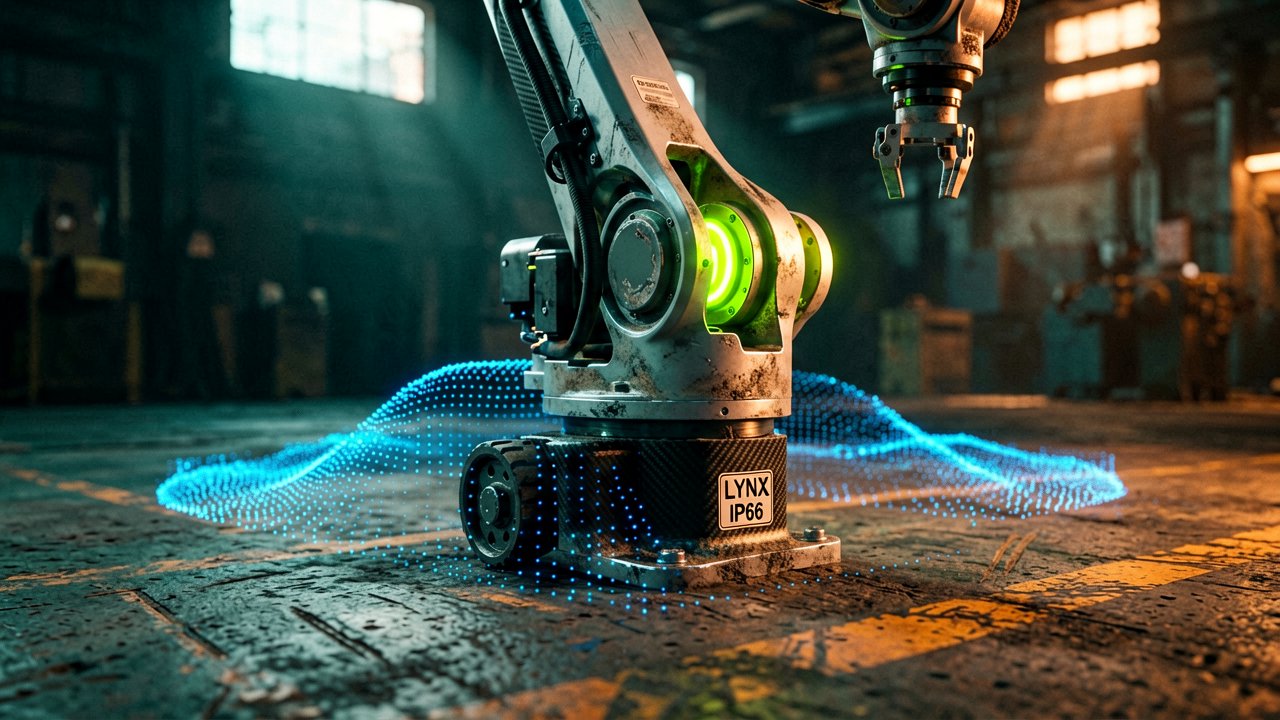
There’s a persistent headache in industrial inspection: choosing between the speed of wheels and the sheer grit of legs. You usually can't have both. But Deep Robotics just threw that compromise out the window with the launch of the LYNX M20, a wheeled-legged hybrid designed to sprint across flat factory floors and then, without skipping a beat, scramble over the kind of debris that would stop a standard rover in its tracks. Weighing in at a nimble 33kg, it’s light enough for one person to haul around, but don’t let the small frame fool you—this machine is built for the high-stakes world of emergency response and high-voltage substations.
What makes the LYNX M20 stand out isn't just the fact that it can hit 2 m/s on its integrated wheels; it’s the "front-elbow-rear-knee" joint structure. This symmetrical setup means the robot doesn't really have a "front" or "back" in the traditional sense, allowing it to navigate narrow 50cm passages without the awkward 180-degree turns that plague bulkier units. According to recent reporting from Automation.com, the robot manages a solid 2.5 hours of runtime even when hauling its effective 15kg payload, making it a viable workhorse for long-distance utility tunnel patrols where manual human inspection is both dangerous and mind-numbingly dull.
Built for the Grime and the Dark
We’ve seen plenty of "lab-ready" robots that crumble the moment they see a raincloud, but the M20 is clearly aiming for the rough stuff. It carries an IP66 rating, which in plain English means it’ll keep working while getting blasted by dust or heavy rain. Whether it’s enduring the blistering 55°C heat of a desert substation or the -20°C chill of a northern winter, the hardware is hardened for the reality of field work. It even packs "night fill lights" to supplement its 3D LiDAR-based SLAM technology, ensuring it doesn't trip over a stray pipe when the power goes out in a disaster zone.
Intelligence Beyond the Hardware
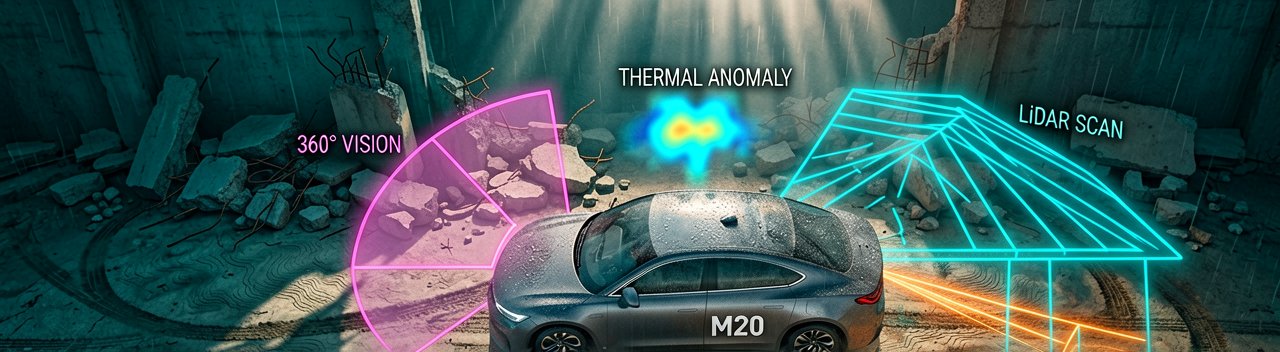
The real magic happens in the software stack, where Deep Robotics is pushing what they call "fusion perception." By blending 96-line LiDAR with 360-degree vision, the M20 doesn't just see obstacles; it understands them. It can identify gas leaks, detect thermal anomalies with dual-spectrum cameras, and even listen for the telltale hiss of a mechanical failure. It's an evolution from the company's earlier quadruped platforms, like the flagship X30, which has already seen action in Singapore’s power tunnels. As noted by Robotics 24/7, this new breed of "wheeled-legged" agility is quickly becoming the benchmark for companies looking to automate the "last-mile" of industrial safety.
The Hybrid Gambit: Why Hybrid Locomotion is the New Industrial Gold Standard
What Most Reports Miss: The shift from pure quadrupeds to wheeled-legged hybrids like the LYNX M20 isn't just a hardware gimmick; it’s a direct response to the "energy tax" of legged movement. In the robotics world, walking is expensive. Every step requires constant power to maintain balance and overcome friction, which has historically crippled the battery life of industrial dogs. By putting wheels at the ends of those limbs, Deep Robotics has effectively created a "dual-mode" efficiency profile. On smooth concrete, the robot cruises like a high-end RC car with minimal draw, preserving its battery for the high-torque, high-drain maneuvers required when it actually encounters stairs or rubble.
From a stakeholder perspective, this transition solves the "deployment friction" that has kept many facility managers from adopting robotics. Earlier iterations of legged robots were often seen as too slow for routine patrols, taking hours to cover grounds that a human on a golf cart could finish in minutes. The LYNX M20’s 2 m/s top speed changes that math. For utility giants and grid operators, the ability to cover several kilometers of terrain quickly—while still maintaining the capability to step over a fallen branch or climb a curb—moves these machines from "experimental toy" to a legitimate replacement for traditional security and maintenance rounds.
Historically, we’ve seen the industry struggle with the trade-off between stability and dexterity. Heavy-duty rovers are stable but get stuck on a single misplaced pallet; quadrupeds are dexterous but prone to "drifting" during high-speed turns. Deep Robotics’ integration of 360-degree vision with 96-line LiDAR addresses this by creating a real-time, high-fidelity digital twin of the environment. This level of spatial awareness allows the M20 to adjust its leg height and wheel speed millisecond by millisecond, a feat of control engineering that seasoned reporters recognize as the "secret sauce" of modern autonomous systems.
In the field of emergency response, seconds are the only currency that matters. During a chemical leak or a structural fire, a robot that has to "think" about every step is a liability. The M20’s symmetrical joint structure—the "front-elbow-rear-knee" design—allows for instantaneous direction changes without the mechanical lag of a full body rotation. This "omni-directional" logic is a game-changer for Search and Rescue (SAR) teams who need to navigate the unpredictable, claustrophobic geometry of a collapse zone where backing out is often the only way forward.
The addition of "night fill lights" and IP66 hardening also speaks to a move away from the sterilized lab environments of the past decade. We are seeing a maturation of the supply chain where components are finally being rated for the "grime and grease" of heavy industry. Deep Robotics is leaning into this by ensuring their sensors can see through the haze of a steam leak or the pitch black of a subterranean tunnel. This reliability is what eventually bridges the gap between a successful pilot program and a multi-unit fleet rollout across global operations.
Ultimately, the LYNX M20 represents a pivot toward pragmatic robotics. It acknowledges that the world isn't just a series of stairs or a flat parking lot; it’s a messy mix of both. By fusing the high-speed efficiency of a wheel with the obstacle-negotiation of a leg, Deep Robotics is betting that the future of industrial automation isn't about looking human or looking like a dog—it’s about looking like whatever gets the job done without getting stuck in the mud.
The Reality Check: Can Hybrid Robots Survive the Spreadsheet?
Reading Between the Lines: For all the slick promotional footage of the LYNX M20 gracefully hopping over obstacles, the industrial sector remains a notorious graveyard for "over-engineered" solutions. The central contradiction of the wheeled-legged hybrid lies in its mechanical complexity. By adding motorized hubs to the ends of articulated limbs, Deep Robotics has exponentially increased the number of potential failure points. In a pristine lab, this is a feat of engineering; in a 24/7 steel mill where grit, heat, and vibration are the baseline, every extra bearing and motor controller is a liability that maintenance teams will eventually have to service.
There is also the matter of the "jack of all trades" trap. While the M20 boasts a 2.5-hour runtime, that figure likely reflects a generous mix of wheeled cruising. Once the robot is forced into high-intensity legged locomotion—the very thing it is sold on—the battery drain spikes. Decision-makers must weigh whether the hybrid's agility actually justifies its price tag over a fleet of cheaper, "dumb" wheeled rovers supplemented by occasional manual human inspections. The industry has a habit of falling in love with the "cool factor" of bionics while ignoring the boring reality of total cost of ownership and the logistical nightmare of proprietary spare parts.
Furthermore, the promise of autonomous "fusion perception" often hits a wall when it meets the regulatory hurdles of critical infrastructure. While the M20 can technically identify a gas leak or a thermal spike, the legal framework for allowing a robot to make autonomous "triage" decisions in an emergency is still in its infancy. For now, these machines largely remain expensive, mobile sensor platforms tethered to a human operator in a trailer. The leap from "cool tech demo" to "trusted autonomous responder" requires more than just better LiDAR; it requires a level of software reliability and standardized certification that the robotics industry, at large, is still scrambling to define.
Despite these hurdles, the M20 marks a significant shift in how we approach the "last mile" of industrial data collection. We are moving away from the era of general-purpose robots and into the era of specialized hybrids. Even if the M20 doesn't become a ubiquitous sight in every warehouse, it serves as a high-stakes prototype for a future where machines adapt to human environments rather than forcing us to rebuild our factories around their limitations. The measured skepticism here isn't about whether the technology works, but whether the industrial world is ready to pay the premium for a robot that can both sprint and climb.
It turns out that the peak of evolutionary robotics is a machine that combines the grace of a mountain goat with the soul of a grocery cart—finally giving us a robot that can not only find the fire but also beat us to the best parking spot.
Artūras Malašauskas is an AI Systems Integrator with 20+ years of production-grade web engineering experience. He has designed, shipped, and scaled enterprise Python/PHP systems for logistics, SaaS, and public-sector clients. For the past year, he has focused exclusively on AI integrations: deploying open-source LLMs, building generative media pipelines (image, audio, video), and engineering multi-agent workflows for real production environments. His standard: reproducibility, security, cost-efficient inference—no vaporware. He documents and evaluates emerging AI tooling, separating verified capabilities from marketing noise. Technical editor at: muza-ai.eu, ai-verslas.lt, ai-naujinos.lt Connect on LinkedIn
Comments