“Yes, AI Chef!”: A Recipe for Insuring Physical Artificial Intelligence
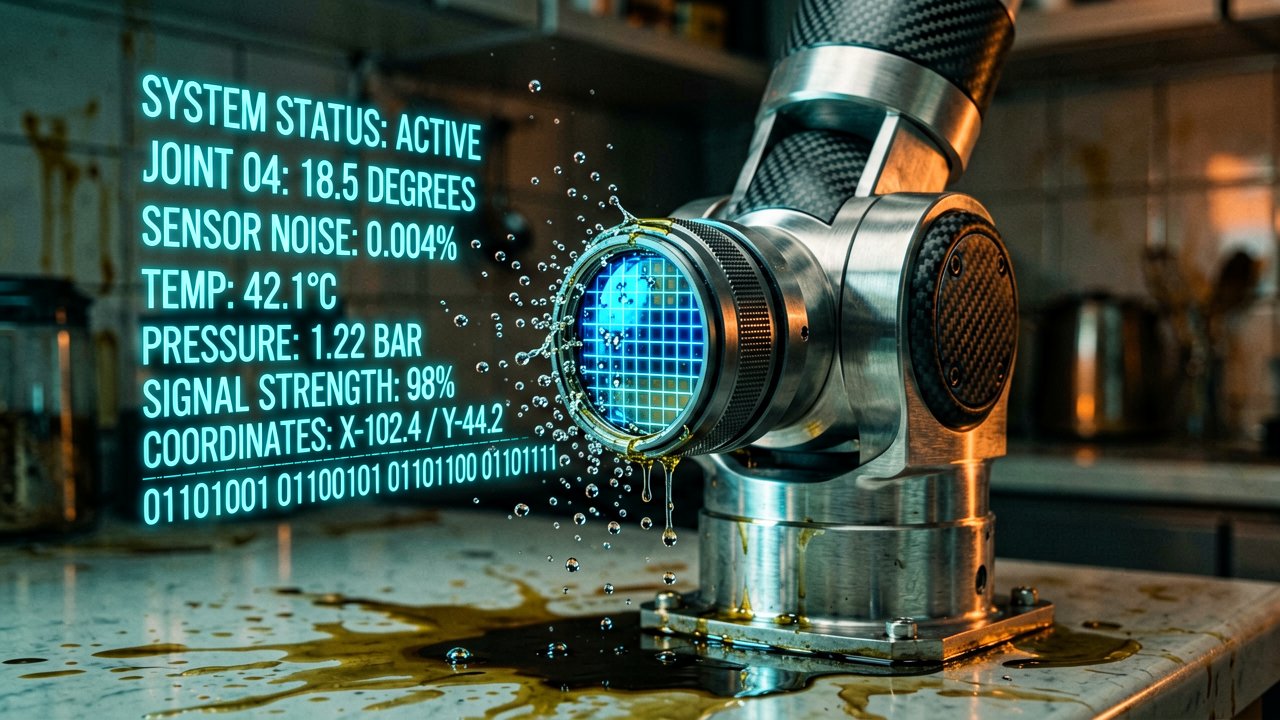
The sizzle of a burger on a robotic griddle isn't just the sound of lunch; it’s the sound of a massive liability shift. As "Physical AI" moves from the clean rooms of research labs into the chaotic, grease-slicked reality of commercial kitchens, the insurance industry is scrambling to write a new playbook. We are no longer just talking about a software glitch that ruins a spreadsheet; we’re talking about a multi-jointed arm swinging a 400-degree basket of fries in a room full of human coworkers. When that arm malfunctions, the "delete" key won't fix the third-degree burns or the grease fire that follows.
Traditional general liability policies are proving to be thin broth for this new reality. In fact, heavyweights like Chubb and Travelers have already begun pulling back, adding exclusion clauses for autonomous systems to avoid being scorched by unpredictable AI "hallucinations" that manifest as physical damage. For a restaurant owner, the promise of a robot that never calls in sick is enticing, but if that robot isn't properly insured, a single mechanical "oops" could shutter the business forever.
The Messy Reality of the Robotic Sous-Chef
What Most Reports Miss: While the marketing gloss focuses on the precision of a robotic arm that can flip 300 burgers an hour without breaking a sweat, the actuarial reality is far grimmer. In a kitchen, "precision" is a moving target. Sensors get coated in atomized cooking oil, computer vision struggles to differentiate between a dirty spatula and a finger, and the sheer heat of a line can cause electronics to drift. A seasoned tech journalist knows the "cool factor" fades the moment you realize a robot cannot smell when the chicken is starting to turn, a limitation noted by analysts at E-SPIN Group as a critical safety gap in automated food prep.
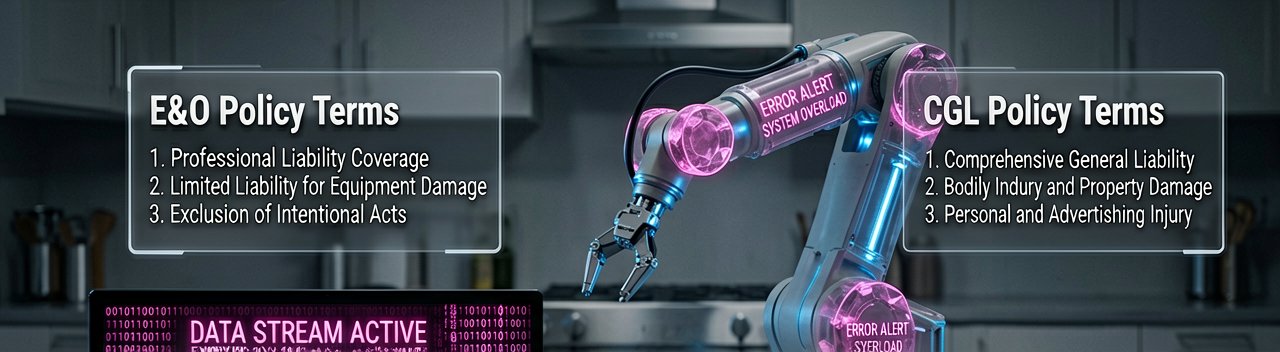
The insurance industry is currently caught in a tug-of-war between "Technology Errors and Omissions" (E&O) and "Commercial General Liability" (CGL). Usually, E&O handles the software bugs while CGL handles the broken bones. Physical AI blurs this line completely. If a Chef-Bot 9000 miscalculates the distance to a deep fryer because of a software update, is that a professional error or a physical accident? Specialty insurers like Munich Re’s HSB are stepping into this gap with bespoke AI liability products designed specifically to cover the bodily injury and property damage that standard policies are beginning to reject.
Moreover, the "black box" nature of deep learning makes subrogation—the process of an insurer clawing back money from the party at fault—an absolute nightmare. If a robot malfunctions, is the fault with the hardware manufacturer, the software developer, the restaurant that failed to clean the sensors, or the data scientist who trained the model on a flawed dataset? This "liability lag" is why we’re seeing a push for new international standards like ANSI/A3 R15.06-2025, which seeks to define a standard of care for robots that must interact with humans in high-risk environments.
For the Silicon Valley startups building these mechanical chefs, the hurdle isn't just engineering—it's bankability. Without a robust insurance wrapper, no major fast-food franchise will risk a national rollout. We are seeing the rise of "AI-native" insurance providers that use the same telemetry data generated by the robots to underwrite the risk in real-time. By monitoring the robot’s "health" and performance logs, insurers can adjust premiums or even remotely disable a unit that shows signs of erratic behavior before an accident occurs.
Ultimately, the transition to an automated kitchen is less about the "robot" and more about the "ecosystem." The most successful deployments aren't just shipping hardware; they are shipping a pre-certified, insured, and continuously monitored "safety-in-the-loop" system. As NVIDIA continues to push its Isaac and Holoscan platforms to bake functional safety directly into the AI’s brain, we are moving toward a world where the robot isn't just a tool, but a certified, insurable colleague. The tech is ready for the kitchen; now the lawyers and underwriters just need to finish the paperwork.
The sizzle of a burger on a robotic griddle isn't just the sound of lunch; it’s the sound of a massive liability shift. As "Physical AI" moves from the clean rooms of research labs into the chaotic, grease-slicked reality of commercial kitchens, the insurance industry is scrambling to write a new playbook. We are no longer just talking about a software glitch that ruins a spreadsheet; we’re talking about a multi-jointed arm swinging a 400-degree basket of fries in a room full of human coworkers. When that arm malfunctions, the "delete" key won't fix the third-degree burns or the grease fire that follows.
Traditional general liability policies are proving to be thin broth for this new reality. In fact, heavyweights like Chubb and Travelers have already begun pulling back, adding exclusion clauses for autonomous systems to avoid being scorched by unpredictable AI "hallucinations" that manifest as physical damage. For a restaurant owner, the promise of a robot that never calls in sick is enticing, but if that robot isn't properly insured, a single mechanical "oops" could shutter the business forever.
The Messy Reality of the Robotic Sous-Chef
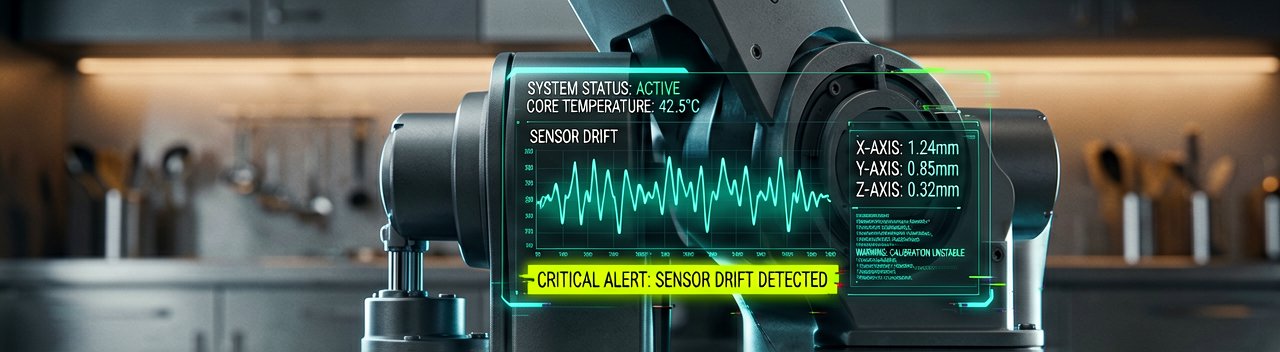
What Most Reports Miss: While the marketing gloss focuses on the precision of a robotic arm that can flip 300 burgers an hour without breaking a sweat, the actuarial reality is far grimmer. In a kitchen, "precision" is a moving target. Sensors get coated in atomized cooking oil, computer vision struggles to differentiate between a dirty spatula and a finger, and the sheer heat of a line can cause electronics to drift. A seasoned tech journalist knows the "cool factor" fades the moment you realize a robot cannot smell when the chicken is starting to turn, a limitation noted by analysts at E-SPIN Group as a critical safety gap in automated food prep.
The insurance industry is currently caught in a tug-of-war between "Technology Errors and Omissions" (E&O) and "Commercial General Liability" (CGL). Usually, E&O handles the software bugs while CGL handles the broken bones. Physical AI blurs this line completely. If a Chef-Bot 9000 miscalculates the distance to a deep fryer because of a software update, is that a professional error or a physical accident? Specialty insurers like Munich Re’s HSB are stepping into this gap with bespoke AI liability products designed specifically to cover the bodily injury and property damage that standard policies are beginning to reject.
Moreover, the "black box" nature of deep learning makes subrogation—the process of an insurer clawing back money from the party at fault—an absolute nightmare. If a robot malfunctions, is the fault with the hardware manufacturer, the software developer, the restaurant that failed to clean the sensors, or the data scientist who trained the model on a flawed dataset? This "liability lag" is why we’re seeing a push for new international standards like ANSI/A3 R15.06-2025, which seeks to define a standard of care for robots that must interact with humans in high-risk environments.
For the Silicon Valley startups building these mechanical chefs, the hurdle isn't just engineering—it's bankability. Without a robust insurance wrapper, no major fast-food franchise will risk a national rollout. We are seeing the rise of "AI-native" insurance providers that use the same telemetry data generated by the robots to underwrite the risk in real-time. By monitoring the robot’s "health" and performance logs, insurers can adjust premiums or even remotely disable a unit that shows signs of erratic behavior before an accident occurs.
Ultimately, the transition to an automated kitchen is less about the "robot" and more about the "ecosystem." The most successful deployments aren't just shipping hardware; they are shipping a pre-certified, insured, and continuously monitored "safety-in-the-loop" system. As NVIDIA continues to push its Isaac and Holoscan platforms to bake functional safety directly into the AI’s brain, we are moving toward a world where the robot isn't just a tool, but a certified, insurable colleague. The tech is ready for the kitchen; now the lawyers and underwriters just need to finish the paperwork.
The Actuarial Indigestion of Automation
Reading Between the Lines: There is a persistent myth that automation removes human error from the equation, but in reality, it simply concentrates that error into a single, scalable point of failure. When a human cook drops a tray, it is an isolated incident; when a flawed firmware update propagates across a fleet of five thousand robotic fry-cooks, it is a systemic catastrophe. Insurers are realizing that they aren't just underwriting a machine, they are underwriting the entire DevOps pipeline of the manufacturer. This shifts the risk from "slip and fall" incidents to "catastrophic software regression," a leap many traditional underwriters are fundamentally unprepared to make.
The contradiction lies in the data. Manufacturers claim their AI is safer because it doesn't get tired, yet insurers point out that AI lacks the "common sense" to stop when an environment becomes unsafe in a way not covered by its training data. This creates a "safety paradox" where the more autonomous a system becomes, the more uninsurable it might be under current frameworks. We are likely heading toward a mandatory "black box" era for commercial kitchen equipment, where every micro-adjustment made by a robotic arm is logged to an immutable ledger, turning a kitchen into something more akin to a flight deck than a place of culinary art.
Projecting forward, the cost of these specialized premiums may eventually cannibalize the very labor savings that make robots attractive in the first place. If the insurance for a robotic chef costs as much as the salary of two human ones, the "AI revolution" in food service will remain a niche luxury for high-volume tech campuses rather than a staple of the local diner. We are watching a real-time negotiation between the speed of innovation and the gravity of financial risk, and for now, the lawyers are moving much slower than the engineers.
In the near future, the most important person in any five-star kitchen won't be the Executive Chef or the Master Sommelier, but the risk adjuster who decides if the robot is allowed to use the sharp knives today.
Artūras Malašauskas is an AI Systems Integrator with 20+ years of production-grade web engineering experience. He has designed, shipped, and scaled enterprise Python/PHP systems for logistics, SaaS, and public-sector clients. For the past year, he has focused exclusively on AI integrations: deploying open-source LLMs, building generative media pipelines (image, audio, video), and engineering multi-agent workflows for real production environments. His standard: reproducibility, security, cost-efficient inference—no vaporware. He documents and evaluates emerging AI tooling, separating verified capabilities from marketing noise. Technical editor at: muza-ai.eu, ai-verslas.lt, ai-naujinos.lt Connect on LinkedIn
Comments