Rocsys Automates the Last Inch: $13M Boost for the World’s First Multi-Bay Hands-Free Charger
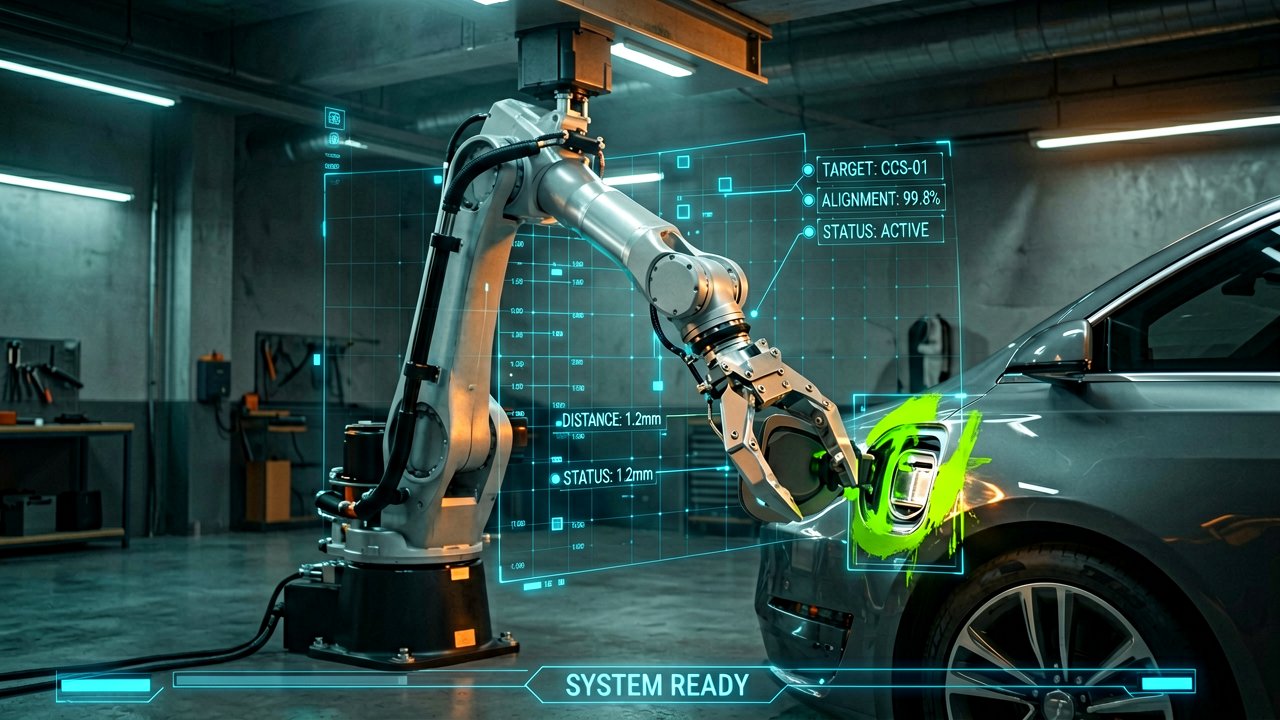
The quest for a truly autonomous ride-hailing future just cleared a massive physical hurdle. Rocsys, the Dutch robotics firm, has tucked another $13 million into its Series A coffers, pushing its total war chest to $56 million. This isn’t just another venture round to keep the lights on; it’s the fuel for the global rollout of their "M1" system. As robotaxi fleets from Phoenix to Beijing try to scale, the industry has realized that a car that drives itself isn't truly autonomous if it still needs a human "gas station" attendant to plug it in at the end of a shift.
The M1 is billed as the world’s first multi-bay, hands-free charging solution, and it’s a clever bit of engineering. Instead of a bulky stationary pedestal for every parking spot, Rocsys uses a rail-mounted robotic arm that glides overhead. Using a mix of computer vision and soft-robotics, the arm identifies the charging port on a vehicle and docks the plug with a level of precision that human drivers often lack. It’s a specialized approach to solving the "last inch" problem—the final physical connection that has remained a stubborn bottleneck in the electrification of autonomous fleets. Detailed insights on this funding and tech can be found via TechCrunch.
The Infrastructure Reality Check
The Logistics of Scale: What most reports miss is the sheer logistical nightmare of managing a fleet of hundreds, or eventually thousands, of electric autonomous vehicles (AVs) in a cramped urban depot. Traditional chargers require precise parking and significant floor space for pedestals. By moving the robotics to an overhead rail system, Rocsys effectively reclaims the garage floor. This allows fleet operators to pack vehicles tighter and automate the charging rotation without moving the cars themselves, which is a massive win for operational efficiency in high-rent logistics hubs.
From a hardware perspective, the "soft-robotics" element is the secret sauce here. Unlike rigid industrial robots that might snap a charging port if the car settles on its suspension or gets bumped, Rocsys’ tech is designed to be compliant. It feels its way into the socket, compensating for the natural misalignments that happen in the real world. This durability is exactly what fleet managers at companies like Waymo or Cruise are looking for when they calculate the total cost of ownership and uptime requirements for a 24/7 service.

Stakeholders are increasingly aware that the transition to EVs isn't just about the battery chemistry; it’s about the "frictionless" experience. For robotaxi companies, every minute a car spends waiting for a human to plug it in is a minute of lost revenue. Rocsys is betting that the industry will consolidate around a few standardized robotic interfaces, and by getting their M1 units into pilot programs now, they are positioning themselves as the "hidden" utility of the autonomous era. The $13 million extension specifically targets the North American market, where the demand for specialized AV infrastructure is currently peaking.
Historical context tells us that proprietary charging standards often kill innovation, but Rocsys has wisely played the compatibility game. Their systems are designed to work with standard CCS plugs, meaning they aren't forcing manufacturers to redesign their vehicles from scratch. This "plug-and-play" philosophy for heavy-duty and autonomous applications is likely why investors felt comfortable doubling down on a Series A. They aren't just selling a robot; they are selling the ability to remove the last human from the loop of a multi-billion dollar service industry.
Looking ahead, the challenge will be maintenance and weatherproofing. While an overhead rail works wonders in a controlled garage, scaling this to outdoor lots across varying climates will test the limits of their computer vision systems. However, with this latest capital injection, Rocsys has the runway to refine its sensors and prove that robotics can handle the grime and grit of a working taxi depot. The M1 represents a shift from "can we do this" to "how fast can we build it," signaling a more mature phase of the autonomous infrastructure cycle.
The Skeptic’s Ledger
Reading Between the Lines: The industry’s obsession with "hands-free" charging often ignores a glaring contradiction: the more complex we make the infrastructure, the more points of failure we introduce into an already fragile ecosystem. While Rocsys’ overhead rail is an elegant solution to floor-space congestion, it essentially replaces a reliable, low-tech human worker with a high-maintenance robotic system that requires its own suite of sensors, software updates, and specialized technicians. There is a certain irony in spending millions to automate a five-second physical task, especially when the return on investment relies entirely on the robotaxi market reaching a critical mass that remains perpetually "just a few years away."

Furthermore, the reliance on computer vision and soft-robotics assumes a degree of cleanliness and environmental stability that rarely exists in industrial depots. A stray layer of road salt, a smudge on a camera lens, or a slightly bent charging flap could sideline an expensive robotic arm, turning a "hands-free" solution into a "hands-on" repair job. We have seen time and again in the automation space that the "last inch" is often the most expensive to conquer, and there is a risk that the cost of maintaining these robotic valets might eventually eclipse the labor savings they were intended to provide.
Ultimately, the Rocsys model hinges on the assumption that conductive (plug-in) charging will remain the dominant standard for the foreseeable future. Should wireless inductive charging—currently a slower but mechanically simpler alternative—finally overcome its efficiency hurdles, the entire premise of a robotic arm becomes an expensive historical footnote. For now, Rocsys is successfully selling a bridge to a future that still hasn't quite arrived, betting that the immediate needs of today's logistics giants will outweigh the potential disruption of tomorrow's wireless breakthroughs.
We’ve spent a century perfecting the art of a car driving itself through a four-way intersection at midnight, only to realize the entire revolution might still be thwarted by a charging cable that refuses to cooperate with anything less than a $50,000 robotic arm and a very specific set of coordinates.
The quest for a truly autonomous ride-hailing future just cleared a massive physical hurdle. Rocsys, the Dutch robotics firm, has tucked another $13 million into its Series A coffers, pushing its total war chest to $56 million. This isn’t just another venture round to keep the lights on; it’s the fuel for the global rollout of their "M1" system. As robotaxi fleets from Phoenix to Beijing try to scale, the industry has realized that a car that drives itself isn't truly autonomous if it still needs a human "gas station" attendant to plug it in at the end of a shift.
The M1 is billed as the world’s first multi-bay, hands-free charging solution, and it’s a clever bit of engineering. Instead of a bulky stationary pedestal for every parking spot, Rocsys uses a rail-mounted robotic arm that glides overhead. Using a mix of computer vision and soft-robotics, the arm identifies the charging port on a vehicle and docks the plug with a level of precision that human drivers often lack. It’s a specialized approach to solving the "last inch" problem—the final physical connection that has remained a stubborn bottleneck in the electrification of autonomous fleets. Detailed insights on this funding and tech can be found via TechCrunch and Electrek.
The Infrastructure Reality Check
The Logistics of Scale: What most reports miss is the sheer logistical nightmare of managing a fleet of hundreds, or eventually thousands, of electric autonomous vehicles (AVs) in a cramped urban depot. Traditional chargers require precise parking and significant floor space for pedestals. By moving the robotics to an overhead rail system, Rocsys effectively reclaims the garage floor. This allows fleet operators to pack vehicles tighter and automate the charging rotation without moving the cars themselves, which is a massive win for operational efficiency in high-rent logistics hubs.
From a hardware perspective, the "soft-robotics" element is the secret sauce here. Unlike rigid industrial robots that might snap a charging port if the car settles on its suspension or gets bumped, Rocsys’ tech is designed to be compliant. It feels its way into the socket, compensating for the natural misalignments that happen in the real world. This durability is exactly what fleet managers at companies like Waymo or Cruise are looking for when they calculate the total cost of ownership and uptime requirements for a 24/7 service.
Stakeholders are increasingly aware that the transition to EVs isn't just about the battery chemistry; it’s about the "frictionless" experience. For robotaxi companies, every minute a car spends waiting for a human to plug it in is a minute of lost revenue. Rocsys is betting that the industry will consolidate around a few standardized robotic interfaces, and by getting their M1 units into pilot programs now, they are positioning themselves as the "hidden" utility of the autonomous era. The $13 million extension specifically targets the North American market, where the demand for specialized AV infrastructure is currently peaking.
Historical context tells us that proprietary charging standards often kill innovation, but Rocsys has wisely played the compatibility game. Their systems are designed to work with standard CCS plugs, meaning they aren't forcing manufacturers to redesign their vehicles from scratch. This "plug-and-play" philosophy for heavy-duty and autonomous applications is likely why investors felt comfortable doubling down on a Series A. They aren't just selling a robot; they are selling the ability to remove the last human from the loop of a multi-billion dollar service industry.
Looking ahead, the challenge will be maintenance and weatherproofing. While an overhead rail works wonders in a controlled garage, scaling this to outdoor lots across varying climates will test the limits of their computer vision systems. However, with this latest capital injection, Rocsys has the runway to refine its sensors and prove that robotics can handle the grime and grit of a working taxi depot. The M1 represents a shift from "can we do this" to "how fast can we build it," signaling a more mature phase of the autonomous infrastructure cycle.
The Skeptic’s Ledger
Reading Between the Lines: The industry’s obsession with "hands-free" charging often ignores a glaring contradiction: the more complex we make the infrastructure, the more points of failure we introduce into an already fragile ecosystem. While Rocsys’ overhead rail is an elegant solution to floor-space congestion, it essentially replaces a reliable, low-tech human worker with a high-maintenance robotic system that requires its own suite of sensors, software updates, and specialized technicians. There is a certain irony in spending millions to automate a five-second physical task, especially when the return on investment relies entirely on the robotaxi market reaching a critical mass that remains perpetually "just a few years away."
Furthermore, the reliance on computer vision and soft-robotics assumes a degree of cleanliness and environmental stability that rarely exists in industrial depots. A stray layer of road salt, a smudge on a camera lens, or a slightly bent charging flap could sideline an expensive robotic arm, turning a "hands-free" solution into a "hands-on" repair job. We have seen time and again in the automation space that the "last inch" is often the most expensive to conquer, and there is a risk that the cost of maintaining these robotic valets might eventually eclipse the labor savings they were intended to provide.
Ultimately, the Rocsys model hinges on the assumption that conductive (plug-in) charging will remain the dominant standard for the foreseeable future. Should wireless inductive charging—currently a slower but mechanically simpler alternative—finally overcome its efficiency hurdles, the entire premise of a robotic arm becomes an expensive historical footnote. For now, Rocsys is successfully selling a bridge to a future that still hasn't quite arrived, betting that the immediate needs of today's logistics giants will outweigh the potential disruption of tomorrow's wireless breakthroughs.
We’ve spent a century perfecting the art of a car driving itself through a four-way intersection at midnight, only to realize the entire revolution might still be thwarted by a charging cable that refuses to cooperate with anything less than a $50,000 robotic arm and a very specific set of coordinates.
Artūras Malašauskas is an AI Systems Integrator with 20+ years of production-grade web engineering experience. He has designed, shipped, and scaled enterprise Python/PHP systems for logistics, SaaS, and public-sector clients. For the past year, he has focused exclusively on AI integrations: deploying open-source LLMs, building generative media pipelines (image, audio, video), and engineering multi-agent workflows for real production environments. His standard: reproducibility, security, cost-efficient inference—no vaporware. He documents and evaluates emerging AI tooling, separating verified capabilities from marketing noise. Technical editor at: muza-ai.eu, ai-verslas.lt, ai-naujinos.lt Connect on LinkedIn
Comments