The Silicon Steep: Why Your Next Milk Tea Is Being Brewed by an Algorithm
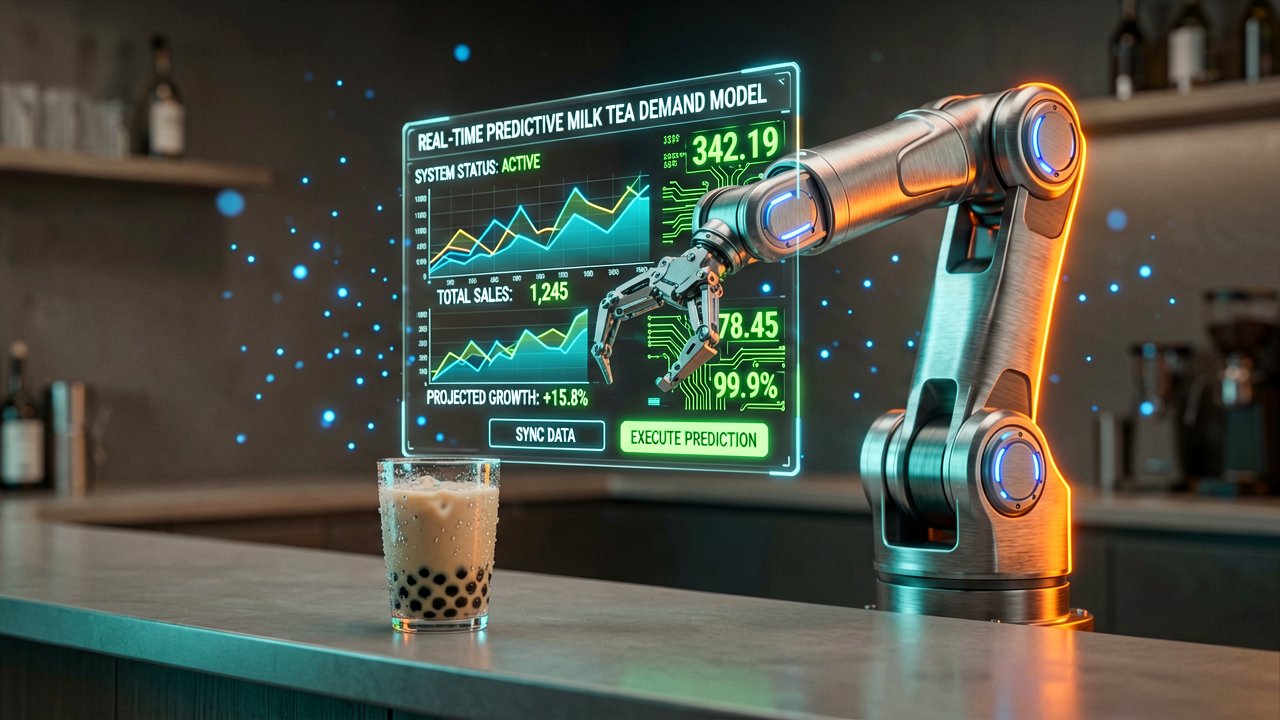
If you’ve walked through the neon-soaked streets of Hangzhou or Shenzhen lately, you might have noticed a subtle but definitive shift in the local "boba" ritual. Gone are the days of just scanning a static QR code and waiting fifteen minutes for a human barista to shake your drink. Instead, a new phenomenon—colloquially dubbed "AI milk tea"—is taking over, offering a literal taste of what the China Daily describes as the "new smart economy."
It’s not just about flashy robot arms, though they certainly look cool. The real magic is happening under the hood. Take Alibaba’s recent campaign with its AI agent, Quen. By offering free tea vouchers, the tech giant triggered a digital gold rush that saw People's Daily reporting 10 million orders in just nine hours. This wasn’t just a gimmick; it was a stress test for an ecosystem where AI doesn’t just chat—it shops, pays, and coordinates.
The Rise of the Robotic Barista
At the ground level, the "smart" in smart economy looks like the 6-axis robotic arms being deployed by firms like Anno Robot. These mechanical baristas can whip up a customized drink 24/7 with zero human intervention. They don't take lunch breaks, and they maintain a 98% consistency rate that human baristas, frankly, can’t touch during a Friday night rush.
For the shop owner, the math is becoming irresistible. Automation can cut labor costs by up to 60%, essentially replacing three full-time employees with a single compact kiosk. It’s a survival tactic in an industry where Taipec notes that rising ingredient costs and labor shortages are squeezing margins to the breaking point.
But let’s be honest: for the consumer, the appeal is often more about the "introvert-friendly" experience. As seen in recent deployments, interacting with a robot named "Toffee" that weighs your pearls to the gram and prints your label with surgical precision is oddly satisfying. It’s the ultimate high-tech "third space" where the social friction is zero, but the quality is high.
A Data-Driven Brew
The smart economy isn’t just about the physical pour; it’s about the predictive power behind it. Modern AI tools are now helping even independent shops forecast demand by analyzing everything from local weather patterns to holiday trends. According to Master Software Solutions, these systems can even manage real-time inventory, ensuring that a sudden heatwave doesn't lead to a "pearl-less" disaster.
This shift toward "AI Plus"—a concept highlighted during China’s recent political advisory sessions—represents the next phase of industrial evolution. By integrating Large Language Models (LLMs) like those from DeepSeek or Moonshot AI, the service sector is finding "application scenarios" that actually matter to the average person. It’s moving AI out of the research lab and into the 2-square-meter kiosks of your local subway station.
Critics might argue that we’re losing the soul of the "tea room" experience, but the data suggests otherwise. The global bubble tea market is projected to hit nearly USD 10 billion by 2035. To reach that scale, the industry needs the speed and efficiency that only silicon can provide. If the price of that growth is a robotic arm instead of a human one, most consumers seem perfectly happy to take that trade—provided the boba is still chewy and the sugar level is exactly 30%.
Ultimately, "AI milk tea" is a bellwether. It’s a signal that the smart economy isn't some distant, abstract future—it's something you can order, sip, and enjoy right now. And if this is what the future tastes like, I’ll take mine with extra pearls and a side of high-speed data.
What's your take—would you trust a robotic arm to brew your morning caffeine fix, or do you still crave that human touch?
The Silicon Steep: While the headlines focus on the choreography of robotic arms, the true disruption of the "AI milk tea" movement lies in the invisible architecture of the supply chain. What most reports miss is that we are witnessing the birth of "hyper-localized manufacturing." In the traditional model, a milk tea brand’s success depended on the "Golden Barista"—that one employee who knew the exact flick of the wrist to emulsify the powder. AI has effectively de-skilled the labor while up-skilling the infrastructure, turning every 20-square-foot kiosk into a data-emitting node.
The Ghost in the Machine
Veteran industry analysts point out that the pivot to AI isn't just about saving on wages; it’s a desperate play for consistency in a market where brand loyalty is notoriously fickle. If a customer gets a drink that’s too sweet in Shanghai and perfect in Beijing, the brand loses. By using sensors that monitor the viscosity of the tea and the temperature of the milk in real-time, companies like Taipec are ensuring a "global flavor standard" that was previously impossible. It’s the McDonaldization of tea, but with a degree of precision that Ray Kroc could only dream of.
However, the human element hasn't vanished—it has merely shifted behind the curtain. For every robot arm installed, there is a burgeoning need for "Prompt Engineers" for flavor profiles and maintenance technicians who understand both hydraulics and haptics. Stakeholders from the China Daily reports suggest that the "smart economy" is creating a tiered workforce: the low-level service jobs are evaporating, replaced by technical roles that oversee these automated fleets across entire city blocks.
Historical Echoes and the New Ritual
To understand why this is happening now, we have to look back at the "vending machine culture" of 1980s Japan. Back then, it was about convenience and novelty. Today’s AI tea kiosks are different because they are conversational and adaptive. When an AI agent like Alibaba’s Quen interacts with a user, it isn't just taking an order; it’s harvesting preference data to influence next season’s product development. As noted by People's Daily, the integration of LLMs means the machine can "recommend" a drink based on your previous mood or even the air quality index outside.
This creates a strange new social ritual. In high-traffic hubs, the "wait" for a drink has been transformed from a moment of boredom into a spectacle of industrial art. Passersby often stop to film the precision of the pour, effectively providing free marketing for the brands. This "viral-ready" nature of AI-made tea is a deliberate design choice. In the smart economy, if an automated process isn't "Instagrammable," it’s considered a failure of user experience (UX) design.
There is, of course, the lingering question of the "uncanny valley" of service. Does a drink taste better because a human didn't touch it? For the younger "Gen Alpha" consumers, the answer is increasingly yes. They value the hygiene and the technical perfection over the chatty barista. As Anno Robot pushes into the global market, we are seeing a shift where the machine is no longer a tool, but the primary artisan.
Ultimately, the "AI milk tea" trend is the first major bridge between the metaverse and the physical world for the masses. It’s a tangible, 700ml proof of concept. When you tap a screen and a machine three miles away begins boiling water based on your specific biometric authorization, the boundary between the digital and the physical dissolves. It’s not just tea; it’s the liquid frontier of the next industrial revolution.
Are you ready to trade the barista's smile for the robot's precision, or is the soul of the drink lost in the code?
Reading Between the Lines: While the tech sector breathlessly frames the "AI milk tea" boom as a triumph of engineering, a more cynical lens suggests it might be a sophisticated hedge against a demographic cliff. We are told this is about "smart" convenience, but under the surface, it’s a frantic race to decouple the service industry from a shrinking, increasingly expensive youth labor pool. The contradiction is glaring: we are using the world's most advanced silicon chips to solve the "problem" of scooping tapioca pearls.
The Myth of the Frictionless Economy
The narrative of the "smart economy" often glosses over the massive energy and capital expenditures required to maintain these robotic fleets. As Taipec highlights the efficiency gains, they rarely dwell on the carbon footprint of the server farms required to process "predictive pearl demand." There is a certain irony in replacing a low-voltage human with a high-voltage mechanical arm and an LLM backend just to deliver a drink that people used to buy for its "artisanal" charm.
Furthermore, the promise of "unlimited customization" through AI often leads to what psychologists call the tyranny of choice. By allowing an algorithm to tweak 1,000 variables, brands risk alienating the casual consumer who just wants a drink, not a collaborative project with a neural network. As seen in the massive voucher surges reported by People's Daily, demand is currently driven by novelty and subsidies, not necessarily a fundamental shift in how people value the beverage itself.
Sovereignty in a Cup
There is also the thorny issue of data sovereignty. In this new smart economy, your milk tea habit is no longer a private vice; it is a data point in a broader social credit or consumer behavior model. When an AI like Alibaba’s Quen handles your transaction, it isn't just selling tea—it’s refining a profile of your spending power and health conscious choices. The "convenience" of having a machine know your order before you do comes at the cost of being permanently "legible" to the state and corporate entities.
We must also question the long-term viability of these 24/7 autonomous kiosks. While Anno Robot touts the "perfect pour," they cannot automate the physical upkeep of a city’s "third spaces." A robot can't clean up a spilled drink in the seating area or handle a disgruntled customer whose QR code won't scan. The smart economy risks creating a "sterile" urban environment where the infrastructure is flawless but the human connection—the very reason people gather in tea shops—is completely hollowed out.
Ultimately, the AI milk tea trend might be less about the tea and more about the "normalization" of automation. If we can accept a robot as our barista, we are one step closer to accepting them as our pharmacists, drivers, and caregivers. The boba cup is merely the Trojan horse for a total shift in the social contract of service. It’s a brilliant marketing move, but as a cultural shift, it remains a bitter pill—or pearl—to swallow for those who value the messy, unpredictable nature of human interaction.
In the end, we’ve spent billions of dollars and decades of research to ensure that a robotic arm can shake a plastic cup with the same weary precision as a teenager on his first day of work—except the robot never forgets to charge you for the extra pearls.
Artūras Malašauskas is an AI Systems Integrator with 20+ years of production-grade web engineering experience. He has designed, shipped, and scaled enterprise Python/PHP systems for logistics, SaaS, and public-sector clients. For the past year, he has focused exclusively on AI integrations: deploying open-source LLMs, building generative media pipelines (image, audio, video), and engineering multi-agent workflows for real production environments. His standard: reproducibility, security, cost-efficient inference—no vaporware. He documents and evaluates emerging AI tooling, separating verified capabilities from marketing noise. Technical editor at: muza-ai.eu, ai-verslas.lt, ai-naujinos.lt Connect on LinkedIn
Comments