Beyond the Bottleneck: Bear Robotics’ Servi Q Tackles the Final Frontier of Narrow-Aisle Automation
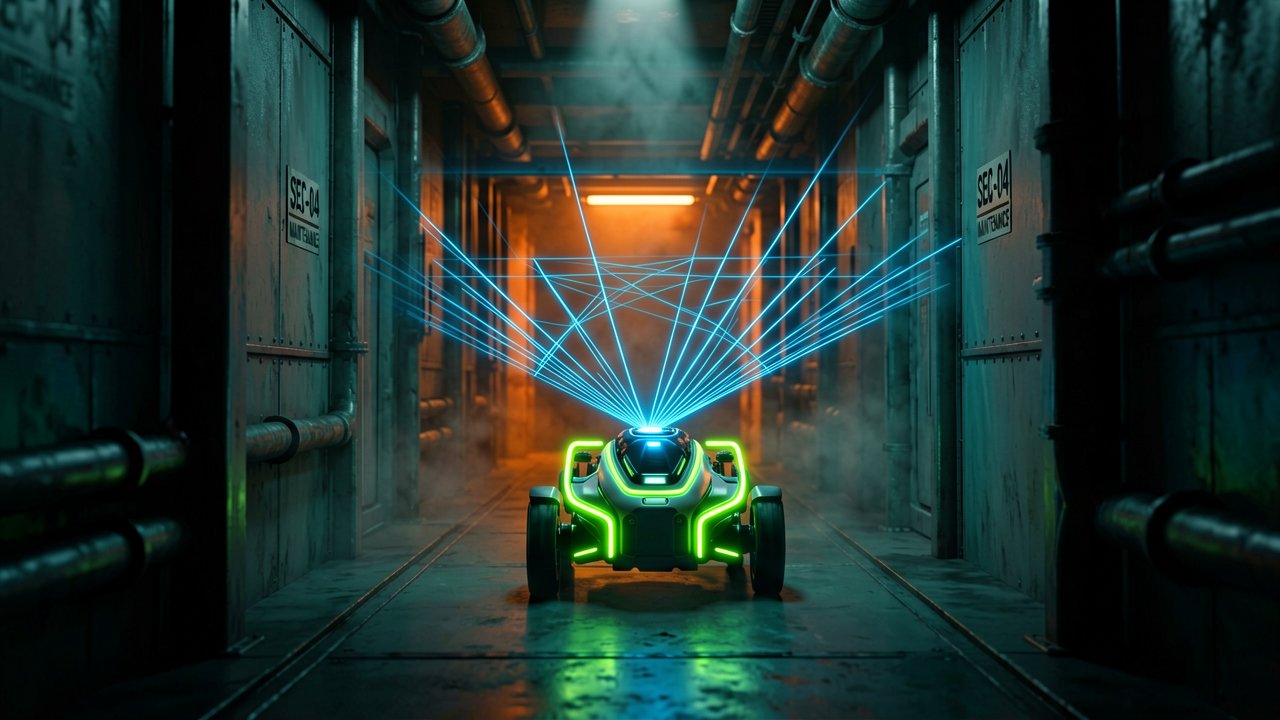
If you’ve ever tried to squeeze into a packed bistro on a Friday night, you know the physical reality of the hospitality business: space is a premium, and usually, there’s not enough of it. For years, the dream of automated table service has been stymied by this very layout. Large, lumbering robots were great for sprawling banquet halls, but they’d essentially become expensive paperweights the moment they encountered a narrow bar corridor or a tight corner. That changes today.
Bear Robotics just pulled the curtain back on Servi Q at the National Restaurant Association Show 2026, and it’s a clear shot across the bow for anyone who thought their floor plan was "too cozy" for tech. Developed in a high-profile partnership with SoftBank Robotics, Servi Q is essentially the nimble younger sibling to the massive Servi Plus workhorse. It doesn't just navigate tight spots; it thrives in them.
The Physics of the Pivot
The headline stat here is the 18-inch minimum passage width. To put that in perspective, that’s barely wider than a standard serving tray. While the flagship Servi Plus handles the heavy lifting with its 88-pound payload, it often requires a wider berth that many urban cafés simply can't provide. According to Yahoo Finance , Bear Robotics CEO John Ha noted that "space is the number one barrier" to adoption. By shrinking the footprint without sacrificing the brains, they’ve effectively removed the final physical excuse for staying analog.
But it’s not just about being small; it’s about being smart when you're stuck. Servi Q features a clever "backward movement" capability. In a hallway where a 180-degree turn is impossible, the robot simply reverses out of the way. It’s equipped with specialized backward obstacle detection to ensure it doesn't clip a stray chair or a surprised diner during its retreat. It’s a pragmatic solution to a very human problem: the "oops, let me back up" moment.

A Fleet that Talks to Itself
One of the most impressive technical feats of the Servi ecosystem is the peer-to-peer coordination. These robots aren't just independent agents; they function as a self-organizing fleet. You can have a "mixed fleet" where the beefy Servi Plus patrols the main dining room while the agile Servi Q handles the bar and the narrow kitchen entrance. They communicate in real-time to prevent "robot deadlocks" in high-traffic zones, all without needing a centralized network to babysit them.
Beyond the nuts and bolts, there's a serious attempt here to turn these machines into more than just delivery trays on wheels. Servi Q sports a built-in display screen designed for guest engagement. Venues can use this to flash daily specials, show off branded content, or even help with wayfinding. It’s a shift from seeing a robot as a "tool" to seeing it as a "touchpoint"—a way to generate revenue or at least keep a guest entertained while their appetizer arrives.
Ultimately, Bear Robotics—backed by heavyweights like LG Electronics—is betting that the future of hospitality isn't just about big, flashy tech. It’s about the tech that actually fits into the world we already built. If you’ve got a hallway, you now have room for a robot. The question for restaurateurs is no longer "Can it fit?" but "Why aren't we using it?"
Would you like to explore the technical specifications of the Servi Q or compare its operational costs to the larger Servi Plus model?
The Real Friction Point: While the glossy press releases focus on 18-inch hallways and backward-facing sensors, there is a much deeper sociological shift happening between the kitchen swinging doors and the table. Most people assume these robots are meant to replace the waiter, but that misses the forest for the trees. In reality, Servi Q is the industry's answer to the "ghost trip"—the thousands of steps a server takes every shift just to drop off a side of ranch or a clean fork, which effectively keeps them away from the guests who actually pay their bills.
Historically, the hospitality industry has been allergic to anything that felt "clinical." Early service robots looked like refrigerators with tablets glued to them, creating a jarring aesthetic clash in high-end environments. By shrinking the form factor, Bear Robotics is leaning into "peripheral automation." The goal isn't for the Servi Q to be the star of the show; it’s designed to be a piece of background infrastructure, as unremarkable and efficient as a dumbwaiter once was in a 19th-century townhouse.
The "Human-in-the-Loop" Paradox
There is a specific tension that tech journalists have watched play out since Bear Robotics first hit the scene. Every time a robot gets more capable, the human staff initially fears for their job security. However, seasoned floor managers see it differently. They point to the "burnout threshold." When a server is physically exhausted from hauling heavy trays across a 10,000-square-foot floor, their hospitality—the smile, the eye contact, the suggestive sell—is the first thing to evaporate. Servi Q acts as a mechanical mule, absorbing the physical toll so the human can focus on the "theatre" of dining.
This "compact" evolution also signals a shift in the investor landscape. LG’s significant $60 million stake in Bear Robotics, as noted by Reuters, wasn't just a bet on a gadget. It was an investment in the AI-driven mapping and "swarm intelligence" that allows these robots to negotiate space. In a tight urban environment, a robot can't just follow a pre-programmed path; it has to have the "reflexes" of a human busser. The Servi Q’s ability to reverse out of a confrontation with a high-chair is the result of millions of hours of edge-case training.
Designing for the "Social Space"
We also have to talk about the psychology of the "narrow gap." In architecture, the "social distance" between humans is carefully managed. When a large robot occupies a narrow hallway, it feels like an intrusion into a diner's personal space. By reducing the robot’s width to 12.6 inches and its base to 18 inches, Bear Robotics is attempting to minimize the "uncanny valley" of physical presence. It feels less like a vehicle and more like a moving piece of furniture. It’s an exercise in humility for robotics design: the best robot is the one you stop noticing after five minutes.
As we look toward 2027 and beyond, the success of Servi Q will likely be measured by its invisibility. If it can successfully integrate into the "old world" architecture of London pubs or New York speakeasies—places never designed with automation in mind—it will have solved the final puzzle of indoor logistics. The era of the "clunky" robot is ending, replaced by a generation of tech that knows how to step aside, literally and figuratively, to let human hospitality take the lead.
Would you like to analyze how Servi Q's AI mapping handles unpredictable obstacles like moving pets or toddlers, or should we look at the subscription-based "RaaS" (Robot as a Service) pricing models?
The Great Narrow-Hallway Gamble: For all the talk of "innovation," there is a nagging contradiction at the heart of the Servi Q launch that the tech industry is loath to admit. We are currently spending millions of dollars to build robots that can navigate the messy, cramped environments we refused to fix. There is a certain irony in a restaurant owner paying a monthly subscription for a "compact" robot to squeeze through a 20-inch gap instead of simply moving a table to improve the human flow of the room. We are effectively automating our own poor spatial planning.
The skepticism doesn't stop at floor plans. While Bear Robotics champions the "backward movement" capability as a breakthrough, it’s also a tacit admission of the tech's current limitations. A robot that has to reverse out of a hallway because it can’t complete a point-turn is a robot that is, for at least a few seconds, a bottleneck. In a high-volume environment where every second counts, a "polite" robot that yields to everything might actually decrease the total velocity of service. We have to wonder if, in some scenarios, the robot becomes just one more thing for a stressed-out server to dodge.
The Sustainability of the "Robot-as-a-Service" Hype
Then there is the financial reality. The industry is pivoting hard toward the RaaS (Robot as a Service) model, which looks great on a quarterly balance sheet but raises questions about long-term viability. As noted by analysts at Bloomberg, the labor shortage is the primary tailwind for this tech, but what happens if the labor market stabilizes? If the cost of maintaining a fleet of Servi Q units—with their sophisticated LiDAR and proprietary software updates—exceeds the cost of a part-time runner, these sleek machines will end up in the same graveyard as the automated tablet menus of 2012.
Furthermore, we must consider the "engagement" factor. The Servi Q includes a screen for "branded content," but there is a very fine line between helpful service and digital clutter. Does a guest at a dimly lit, intimate bistro really want a glowing LCD screen approaching their table to "upsell" them on a dessert? There is a risk that by making robots more compact and pervasive, we are inadvertently turning the dining experience into a physical version of a pop-up ad. The challenge for Bear Robotics isn't just engineering; it's social engineering—convincing us that a screen on wheels doesn't kill the vibe.
Ultimately, the Servi Q represents the "last mile" of indoor automation. It is an impressive feat of miniaturization, but it also forces us to decide what we want our social spaces to look like. If we fill our narrowest corridors with autonomous trays, we might gain five percent in efficiency while losing the very "human" spontaneity that makes going out worthwhile. The tech is finally ready to fit into our world; the question remains whether our world actually wants it there once the novelty wears off.
Would you like to dive into the maintenance costs associated with high-traffic robot deployments, or shall we examine the guest feedback data from early Servi Q pilot programs?
"We’ve finally reached the pinnacle of modern engineering: a machine that can navigate a crowded bar better than a person who’s had three martinis—though it still can’t laugh at the owner's jokes or hide its disappointment when someone tips in pocket change."
Artūras Malašauskas is an AI Systems Integrator with 20+ years of production-grade web engineering experience. He has designed, shipped, and scaled enterprise Python/PHP systems for logistics, SaaS, and public-sector clients. For the past year, he has focused exclusively on AI integrations: deploying open-source LLMs, building generative media pipelines (image, audio, video), and engineering multi-agent workflows for real production environments. His standard: reproducibility, security, cost-efficient inference—no vaporware. He documents and evaluates emerging AI tooling, separating verified capabilities from marketing noise. Technical editor at: muza-ai.eu, ai-verslas.lt, ai-naujinos.lt Connect on LinkedIn
Comments