The 3.4-Mile Sting: Germany’s Ziesel Robot Rewrites the Rules of Anti-Tank Warfare
The Rise of the Robotic Tank-Killer
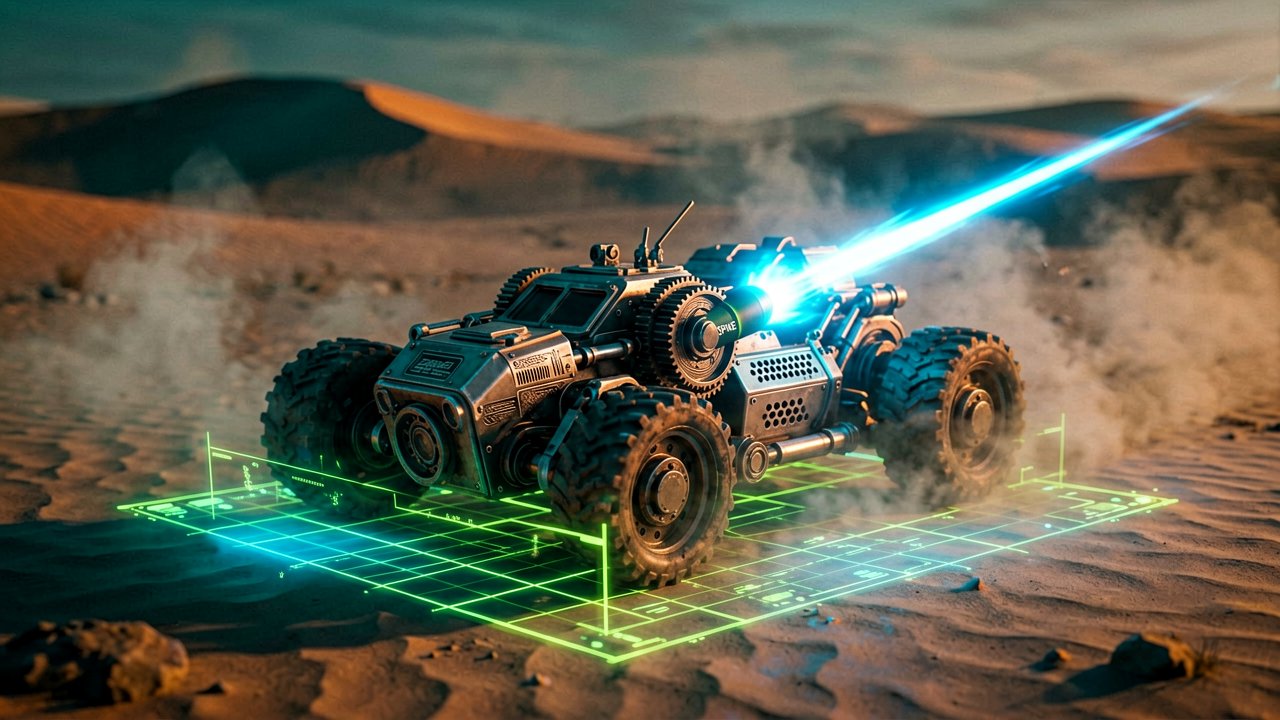
In a significant shift for autonomous warfare, the German Bundeswehr recently showcased a pint-sized powerhouse during tactical trials: the Ziesel combat robot. This uncrewed ground vehicle (UGV), developed by Diehl Defence, proved that size isn't everything on the modern battlefield. Despite its compact, "caterpillar-track" silhouette that looks more like a high-tech lawnmower than a weapon of war, the Ziesel successfully integrated and fired heavy anti-tank guided missiles (ATGMs), marking a milestone in European robotic infantry support.
The star of the show during these trials was the integration of the SPIKE LR2 missile system. Capable of striking targets at a range of up to 5.5 kilometers (approximately 3.4 miles), this setup transforms the Ziesel from a simple cargo mule into a lethal "hunter-killer" platform. According to reports from European Defence Review, the demonstration highlighted how a remotely operated vehicle can engage heavy armor from a distance that keeps human operators well out of the line of fire.
Agility Meets Firepower
What makes the Ziesel particularly interesting is its off-road pedigree. Originally derived from a platform designed for forestry and alpine rescue, its electric drivetrain and low center of gravity allow it to navigate dense woods and steep terrain where traditional armored vehicles might struggle. As noted by Army Recognition, this mobility is crucial for "last-mile" logistics and fire support, providing infantry squads with organic anti-tank capabilities that don't require calling in air support or heavy tanks.
During the Unmanned Ground Systems (UGS) Training Week, the Ziesel demonstrated its ability to operate in "follow-me" modes or via remote control. This flexibility allows soldiers to use the robot as a shield or a scout. By mounting the SPIKE launcher on a stabilized platform, the Ziesel can fire while maintaining a low profile, making it an incredibly difficult target for enemy sensors to detect and hit compared to a full-sized Main Battle Tank.

A Paradigm Shift in Infantry Tactics
The implications for future conflicts are clear: the democratization of high-end anti-tank lethality. With a 3.4-mile reach, a single operator hidden in a trench or basement can disable a multi-million dollar tank using a robot that costs a fraction of the price. Industry analysts at Janes have long suggested that the "sensor-to-shooter" link is shrinking, and the Ziesel is a living—or rather, mechanical—example of that trend accelerating within NATO forces.
However, the Ziesel isn't just about blowing things up. Its modular design means the missile rack can be swapped for stretchers to evacuate wounded soldiers or cargo racks to haul ammunition. This versatility is exactly what the German military is looking for as it modernizes under the "Land.Digital" initiative. By offloading the most dangerous tasks to expendable or semi-expendable robots, the Bundeswehr aims to increase mission success rates while drastically reducing the risk to human life.
As these trials conclude, the focus shifts to how quickly these systems can be integrated into active units. The success of the SPIKE integration suggests that the "robotic wingman" concept is no longer science fiction—it’s a practical, portable reality. For the modern infantryman, the best friend on the battlefield might soon be a silent, electric-powered robot with a very long-reaching sting.
The Architects of Autonomous Lethality
Under the Hood of the Ziesel: The evolution of this platform from a rugged off-road utility vehicle to a specialized combatant is the result of a strategic partnership between Diehl Defence and the original manufacturer, Mattro. While Diehl provides the tactical "brain" and weaponry, the base vehicle was born in the Austrian Alps, designed to handle extreme inclines and sensitive environments where traditional combustion engines are too loud or heavy. This transition highlights a growing trend in the defense industry: militarizing proven civilian "workhorse" technology to speed up development cycles.

Diehl Defence has positioned itself as a leader in the German "Land.Digital" strategy, focusing on modularity. During the trials, the company emphasized that the Ziesel’s architecture is open, meaning it isn't locked into a single weapon system. While the SPIKE LR2 was the highlight of the recent 3.4-mile demonstration, the platform can be reconfigured for electronic warfare, 7.62mm machine gun support, or advanced reconnaissance. This modularity is a key selling point for the Bundeswehr, which seeks to avoid "one-trick pony" equipment in an era of shrinking defense budgets and evolving threats.
The SPIKE Connection: EuroSpike and Global Reach
The missile system itself—the SPIKE LR2—is a product of EuroSpike GmbH, a joint venture between Diehl Defence, Rheinmetall, and Rafael Advanced Defense Systems. This collaboration ensures that the technology is tailor-made for European interoperability. By integrating a "fire-and-forget" missile that can also be redirected mid-flight via a fiber-optic link, the Ziesel provides infantry with a level of precision usually reserved for attack helicopters. The recent trials proved that the Ziesel’s chassis could handle the recoil and weight of the SPIKE launcher without compromising its nimble footprint.
The involvement of Rheinmetall in the broader EuroSpike ecosystem also hints at future scaling. As Germany continues to overhaul its military readiness, the data gathered from the Ziesel's successful missile launches is being funneled into larger autonomous projects. The goal is a networked battlefield where the Ziesel acts as a forward scout, feeding targeting data back to larger platforms like the Boxer CRV or even the upcoming Main Ground Combat System (MGCS). This "system of systems" approach is where the real value of the combat robot lies, moving beyond a standalone gadget to a vital node in a digital web.
Operational Testing and the Human Element
The military trials weren't just about testing hardware; they were about testing the "human-machine interface." The Bundeswehr’s 6th Infantry Company was heavily involved in the UGS Training Week to see how easily a standard soldier could master the Ziesel's controls under stress. Feedback from the field suggested that the intuitive, game-like controller reduced the training burden, allowing soldiers to focus on tactics rather than the mechanics of driving. This ease of use is vital for rapid deployment in high-intensity conflict zones where time is a luxury.
Finally, the strategic context of these trials cannot be ignored. With the shifting security landscape in Eastern Europe, the German military is under immense pressure to modernize its anti-armor capabilities. The Ziesel represents a cost-effective way to multiply force presence. By deploying a swarm of missile-armed robots, a single platoon can effectively control a much larger area of operations, creating a "no-go zone" for enemy tanks while keeping German personnel in hardened, protected positions. The success of these 3.4-mile shots is a clear signal that Germany is ready to embrace a more roboticized future for its land forces.
Engineering Survivability in the Age of Autonomy
The Recoil Dilemma and the Fragility of Logic: While the headline-grabbing 3.4-mile strike showcases lethal reach, the true analytical victory lies in the structural integrity of the platform itself. Integrating heavy anti-tank guided missiles (ATGMs) like the SPIKE LR2 onto a lightweight, 380 kg chassis such as the Ziesel is an engineering paradox. Small unmanned ground vehicles (UGVs) typically struggle with the violent physical punishment of repeated launches, which can rack suspension systems and de-calibrate sensitive onboard electronics. During the five-day trial conducted by Interesting Engineering, the Ziesel fired 17 missiles, proving that a compact robotic carrier can survive the operational loads that usually necessitate a much larger, more expensive vehicle frame.
This durability is a prerequisite for what defense analysts call "software-defined defense." By proving the hardware can withstand the kinetic stress of frontline combat, Diehl Defence is validating a new business model where the platform is secondary to the capabilities—such as the PLATON autonomy kit—it carries. This shift mirrors the evolution of the smartphone: the hardware must be rugged enough to survive the environment, but the value is in the "apps" (in this case, modular weapon systems and AI-driven navigation) that allow it to perform multiple roles without a complete redesign.
A Cost-Exchange Equation That Favors the Underdog
From a strategic perspective, the Ziesel-SPIKE combination fundamentally alters the cost-exchange ratio on the battlefield. As noted by analysts at Israel Defense, this represents the world's first successful live-fire ATGM launch from a UGV of this class. In modern warfare, as seen in recent conflicts in Eastern Europe, the ability to disable a main battle tank—costing upwards of $10 million—with a robotic platform and a guided missile is a tactical game-changer. The Ziesel allows NATO forces to impose a "cost dilemma" on adversaries: do you fire an expensive interceptor at a small, $100k robot, or do you risk losing a multi-million dollar tank to its 3.4-mile sting?
The "man-in-the-loop" philosophy remains central to the Bundeswehr’s approach, as confirmed by reports from The Defense Watch. By using fiber-optic links for guidance, the system bypasses the electronic warfare (EW) vulnerabilities that plague GPS-dependent drones. This "analog" tether in a digital age provides a level of reliability that wireless autonomous systems cannot yet match in contested environments. It ensures that while the robot takes the physical risk, a human operator maintains the ethical and tactical final word, a critical balance as NATO debates the role of AI in lethal decision-making.
Interoperability as a Force Multiplier
Finally, the Ziesel's integration into the broader European defense ecosystem cannot be overlooked. The SPIKE missile family is already a staple for over 30 countries, including many in Eastern Europe and South America, as detailed by Defense News. By mounting this proven munition on the Ziesel, Germany isn't just buying a new tool; it's reinforcing a regional supply chain. This interoperability allows for shared logistics, joint training exercises, and a more cohesive "robotic buffer zone" along NATO's frontiers, where technology—rather than human troops—acts as the first line of detection and disruption.
As these robotic units move from prototypes to frontline assets, the focus will shift toward "swarm" coordination. One Ziesel is a threat; twenty Ziesels, coordinated via a digital mesh network and operating from concealed positions, are a nightmare for any invading armored column. The recent trials in Germany are less of a final destination and more of a starting gun for a new era of attrittable, autonomous land warfare.
Ultimately, the Ziesel proves that while the future of war might be robotic, it’s also surprisingly small and electric—meaning the scariest thing on the next battlefield won't be a 70-ton tank, but a silent, 800-pound motorized "lawnmower" with a very, very long reach and an even longer memory. At least it doesn't need to stop for lunch.
Artūras Malašauskas is an AI Systems Integrator with 20+ years of production-grade web engineering experience. He has designed, shipped, and scaled enterprise Python/PHP systems for logistics, SaaS, and public-sector clients. For the past year, he has focused exclusively on AI integrations: deploying open-source LLMs, building generative media pipelines (image, audio, video), and engineering multi-agent workflows for real production environments. His standard: reproducibility, security, cost-efficient inference—no vaporware. He documents and evaluates emerging AI tooling, separating verified capabilities from marketing noise. Technical editor at: muza-ai.eu, ai-verslas.lt, ai-naujinos.lt Connect on LinkedIn
Comments