Unitree's $574K GD01 Transformer Robot Shifts Between Two and Four Legs
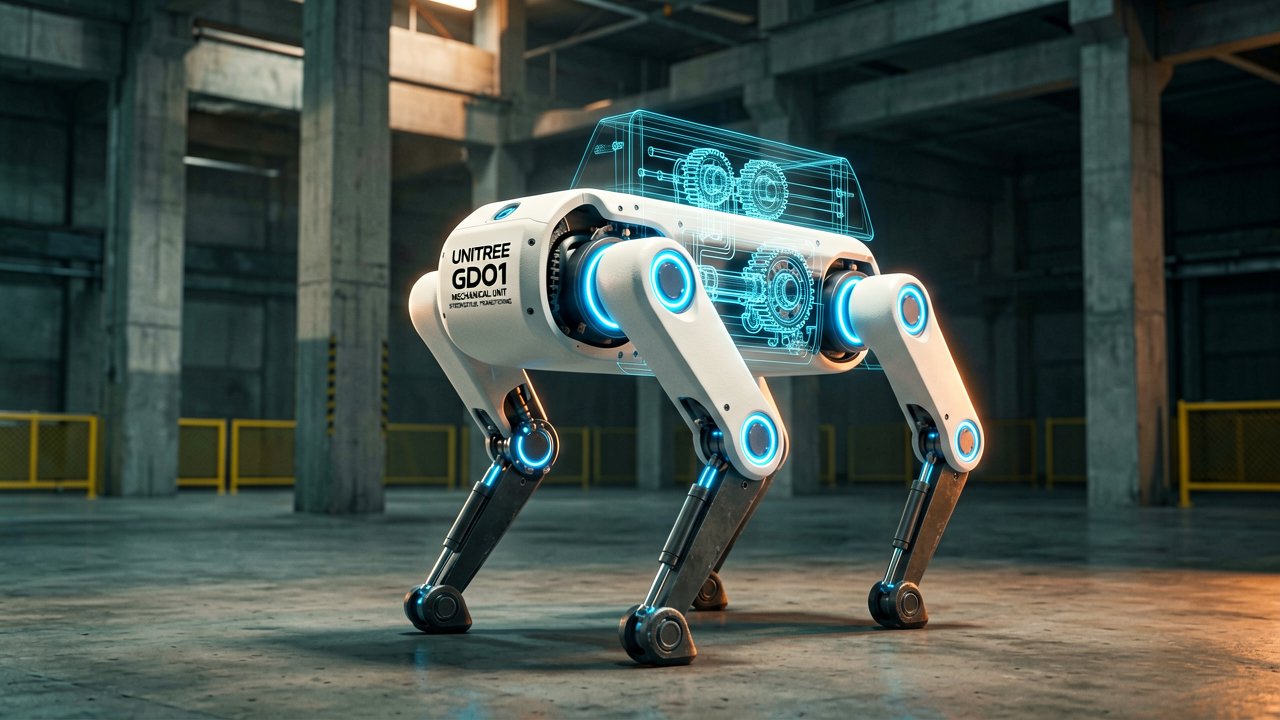
The robotics industry just got a lot more theatrical. Unitree unveiled the GD01, a manned mecha capable of transitioning between bipedal walking and four-legged crawling, in a demonstration that quickly went viral across Chinese and international social media.
The machine weighs approximately 500 kilograms with a pilot on board—roughly the weight of a grand piano—and carries a starting price of 3.9 million yuan (US$574,000), according to the company's announcement.
In the demonstration video released Tuesday, Wang Xingxing, Unitree's founder, climbed into the chest cavity of the 9.8-foot-tall metal robot, walked around, and destroyed a concrete brick wall with a single punch. The machine then reconfigured its chassis, shifting into a four-legged crawl.
According to South China Morning Post, the GD01 is built from a skeleton of titanium alloy and aerospace-grade aluminum with a carbon fiber shell, designed and engineered almost entirely in-house by the Hangzhou-based company.
Unitree describes the GD01 as the world's first mass-produced transformable mecha. While some amateur enthusiasts have built mechas before, those units weren't designed for work but rather for show, and none possessed the extraordinary capabilities and dexterity that the GD01 demonstrates.
The product is still in its first generation at this stage, and there is indeed a lot of room for imagination, said Huang Jiawei, a marketing staff member at Unitree. The price remains high, but it is only a preliminary reference as further functional improvements and cost reductions will take time after the product's initial launch.
Chen Jing, vice president of the Technology and Strategy Research Institute, told the Global Times that the GD01 represents an important step for embodied artificial intelligence in China. It is no longer just a proof-of-concept machine confined to laboratories, but a product with a clear price tag and commercialization roadmap.
He added that the machine still faces practical challenges, including difficulty getting in and out of the cockpit, battery-life concerns, limited comfort, regulatory uncertainty, and maintenance complexity (which should come as no surprise to anyone who has tried to parallel park a semi-truck).
The GD01 expands Unitree's portfolio at a time when Chinese manufacturers are significantly outstripping their US rivals, helped by lower production costs and faster manufacturing scale-up. Chinese companies accounted for nearly 90% of global humanoid sales in 2025, according to research firm Omdia.
Unitree shipped more than 5,500 humanoid robots last year, demonstrating the company's strong position in the rapidly growing robotics market. This manufacturing scale advantage is becoming increasingly visible as the race shifts from who can demo a robot folding laundry to which companies can support fleets of humanoid robots in production environments doing real work.
Behind the spectacle of this new giant robot, an entire industrial ecosystem is quietly reshaping the country's mining, manufacturing infrastructure, airport terminals, and high-voltage power grids. We are at the very beginning of this shift, and its practical consequences are only starting to surface.
The Chinese media reaction was instant: "Unitree really built a 'Gundam'!" That was a wild exaggeration, but there's a kernel of truth to it. The GD01 feels like the first version of something much bigger. Not in size, but in scope.
China is waging a full-spectrum push into embodied AI—"digital brains" with physical bodies that perceive and act on the real world—and it's playing out simultaneously across daily life, logistics, heavy industry, medical care, and military applications.
According to Fast Company, the GD01 is designed for civilian transport, though the exact use cases remain somewhat vague. The company has not specified whether this is intended for industrial applications, entertainment, or something else entirely.
The demonstration video shows the GD01 carrying a pilot in its torso-mounted cockpit, walking like a humanoid robot and knocking over a brick wall with its hand. The machine then reconfigures its chassis, shifting into a four-legged crawl. How did they even come up with this track? It feels like watching Transformers in real life, one user wrote on Weibo, as quoted by Global Times.
Another commented: "The avatar armor is real now," while others said "China is truly a paradise for engineers." The viral nature of the demonstration suggests the marketing impact may be as significant as the technical achievement.
Whether users actually pay $574,000 for a machine that's difficult to enter, has limited battery life, and faces regulatory uncertainty remains the real question. The technology is impressive, but the business case is still being written.
Time will tell if this becomes a viable product or just another expensive demo. At least it's better than watching a robot try to fold laundry for the tenth time.
Artūras Malašauskas is an AI Systems Integrator with 20+ years of production-grade web engineering experience. He has designed, shipped, and scaled enterprise Python/PHP systems for logistics, SaaS, and public-sector clients. For the past year, he has focused exclusively on AI integrations: deploying open-source LLMs, building generative media pipelines (image, audio, video), and engineering multi-agent workflows for real production environments. His standard: reproducibility, security, cost-efficient inference—no vaporware. He documents and evaluates emerging AI tooling, separating verified capabilities from marketing noise. Technical editor at: muza-ai.eu, ai-verslas.lt, ai-naujinos.lt Connect on LinkedIn
Comments