MIPI Alliance Launches Physical AI Group for Humanoid Robotics
The MIPI Alliance announced the formation of a Physical AI Birds of a Feather (BoF) group on April 28, 2026, with an initial focus on humanoid robotics. The organization, which develops specifications that standardize wired interfaces for mobile and connected ecosystems, aims to examine how MIPI specifications can support the rapidly developing humanoid application space.
This isn't the first time interface standards have migrated from one industry to another. Mobile phone connectors became USB-C. Automotive protocols now power industrial controllers. Humanoid robots are the next frontier, and the industry is betting that standardized interfaces will accelerate deployment rather than slow it down with proprietary lock-in.
According to the official MIPI press release, the market emerging around humanoid robots is dynamic. Yole Group projects a 56 percent compound annual growth rate to reach more than $6 billion by 2030. As adoption accelerates at the start of the next decade, the value could soar to $51 billion by 2035.
Pierrick Boulay, principal analyst for automotive semiconductors at Yole Group, says humanoids are reaching an inflection point. AI progress, supply-chain maturity, and component scaling are turning humanoids from complex prototypes into deployable systems with measurable ROI in logistics, manufacturing, and other high-value industrial applications.
The humanoid-focused BoF group will analyze and compare current hardware and software architectures, develop system diagrams for key application areas, and identify how MIPI specifications can be leveraged or enhanced to meet market needs. At the conclusion of its evaluation, the group will provide a formal recommendation to the MIPI Alliance Board of Directors regarding potential specification development opportunities.
Edo Cohen, chair of the MIPI Physical AI BoF Group and vice chair of MIPI's Technical Steering Group, notes that many of today's robotics systems rely on architectures originally developed for mobile, automotive, and industrial systems. The industry is shifting toward more efficient, commercially viable designs that prioritize power efficiency, cost optimization, and reduced form factors (which is what happens when you stop treating robots like science projects and start treating them like products).
This evolution provides an opportunity for MIPI to address the lack of standardized PHY, protocol, and application interfaces for physical AI markets, and introduce an architecture based on MIPI's accumulated experience and proven technology.
Member companies already participating in the BoF group include Amphenol, Binho, BitifEye Digital Test Solutions, Genesys Logic, Intel, I-Pex, Kioxia, Lattice Semiconductor, LG Electronics, MediaTek, Mixel, NXP Semiconductors, Robert Bosch, Rohm, Samsung Electronics, Silvaco, Sony Group, STMicroelectronics, Synopsys, TDK (InvenSense), Texas Instruments, Unisoc (Shanghai) Technologies, and Valens Semiconductor.
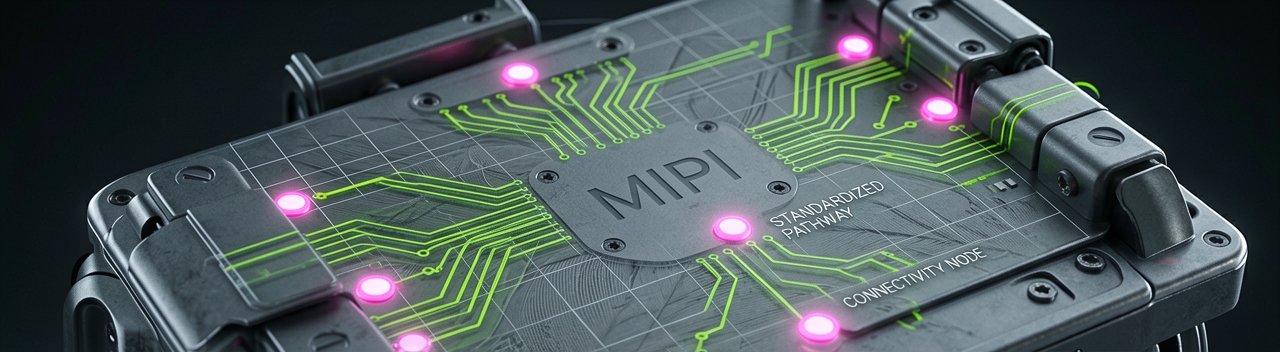
That's a crowded room of semiconductor and connectivity companies. When Intel, Samsung, Sony, and Texas Instruments sit at the same table, you know the stakes involve billions in infrastructure spending. The physical reality of humanoid robotics means dealing with heat dissipation, cable routing through joints, sensor latency, and power delivery across moving mechanical parts. Standardized interfaces reduce the friction of integrating these components.
MIPI is also launching an Emerging Technologies Initiative to encourage broader industry participation for members and non-MIPI members in the exploration of emerging technology markets. Initial areas of focus will be on the Physical AI BoF and forthcoming Die-to-Die BoF, with potentially additional groups to come in 2026 and beyond.
Through the initiative, MIPI Adopter member and nonmember companies will have a pathway to continue their involvement in the effort should the BoF evolve into a working group or the activities transfer to an existing MIPI working group. Companies interested in participating in the Physical AI BoF may sign up through the official MIPI Alliance website.
Independent reporting from Embedded.com corroborates the timeline and scope of the changes, noting that the new BoF group will study both hardware and software architectures used in humanoid systems.
The timing matters. Humanoid robotics has been stuck in the prototype phase for years. Boston Dynamics' Atlas looked impressive but cost more than a house. Tesla's Optimus remains in development. Figure AI's collaboration with BMW showed promise but hasn't scaled. The difference between a prototype and a product is often the supply chain, not the AI model. Standardized interfaces make supply chains predictable.
Think about the physical experience of building a humanoid robot. You're routing cables through joints that flex thousands of times per day. You're managing heat from processors packed into a torso that needs to stay cool. You're dealing with sensor data from cameras, LiDAR, and force sensors that must sync within milliseconds. Every proprietary connector adds another point of failure. Every custom cable adds another SKU to manage.
MIPI's accumulated experience comes from over two decades of standardizing interfaces for mobile devices. The MIPI Alliance was founded in 2003 and has over 375 member companies worldwide with more than 15 active working groups. That institutional knowledge is what the BoF group will leverage.
The question isn't whether humanoid robots will become commercially viable. The question is whether they'll use standardized interfaces or remain fragmented with proprietary solutions. History suggests the industry will fragment first, then consolidate. MIPI is trying to skip the fragmentation phase.
Whether the BoF group's recommendations lead to actual specification development remains to be seen. Working groups often produce white papers that gather dust. The real test comes when manufacturers actually ship products using the new standards.
For now, the BoF group represents a bet that the humanoid market will mature fast enough to justify standardization efforts. If Yole Group's projections hold, the market will be worth $51 billion by 2035. If they don't, MIPI will have spent time on a group that never produced specifications.
Either way, the semiconductor companies participating in the BoF group have already signaled their commitment. They're not waiting for the market to prove itself. They're betting on it.
Whether users actually pay for humanoid robots remains the real question. Standardized interfaces won't fix business models that don't work. But they might make the robots cheaper to build when the business models finally do.
Artūras Malašauskas is an AI Systems Integrator with 20+ years of production-grade web engineering experience. He has designed, shipped, and scaled enterprise Python/PHP systems for logistics, SaaS, and public-sector clients. For the past year, he has focused exclusively on AI integrations: deploying open-source LLMs, building generative media pipelines (image, audio, video), and engineering multi-agent workflows for real production environments. His standard: reproducibility, security, cost-efficient inference—no vaporware. He documents and evaluates emerging AI tooling, separating verified capabilities from marketing noise. Technical editor at: muza-ai.eu, ai-verslas.lt, ai-naujinos.lt Connect on LinkedIn
Comments